
The trillions of human cells must be organized into precise patterns so that tissues and organs function properly. An international team of over 400 researchers came together to create a framework that allows us to map our bodies with a single cell resolution
In three articles published this week in Nature Reference cell maps human intestine, kidney and maternal-fetal interface (where the placenta and maternal cells coexist).
The articles are part of a larger package of articles from the Human BioMolecular Atlas Program (HuBMAP) published in the journals of the group Nature. The goal is to discover new information about how cell types are organized and how they interact in different human tissues and organs, providing a resource for the study of human biology and disease.
What is more. they constitute the first collection of maps generated by scientists from institutions supported by HuBMAP, administered by the US National Institutes of Health (NIH). The authors used the most advanced methods to image a single cell and characterize the structures and organs of the human body.
intestinal neighborhoods
the team of michael snydergeneticist at Stanford University (USA), observed the human intestinea complex organ with many different structures and functions, from digestion to immune system support. Eight sections from nine individuals were analyzed, revealing drastic variations in the cellular composition of the different regions.
“We discovered that cells organize themselves into different arrangements called neighborhoods that help define its function”, explains Snyder to SINC. Like human neighborhoods, which have common elements such as streets, restaurants and houses, these groups of cells are formed by various quantities and types with specific functions. “So cells are not just cells, it’s important to know who they’re with.”
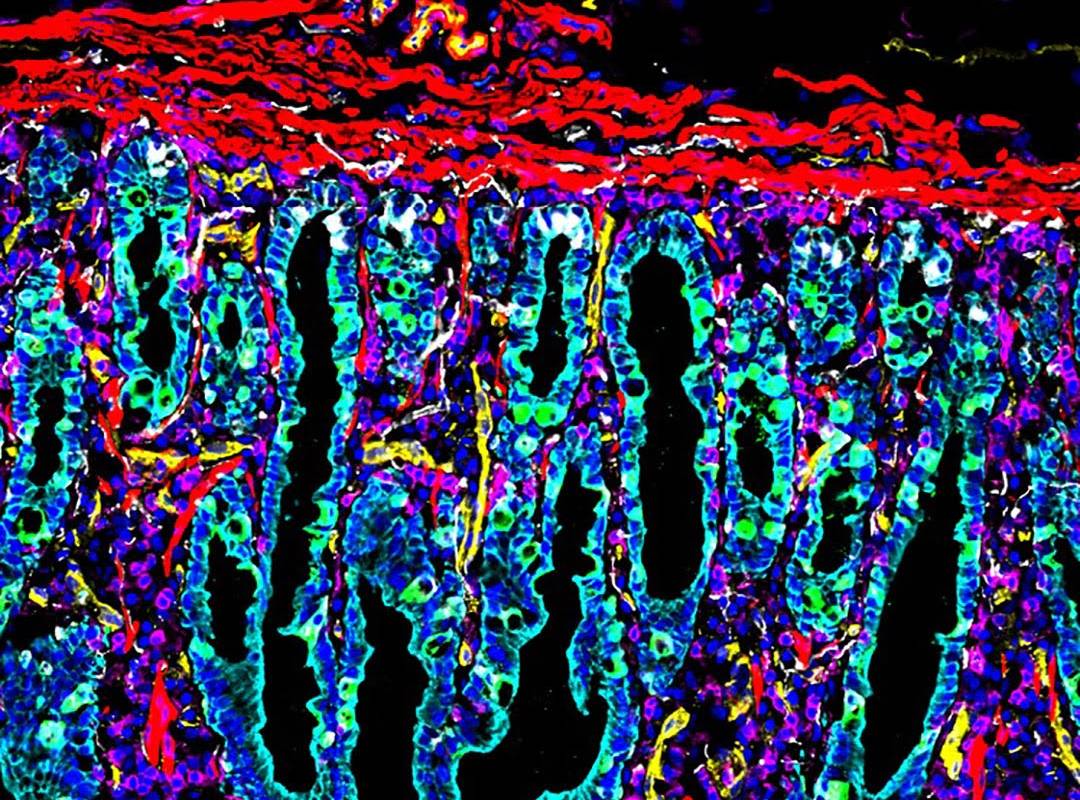
Cell scale image of the small intestine. / John Hickey Lab/Garry Nolan.
The researchers also discovered that some neighborhoods are specifically primed to mediate immune responses. The findings reveal the complex and varied cellular composition that contributes to the functioning of this organ.

We are generating data from healthy organs. This is crucial to understanding all diseases. In the case of the intestine, the main ones would be inflammatory disease and colon cancer

“What is special is that we are generating data from healthy organs and this is crucial to understanding all diseases. In the case of the intestine, the main ones would be intestinal inflammatory diseases and colon cancer”, emphasizes the geneticist.
Among other discoveries, Snyder also mentions that “CD8 T cells, which are involved in the defense against pathogens, decrease from the small intestine to the large intestine and are less present in the colon. people with hypertension”. In addition, “M1 macrophages, which are responsible for protecting the intestine, decrease in people with a high body mass index.”
The largest single-cell atlas of the human kidney
A group led by bioengineers from the University of San Diego (California, USA) examined cells from 45 healthy and 48 diseased human kidneys. Damage to these organs can trigger cellular changes that affect kidney function.
The researchers built the largest single-cell atlas of the human kidney to date, mapping the states of healthy and diseased cells in more than 90 patients. The map is intended to serve as a basis for a better understanding of the evolution of kidney disease after acute injury, which causes the kidneys to suddenly lose their capacity.ability to filter waste from the blood.
This map can be very useful for treating diabetes, hypertension, acute injuries, kidney failure or chronic kidney disease.
This atlas can be especially useful to treat “diabetes, hypertension, acute injuries, kidney failure or chronic kidney disease”, underlines SINC Sanjay Jainephrologist at the Washington School of Medicine (USA) and leader of this study.
According to the author, this work also identified the states and surroundings of immune, stromal, and epithelial cells of the kidney that are altered by acute or chronic injury, including conditions related to the success or failure of repair pathways.
“Integrating and analyzing datasets from multiple sources and technologies has been one of the main challenges,” explains Jain. To build their map, the team analyzed over 400,000 cells and nuclei from a wide range of kidney samples from individuals with healthy kidneys, acute injuries and chronic kidney disease. The researchers are preparing the next version of the atlas with the intention of including data from a more diverse patient population.
transforming placenta
In early pregnancy, cells on the fetal side of the developing placenta invade the uterine endometrium and work with the mother’s immune system to remodel the arteries. “When I read it for the first time, I thought: this is very strange”, confesses the pathologist Miguel Angelofrom Stanford University.
The researcher and his colleagues constructed a map of the human placenta during the first half of pregnancy. analyzed about 500,000 cells and 588 arteries from 66 samples human maternal-fetal interface (where maternal and placental cells cooperate to hold the fetus). Specifically, they looked at the tissue in which maternal arteries are remodeled to supply blood to the fetus.
Studying how the human placenta forms is difficult because it is especially invasive and grows deeper in the womb than in other mammals. An overgrowth or undergrowth of the placenta in the uterine wall can lead to health problems. Knowing the details of optimal development can help you understand what’s wrong with pregnancy complications.
The maps cover different stages of development (from six to 20 weeks of gestation) and identify interactions between placental and immune cells. This latest finding sheds light on how this second cell type supports the coexistence of different maternal and fetal cells.
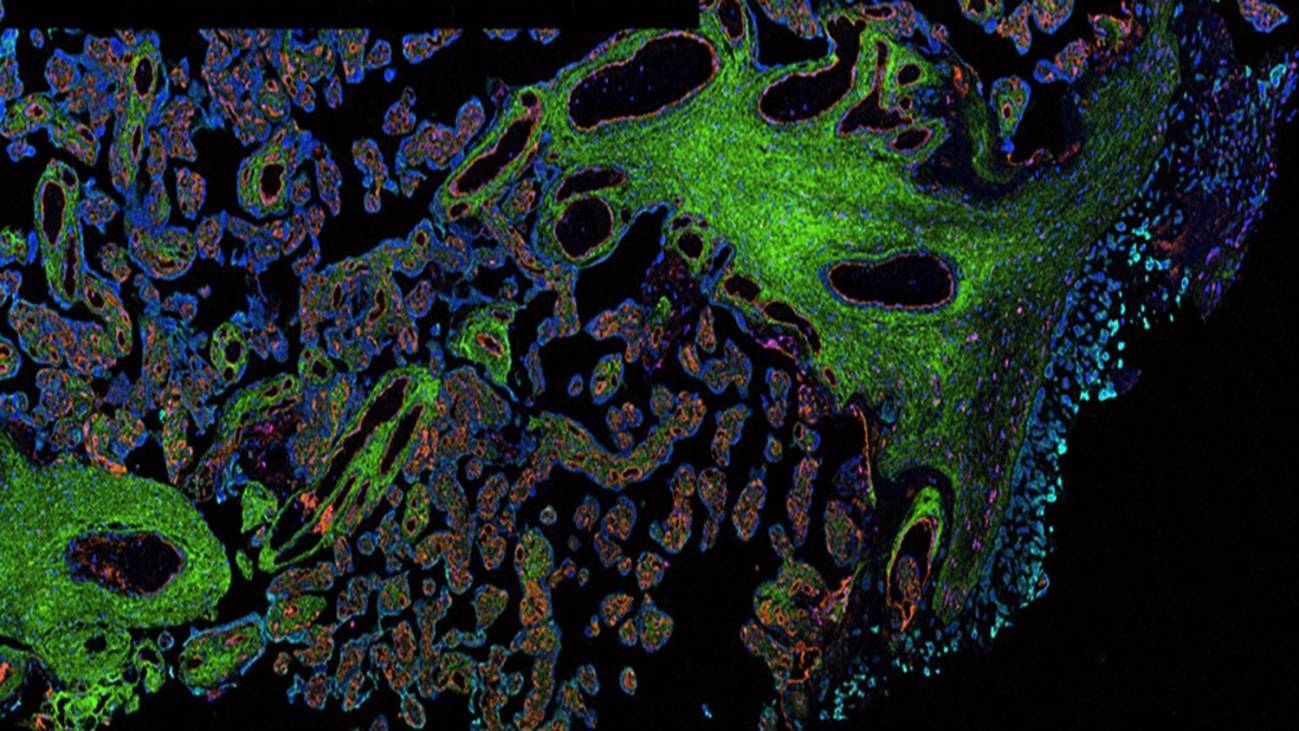
Cell-scale image of a human placenta. / Santhosh Sivajothi/Jackson Lab.
The team’s current goal is to determine how they can apply these findings to advance patient care. pregnancy, transplants and even cancer. According to Angelo, this work can help explain some types of infertility and develop a treatment.
Previous research suggests that some miscarriages occur because the immune system cannot accommodate Sufficient development of the placenta to maintain the pregnancy. “pick it maternal-fetal tolerance around the second or third month of pregnancy is essential to get through the first trimester”, he explains.
Cellular function, an indicator of health
Healthy tissue atlases play a key role in biomedical research, serving as comparable reference with diseased samples. These maps help to understand what is wrong in the early stages of the disease. This knowledge can provide key insights for developing treatments in the early stages of the diseases.
“The three HuBMAP atlases have the potential to advance our understanding of disease by defining the spatial location of disease-related cell states,” they write. Roser Vento-Tormo It is Roser Vilarrasa-Blasi In an opinion article on Nature.
Scientists anticipate the generation of new maps on other fabricsbut note that further testing still needs to be done on more samples to “establish robust associations between cellular organization and function in health and disease.”
References:
Snyder, M et al. “Organization of the human intestine at unicellular resolution” Nature (2023)
Jain, S. et al. “An atlas of healthy and damaged cell states and niches in the human kidney” Nature (2023)
Angelo, M. et al. “A spatially resolved timeline of the human maternal-fetal interface” Nature (2023)