
“In the center of Argentina with the illegal invasion of the Ranqueles territories, and with the genocide any cultural diffusion that had to do with our identity was prohibited and thus the games became invisible ”, began the story of María Inés Canuhé, a member of the Ranquel community in La Pampa.
The Argentine Council of Indigenous Sports It was created last August, but this fight started more than 15 years ago. In 2005, the Ranquel Originary Culture Interpretation Center was created, since they needed to act urgently so that their tradition and customs would not be forgotten. “We did a research work and we discovered that our fun as boys were our ancestral games”, affirmed the coordinator of the Cadi.
The Council is made up of indigenous communities throughout the country. This week A request for a hearing will be presented to the National Sports Secretariat so that they can begin to work on a joint agenda for the implementation of public policies that are exclusively oriented to these peoples. “We are very hopeful that they will receive us, because we have constructive proposals. We want to generate a policy to solve a problem“Canuhé confessed.
One of the priorities to raise in the possible audience will be the documentation of all ancestral knowledge, but with a very important condition: they want the survey to be carried out by them. “We don’t want someone from outside to come teach the kids, because these learnings have a lot to do with our worldview“Canuhé said in reference to the spirituality and vision of the game.
On the other hand, the survey will also try to understand what are the most important needs in terms of space, with the intention of having their own sports center or a place where they can have the game elements.
HOW WAS THE COURSE?
In 2010, Canuhé’s father attended the Mercosur Forum and began to understand that his people were not the only ones who had the same problem regarding the ancient games. Then, he began to contact people from sports, physical education, the Forum of Mercosur and the Consultative Council of Civil Society.
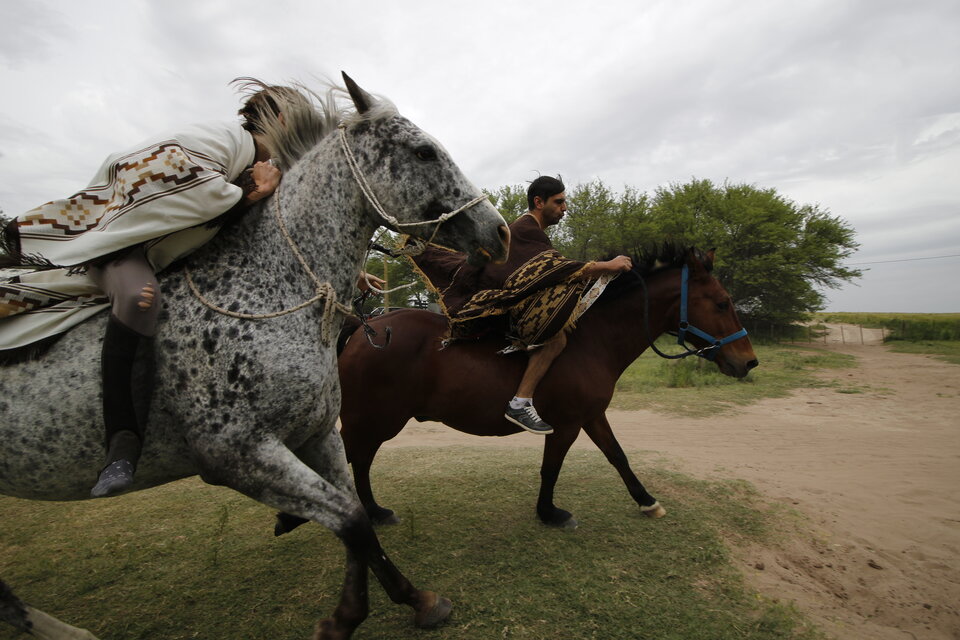
In 2012, the Ranquel community attended a national meeting with a delegation to Puerto Madryn to participate in the nuvan kullin, a game on horseback in which the objective is to chase down opponents to remove the sash from their waist. Formerly the poncho was removed but due to the danger this modality changed.
Time passed and they had the idea of organizing a first national meeting of ancestral and sports games of indigenous peoples in Argentina. Regarding this, Canuhé stated: “We were going to do it in April 2020 with all the confirmed delegations and due to the pandemic we had to suspend ”.
On November 2019 the first preparatory forum in which delegates from different towns were summoned to see how they could organize themselves. At that time, according to Canuhé, all the communities encountered the same problem: “There is no public policy that tends to recover these games.”
THE FOOTPRINTS OF THE PAST
In 1878 the last peace treaty was signed between the Ranquel community and the Argentine nation.. But months later, the Argentine government without prior communication broke the treaty by attacking two parties of Ranqueles that were going to Villa Mercedes. “Thus began the illegal advance of our territory, with hostility and without declaration of war“Canuhé said.
From this, the games of the indigenous communities were hidden and disguised. “Just as they replaced seeds, plants and animals, they also replaced people. For those people, the only thing that served here was the land ”, commented the CADI coordinator.
WHAT DO THE LAWS SAY?
In 1992, Law 24071 approved Convention 169 of the International Labor Organization on indigenous and tribal peoples in independent countries, which includes and includes these ancestral sports. Although the laws are there, the claim is for public policies and programs that do not exist today.
INDIGENOUS GAMES
Ranqueles play nuvan kullin and the other towns have other practices: the boleadoras that are made with stockings or rags, la chueca, archery games, fighting, of chance, of simulation and of vertigo.
“There are games that can be mixed with the western ones and others that are being practiced in communities that need some support such as educational elements and suitable places to play,” Canuhé said.
The main idea of the Council is to take care of the youth, contain it and get it out of bad habits through sports.
DIFFUSION
Currently the The Mercosur Forum is the only one that publishes the shares that they carry out from the community. Their idea is to have their own website, but for that they need to establish an important networking mechanism to have a media action.
Some communities still do not have an Internet signal or technological means. Canuhé also said that there are people who connect from the top of a hill, or climb a tree to participate in the meetings. “Everything has been done with great will and we hope that the national and provincial governments will accompany us to carry out this safeguard action”.
“The most beautiful thing is not documenting and generating policies, but also playing and meeting in championships and meetings”, The Ranquel representative concluded.
The Council will then wait for the Sports Secretariat to receive them so that they can work together to revalue and strengthen part of the indigenous culture, that with the passage of time was increasingly relegated and invisible in the country.
.