
A scientific team has determined the genetic origins of mummies most enigmatic in Asia, those found in the Tarim basin (China). In their day, they were believed to be Indo-European-speaking immigrants from the West; however, they turned out to be a local indigenous population with deep Asian roots and a taste for distant cuisine.
This finding, published in the magazine Nature and done thanks to analysis of your DNA, contradicts previous hypotheses that these mummies descended from populations that migrated from what is now southern Siberia, northern Afghanistan or the mountains of Central Asia.
The remains were found buried in send coffins in an arid desert and they have long baffled researchers as well as inspiring countless theories about their enigmatic origins.
The remains were found buried in ship’s coffins in an arid desert and have long intrigued researchers, as well as inspiring countless theories about their enigmatic origins.
Since the late 1990s, their discovery, which consisted of hundreds of naturally mummified humans, remains They date from 2000 BC to 200 AD in the Tarim basin of China, it has attracted a lot of attention due to its so-called “Western” physical appearance, its woven wool and felt clothing, and its agro-pastoral economy that included cattle, sheep and goats, wheat, barley, millet and even kefir cheese.
Clothes and Food That Confounded Scientists
As part of the Silk Road And situated at the geographical intersection of eastern and western cultures, the Xinjiang Uighur Autonomous Region has been an important crossroads for the trans-European exchanges of people, cultures, agriculture and languages.
This population’s cattle-centric economy and unusual physical appearance have led some scholars to speculate that they were descendants of yamnaya migratory shepherds, a society of bronze age highly mobile steppes of the Black Sea region of southern Russia.
This population’s cattle-centric economy and unusual physical appearance have led some scholars to speculate that they were descendants of migratory Yamnaya herders.
Others placed it among the Central Asian desert oasis cultures of the Bactriana-Margiana Archaeological Complex, a group with strong genetic ties to the first farmers of the Iranian plateau. Controversially, they are also often credited with spreading the first Indo-European language branched, the Proto-Tacharian, in East Asia.
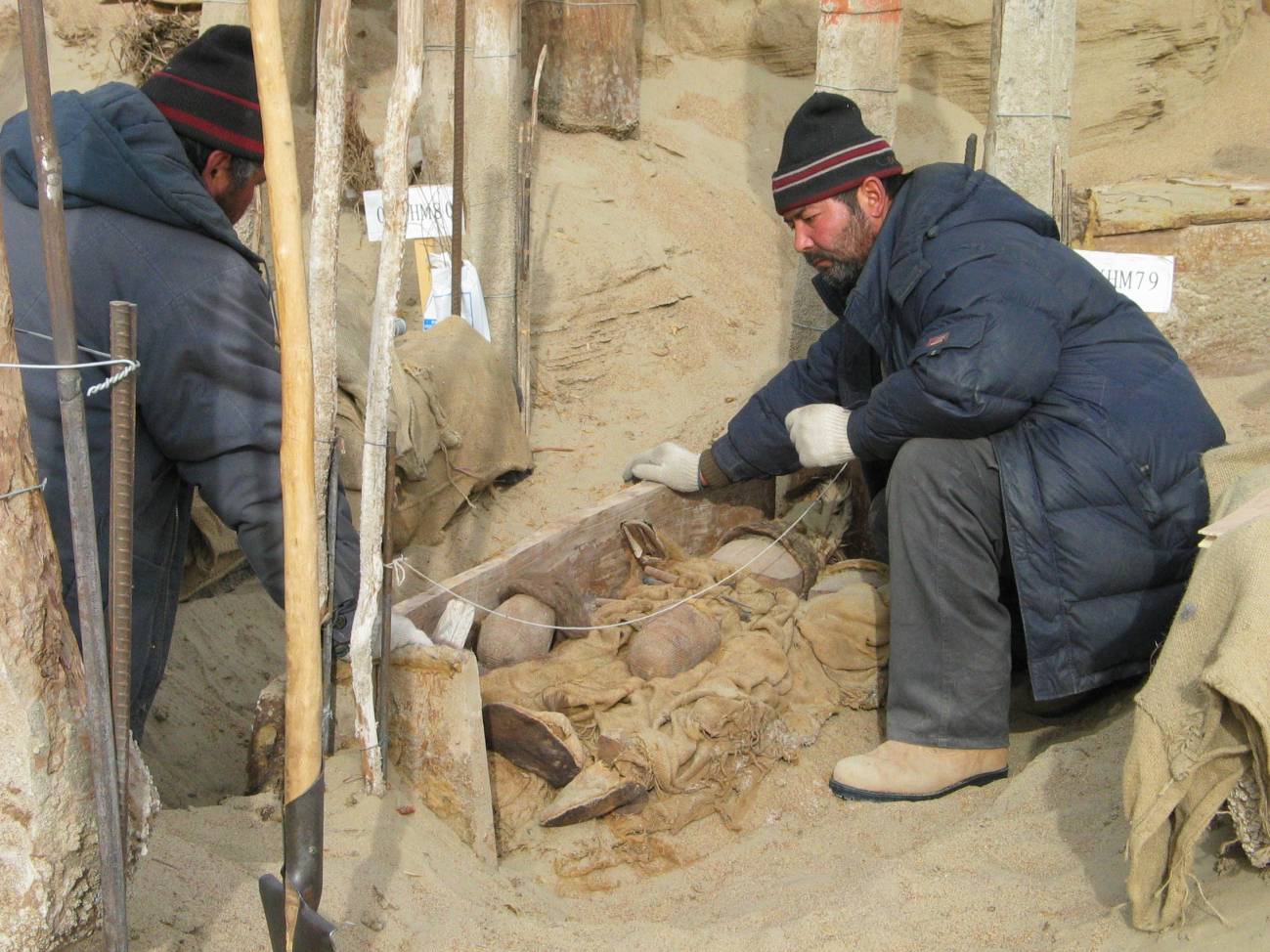
Excavation of M75 Cemetery in Xiaohe Cemetery. / Wenying Li, Xinjiang Institute of Cultural Relics and Archeology
Genetic analysis of mummies
To better understand the origin of the founding population that first settled in the region in places like Xiaohe and Gumugou around 2000 BC, a team of international researchers from the University of Jilin and the Institute of Vertebrate Paleontology and Paleoanthropology of China, Max Planck Institute for Anthropology Evolutionaries (Germany), Seoul National University (Korea) and Harvard University (USA) generated and analyzed the genome data of thirteen of the first known mummies, dated between 2100 and 1700 BC, along with five individuals dated between 3000 and 2800 BC in the neighboring Dzungarian Basin.
This is the first genomic-scale study of prehistoric populations in the Xinjiang Uighur Autonomous Region and includes the first human remains discovered in the region.
“Archaeogeneticists have long looked to Holocene populations to better understand the genetic history of the Eurasian interior. We found one in the most unexpected place,” he says. Chongwon Jeong, lead author of the study and professor of Biological Sciences at Seoul National University.
This is the first genomic-scale study of prehistoric populations in the Xinjiang Uighur Autonomous Region and includes the first human remains discovered in the region.
Therefore, it was by no means a newcomer population to the region, but would be direct descendants of a Pleistocene population that was very widespread and that had largely disappeared by the end of the last Ice Age.
These individuals, known as old northern Eurasians (ANE), only survive fractionally in the genomes of current populations, in indigenous individuals from Siberia and America.
In contrast to current populations, mummies show no evidence of mixing with any other Holocene group, indicating a unknown genetic isolation until now, it has likely suffered an extreme and prolonged genetic bottleneck before settling in the Tarim basin.
These findings contribute to our understanding of the dispersal of Yamnaya ancestry to the east and the scenarios in which the blending occurred when they first encountered the populations of inland Asia,” he explains. Chao Ning, co-author of the study and professor at the School of Archeology and Museology at Peking University.
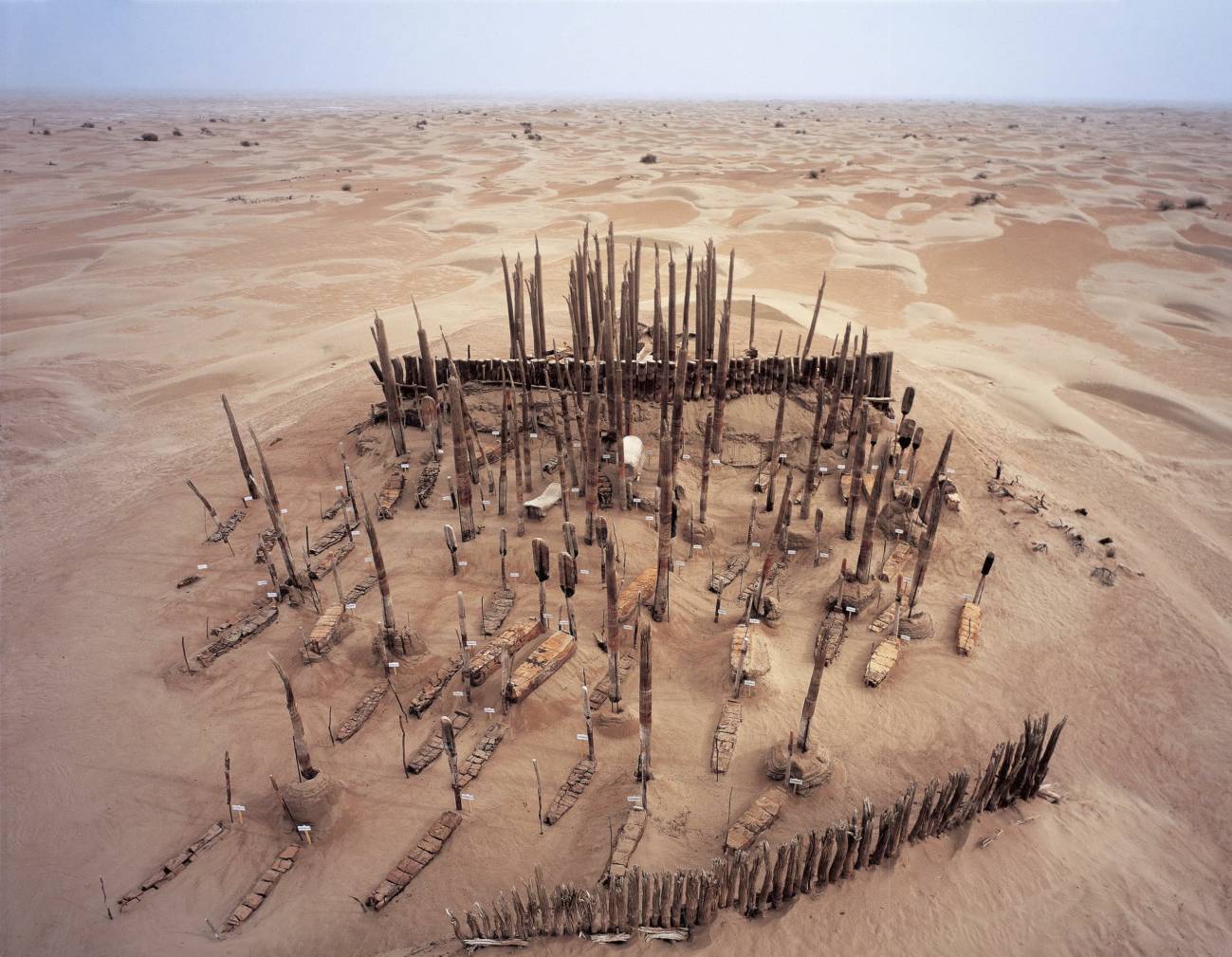
Aerial view of Xiaohe Cemetery. / Wenying Li, Xinjiang Institute of Cultural Relics and Archeology.
your neighboring cities
Unlike the Tarim basin, the first inhabitants of neighboring Dzungarian descended not only from local populations but also from pastoralists from the western steppes, specifically Afanasievo, a group of shepherds with strong genetic ties to the Bronze Age Yamanya.
Genetic characterization of the early Bronze Age Dzungarians also helped to clarify the ancestry of other herding groups known as the Chemurchek, which later spread north into the Altai Mountains and Mongolia.
These groups appear to be the descendants of the early Bronze Age Dzungarians and the Central Asians of the Mountain Corridor of Inner Asia.
These discoveries of a broad genetic mix Along the Tarim basin, throughout the Bronze Age, it is even more surprising that the Tarim mummies do not show evidence of genetic mixing. However, although these groups were genetically isolated, they were not culturally isolated.
“Despite being genetically isolated, the Bronze Age peoples of the Tarim basin were culturally very cosmopolitan: they built their cuisine around the wheat and dairy West Asian millet, East Asian millet and Medicinal plants like the ephedra of central Asia, “he adds Christina Warinner, lead author of the study, professor of anthropology at Harvard University and head of the MPI-EVA research group.
The proteomic analysis of his dental calculus confirmed that the founding population already practiced the creation of cattle, sheep and goats and was well acquainted with the different cultures, cuisines and technologies of their environment.
“The reconstruction of the origins of the mummies in the Tarim basin had a transformative effect on our understanding of the region. We will continue the study of ancient human genomes at other times, to gain a deeper understanding of the history of human migration in the Eurasian steppes”, he concludes. yinquiu cui, lead author of the study and professor at Jilin University College of Life Sciences.
Reference:
Yinqiu Cui et al. “The Genomic Origins of the Bronze Age Mummies Tarim Basin”. Nature.
.