
Secretary of State for the Environment, Hugo Moraninaugurated this Thursday the act of presentation of the report on the state of the climate in Spain 2021.
During his speech, Morán highlighted the importance of the study as a tool to evaluate our mitigation measures and, at the same time, as a warning about the increasing rate of occurrence of extreme weather events linked to climate change.
“This acceleration, added to the growing impacts, forces us to be very agile to prevent the emergence of new risks, reduce existing ones and increase our resilience”, he stressed.
The one presented today is the third edition of a work that shows, in detail, the most significant aspects of the climate and climate in our country during 2021 and its long-term trends.
The report indicates that last year was one of the seven hottest on a global scale. In Europe it was colder than in previous years; even so, it recorded temperatures above the normal average.
In Spain, 2021 was the eleventh warmest since 1961. Thus, the document confirms an accumulation of warm years in the most recent period: seven of the ten years with the highest average temperature were recorded in the last decade.
Rising temperature and greenhouse gases
The rise in average temperatures is linked to an increase in daily temperature records in Spain. Thus, in 2021 there was 13 hot day records and none of the cold days.
The surface temperature of the maritime waters surrounding Spain is also increasing: since 2003, an average temperature above the normal average has been recorded every year. In 2021 the difference was 0.3ºC above normal, although in areas of the Mediterranean and the Gulf of Cádiz anomalies of 0.7ºC were reached.
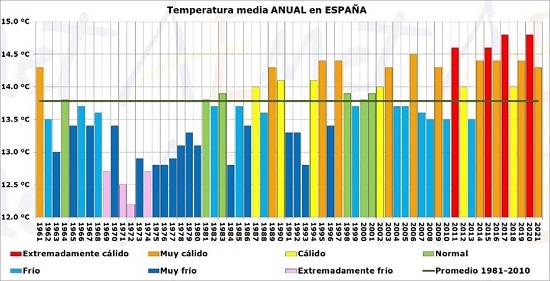
Series of annual average temperatures and thermal character (in relation to the 1981-2010 average) in Spain since 1961. The colors of the bars indicate the thermal character of each year. /AEMET
greenhouse gases reached record values in 2021 at the Izaña Atmospheric Observatoryin Tenerife, managed by AEMET and belonging to the Global Atmospheric Watch network of the World Meteorological Organization (OMM).
CO2 reached a concentration of 416.5 ppm (parts per million), which represents an increase of 2.5 ppm over the previous year. It is also noteworthy that the increase in CO2 concentration is clearly proportional to the accumulated emissions of anthropogenic origin.
A dry year, but not exactly a drought
In 2021 it rained 569.2 l/m² in Spain as a whole, which is 11% less than normal considering the reference period 1981-2010; it was a dry year, the 14th driest since the series began in 1961, and the seventh of the 21st century.
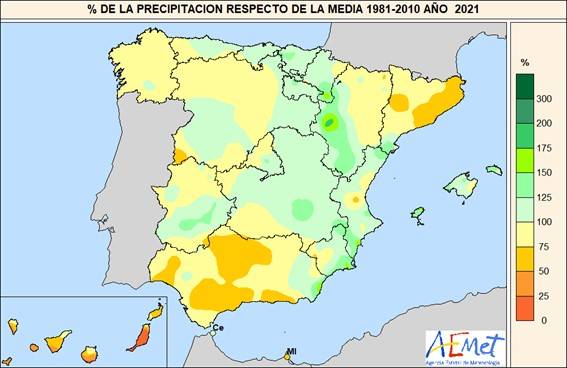
Percentage of accumulated precipitation in 2021 in relation to the average for the period 1981-2010. /AEMET
Although in 2021 no weather drought condition detected In the long term across Spain, the months of October and November began a period of low rainfall that finally led to a meteorological drought at the end of winter 2021-2022.
A detailed analysis by major basins indicates that all were in a situation of rain deficit at the end of December 2021, except for those in the Tagus, Júcar and Segura, while those in the South and East Pyrenees experienced a meteorological drought for 12 months.
At hours of sunshine were in 2021 higher than the normal average in the west of the peninsula and in the Canary Islands; on the contrary, on the Mediterranean façade there was less sun than usual. This pattern was especially accentuated during spring, when it was rainier than usual on the Mediterranean façade, while on the Atlantic and Cantabrian slopes it was very dry.
Electrical activity was generally low, being recorded as the second in the series with the least discharges detected both in the Peninsula area and the Balearic Islands as well as in the Canary Islands; In addition, the lowest number of downloads detected was recorded in July and August.
A historic snowfall and a heat wave
As for the most significant adverse events of the year, two stand out for their significant social impact; the first was the storm Filomena which was preceded and followed by cold snaps.
The blizzards associated with the aforementioned storm affected much of the central and eastern interior of the peninsula and accumulated, between January 8 and 10, snow depths of 30 to 50 cm, particularly in the Madrid metropolitan area. The most notable minimum temperatures achieved were -26.5°C in Torremocha del Jiloca (Teruel) or -25.2°C in Molina de Aragón (Guadalajara).
O subsequent cold snap blizzard lasted 8 days (January 11-18), making it the second longest of the 21st century. Despite the expressive numbers and the relevance of the event, it was not possible to verify records of cold days; this fact contrasts with what happened in previous years in which records were broken with events of lesser historical relevance.
At the other end of the thermal spectrum, the heat wave of mid-August (from 11 to 16 on the outskirts of the Peninsula and the Balearic Islands and from 15 to 19 in the Canary Islands) had an extraordinary character: it was the most intense since at least 1975 and the third with the greatest geographic extension, with 36 provinces affected.
During its journey it reached 47°C in Alcantarilla (Murcia) and up to 47.4°C in Montoro (Córdoba), the highest temperature measured in Spain.
During 2021 there were 9 major storm engagements. This value represents the lowest number since the tagging system was launched, especially given the low activity during the fall when only 2 storms were named.
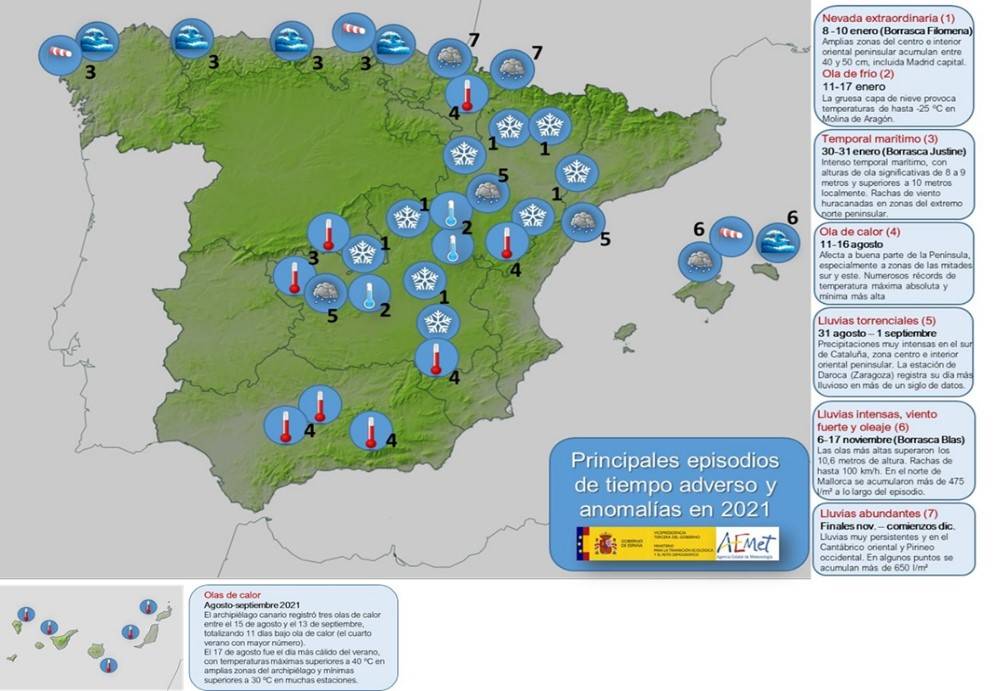
Main episodes of adverse weather and anomalies in mainland Spain and the Canary Islands in 2021. /AEMET
A new chapter for phenology
One of the new features of the report is the inclusion of a new chapter dedicated to phenology. This course is responsible for studying the Biological cycles and their relationship with time and climate. Thus, in 2021 there was a early flowering of certain species of interest such as the almond tree, due to the months of February and March with temperatures above normal.
Regarding the ripening of the fruits, this occurred, in general terms, on the usual dates, but with some progress in certain speciessuch as the vine and the fig tree, in the extreme north areas due to the very hot nature of September.
After the presentation of the key axes of the study, the day continued with a communication entitled Evolution of meteorological drought in Spain in the last centuryperformed by yolanda moonhead of the AEMET Development and Applications Department.
The closing was delivered by Miguel Ángel López González, president of AEMET, who insisted that the report point out that one of the crucial aspects of climate change is its fast pace and the need to act quickly on the mitigation and adaptation chapters.
The executive summary presented summarizes and anticipates the most outstanding results of the annual report on the state of the climate in Spain for 2021 and contains a description of the state of the global and European climate.
It also details the state of the climate in Spain and describes the most striking phenological features of the period. Finally, the atmospheric patterns that gave rise to the climatic variations and the most notable climatic episodes recorded in Spain are analyzed.
As in previous years, the publication intends to be a reference and a support guide for achieving the objectives defined in the National Plan for Adaptation to Climate Change.