
The Institute of Astrophysics of Andalusia (IAA) at CSIC completed the development of the Outburst Observatory and Optical Sporadic Source Exploration System (BOOTES). This is the first network of robotic telescopes with stations on five continents. With facilities in Spain (two stations), New Zealand, China, Mexico, South Africa and Chile, it constitutes the most complete network of its kind and a unique, fully automated resource for combining instrument data from around the world, monitoring the sky and support observations from missions and satellites.
Spain is the first country with a robotic network present on all continents
“BOOTES is the result of almost twenty-five years of continuous effort, since we installed the first station in 1998 at the National Institute of Aerospace Technology (Arenosillo, Huelva), the institution that initially supported the project. The complete implementation represents a scientific milestone, as it is the first robotic network with a presence on all continents”, highlights Alberto J. Castro-Tirado, a researcher at the IAA-CSIC who has led the project since its inception. That put it ahead of networks in the US, whose Asian station is under construction, and Russia, which has no facility in Oceania.
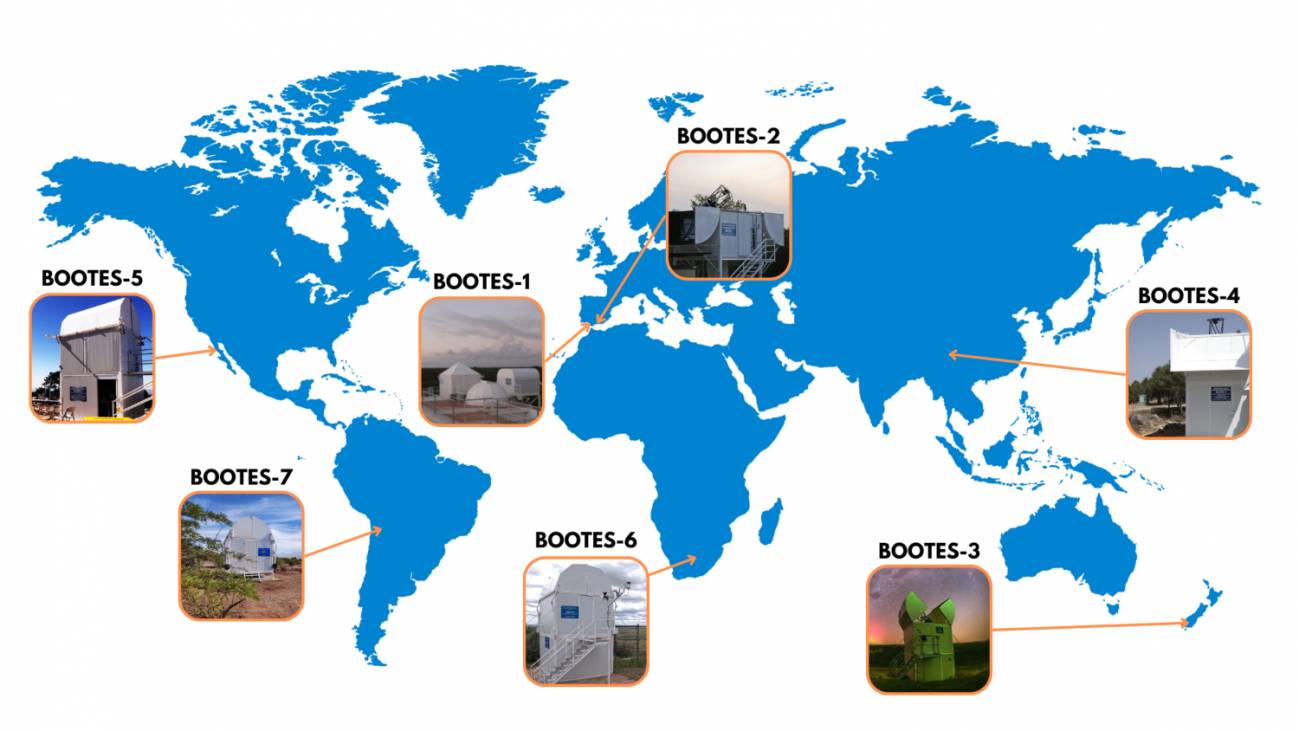
Distribution of the BOOTES network. / IAA-CSIC
The BOOTES network is managed by the IAA-CSIC, with strong involvement from the University of Málaga and with the collaboration of other Spanish entities, such as the National Institute of Aerospace Technology (INTA) and the University of Huelva, and international entities. Its main objective is to quickly and autonomously observe the so-called transient sources, astrophysical objects that do not show a permanent emission over time, but emit light briefly, intensely and suddenly. The detection of these events is usually done from a satellite, and BOOTES provides an automated response in real time that allows their characterization.

This network is the result of almost twenty-five years of continuous effort, since we installed the first station in 1998.
Alberto J. Castro-Tirado, IAA-CSIC researcher

The network will contribute to the study of gamma-ray bursts, which are the most energetic events in the universe and are associated with the death of very massive stars. Its detection usually occurs through satellites, which inform the scientific community about the outbreak so that the event can be studied in detail.
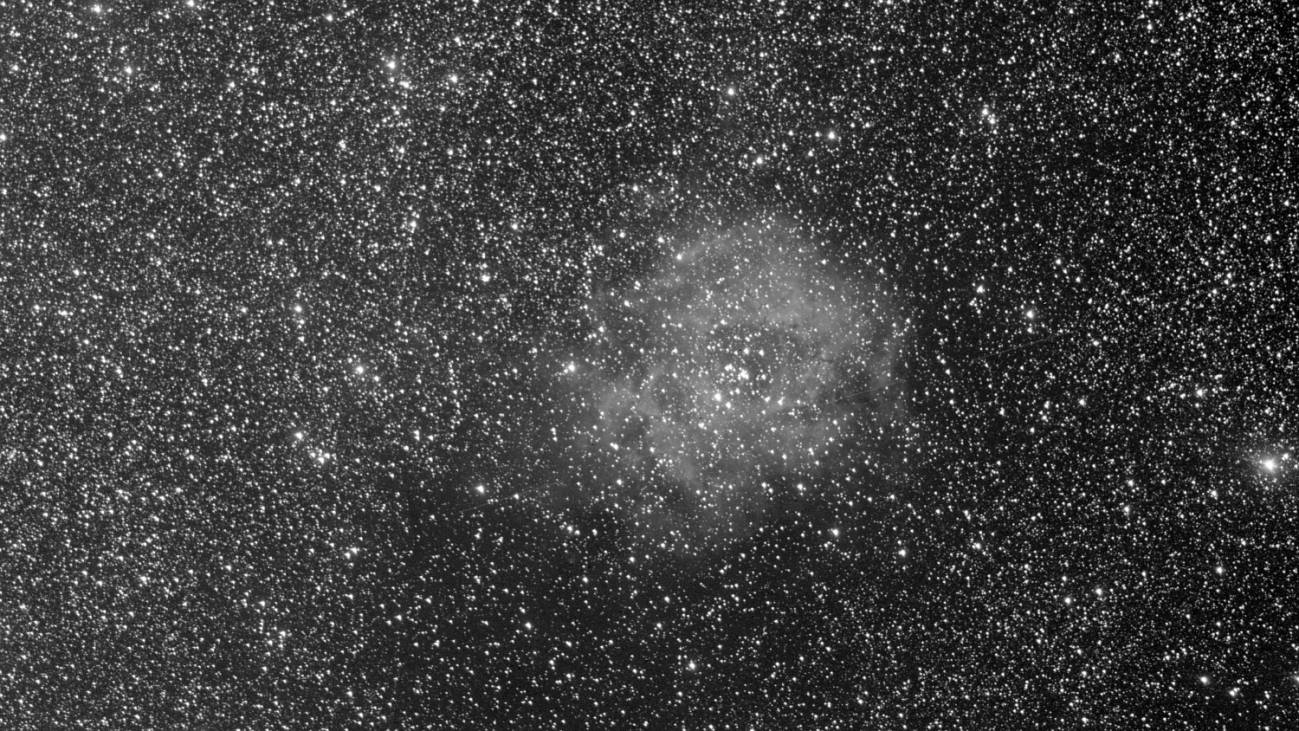
The Rosetta Nebula captured by the BOOTES network. / IAA-CSIC
The telescopes will monitor the sky, among other things, to look for space debris and potentially dangerous objects.
The existence of a network of very fast pointing robotic telescopes such as BOOTES represents an ideal complement for the detection of satellites and, in fact, BOOTES will also work to track and monitor sources emitting neutrinos and gravitational waves, or even objects such as comets , asteroids, variable stars or supernovae. But it will also keep an eye on the sky, both tracking space debris and potentially dangerous objects that could pose a threat to our planet.
A new era in astronomy
Rapid observations of gamma-ray bursts with BOOTES, from the first few seconds to the final phases, allowed to narrow models of gamma-ray bursts and also contributed to some high impact results in recent years. The Mexican observatory of the BOOTES network was the only location in the northern hemisphere that was able to observe the event known as GW170817 in 2017, the fifth detection of gravitational waves in history. The phenomenon responsible for this emission was the merger of two neutron stars, which allowed the first simultaneous study of light and gravitational waves and inaugurated a new era in astronomy.
The network detected gravitational waves in 2017 for the fifth time in human history
BOOTES contributed in 2020 to the identification of a source producing very short-lived radio bursts in our own galaxy, the Milky Way. The discovery was presented in three articles in the journal Nature that suggested that a magnetar, a neutron star with a very strong magnetic field, would be behind this phenomenon.
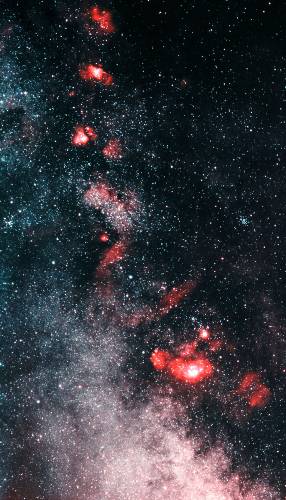
Nebulae captured by the BOOTES/IAA-CSIC network
In 2021, BOOTES contributed to the study, also published in Nature, of different pulses in the gigantic magnetic explosion of a neutron star: in just a tenth of a second, a magnetar released an energy equivalent to that produced by the Sun in a hundred thousand years, and their detailed analysis revealed several pulses at the peak of the eruption, shedding light on these still little-known giant magnetic explosions.
“The culmination of the network is a success, as it was possible with a human team and a much smaller budget than similar projects. With four stations in the northern hemisphere and three in the southern hemisphere, there will always be at least one telescope covering the northern and southern skies, which results in enormous efficiency in detecting transient sources,” says Castro-Tirado.
The astronomer adds that “with all the stations already operational, we can coordinate them as a single observatory that covers the entire planet, whose potential we will show to the international community at the robotic astrophysics congress that we hold every two years and that will take place in October in Malaga”. The researcher conceived the project when he was developing his doctoral thesis in Denmark, three decades ago. “For me, it’s a dream come true,” he concludes.
References:
Y.-D. Hu et al. The Burst Observer and the Optical Transient Exploring System in the age of multi-messenger astronomy. Frontiers of Astronomy (2023).
AJ Castro-Tirado et al. The Burst Observer and the Optical Transient Exploring System (BOOTES). Astronomy and Astrophysics Supplement (1998).