
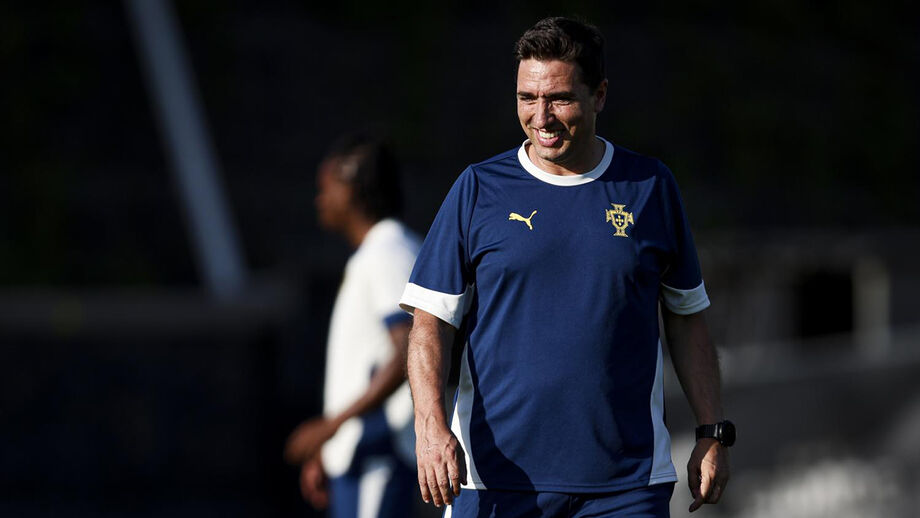
Rui Jorge quietly ended his long run with the national U21 football team this week. He spent 14 and a half years at the helm. During this time, he helped 65 players reach the senior national team. He led his squads to two European Championship finals, but never quite managed to win a trophy.
His departure came nearly a month after a 1-0 loss to the Netherlands in Slovakia. That defeat marked the second straight quarter-final exit for his team. The 52-year-old coach’s contract simply ran out. He first joined the U21s in November 2010, taking over from Oceano Cruz. Now, Luís Freire, who coached Rio Ave and Vitória de Guimarães, steps into his shoes.
Rui Jorge’s time ended about five months after Pedro Proença became the new president of the Football Federation. He started his journey when Gilberto Madail was in charge. Most of his tenure happened under Fernando Gomes’s presidency. He was known for attacking football and often switched between a 4-3-3 and a 4-4-2 diamond formation.
He holds the record for most U21 games coached, with 127 matches. He also boasts 90 wins, 19 draws, and 18 losses. His teams scored 325 goals and gave up 105. More importantly, he consistently nurtured young talent and brought stability to the team below the senior squad. Before Rui Jorge, the U21s missed the Euro finals in 2009 and 2011. They missed again in 2013 under him. The only other time they failed to qualify was in 2019, after a playoff defeat.
The team made it back to the finals in 2015, eight years after their last appearance. They reached the final in the Czech Republic, just like in 1994. They lost a penalty shootout to Sweden, 4-3, after a goalless draw. Funnily enough, Rui Jorge’s very first game in charge was a 3-1 friendly win against Sweden in February 2011.
In 2017, in Poland, the team faltered, exiting in the group stage. This ended a remarkable run of 31 official games without a loss, stretching over five years and eight months. But they bounced back in 2021, reaching the final again. Germany won that match 1-0 with a goal from Lukas Nmecha. The tournament was held in Slovenia and Hungary. Subsequent years saw quarter-final exits: against England in 2023, who went on to win, and against the Netherlands in 2025.
Rui Jorge’s long stay in U21 coaching is truly rare across the continent. He might not have won any major trophies. Yet, his legacy shines through the many players who climbed to the senior national team. This happened during a period where clubs focused heavily on youth development. The rise of B teams and U23 squads also played a role. Plus, young talents started moving to bigger clubs earlier in their careers.
The coach also led the Olympic team to the Rio 2016 quarter-finals. He stuck to his beliefs, even when they weren’t popular. In 2024, he was honored at a Football Federation gala. Bruno Fernandes and Bernardo Silva, both stars now, presented him with an award. They had both grown into top players under his guidance in the U21 setup.
He reflected on his journey in November 2023, on his 13th anniversary in the role. “I can’t pick a best or worst moment,” he said. “I had many great times and some of deep pain. But the moments I truly enjoyed far outnumbered the others. My time here is unusual in football, even for national teams. But I love being here. I’ll keep working hard so people enjoy seeing me here. Later, I hope to feel proud watching the players from this program reach higher levels.”
Rui Jorge leaves with an impressive record: 71% wins and nearly 86% of his U21 matches unbeaten. His coaching career began with Belenenses, where he led the junior team from 2006 to 2010. He also took charge of the senior squad for the last two games of the 2008/09 season. They were relegated, but later got their top-flight spot back.
Belenenses marked his shift from player to coach. Rui Jorge, from Gaiense, was one of the best left-backs of his era. He scored one goal in 45 games for the senior national team between 1994 and 2004. He played in the Euro 2000, 2004, and the 2002 World Cup. As part of Portugal’s “golden generation,” he was a Euro 2004 runner-up. He also helped the Olympic team to a fourth-place finish at Atlanta 1996.
His entire playing career unfolded in Portugal. He won five league titles, two Portuguese Cups, and three Super Cups with FC Porto from 1991 to 1998. He had a loan spell at Rio Ave in 1991/92, where he made his senior debut. There, he reunited with Augusto Inácio, who had coached him in Porto’s youth ranks. They would later win a league title together at Sporting.
In 1998, he moved to Sporting as part of a player exchange. He sought more playing time, which had been scarce at Porto for two seasons. He still celebrated four of Porto’s historic “penta” league titles. At Sporting, he won two league titles, breaking an 18-year drought in 1999/00. He also added a Portuguese Cup and two Super Cups. He left Sporting in 2005, after losing the UEFA Cup final at home to CSKA Moscow.
Rui Jorge played half a season for Belenenses in 2006. He retired at 33, with nearly 490 games and 12 goals. He kept his family’s strong link to sport alive. His brother, Ricardo Oliveira, was a national table tennis champion and former men’s national team coach. Rui Jorge’s story is one of lasting impact, building foundations even without the shine of a major trophy.