
Frogs can breathe through their gills, lungs and skin, depending on their stage of life, but a team at Ludwig-Maximilians University in Munich, Germany, reports in a new way.
Researchers have developed an amazing method that makes it possible bring oxygen into the tadpole’s bloodstream injecting photosynthetic algae into your blood vessels.
The technique developed, featured in the magazine iScience of the group Cell Press, provided enough oxygen to effectively restore the brain neurons of the oxygen-deprived tadpoles, the authors note.
“The algae produced so much oxygen that they were able to bring the nerve cells back to life, so to speak,” he says. Hans Straka, lead author and researcher at the German University. “For a lot of people, this will sound like science fiction, but ultimately it’s about the right mix of biological schemes and principles,” he adds.

The algae produced so much oxygen that they were able to bring the nerve cells back to life, so to speak. To many people, this will sound like science fiction, but at the end of the day it’s about the right mix of biological schemas and principles.
Hans Straka, lead author and researcher at Ludwig-Maximilians University of Munich

Combine plant physiology with neuroscience
Straka was studying the oxygen consumption in the brain of tadpoles from African clawed frogs (Xenopus laevis), when in a lunch conversation with a botanist, he gave her the idea of combining plant physiology with neuroscience: “Taking advantage of the power of photosynthesis to deliver oxygen to nerve cells.”
The idea didn’t seem far-fetched. In nature, algae live harmoniously in sponges, corals and anemones, providing them with oxygen and even nutrients. Why not vertebrates like frogs?
The team injected green algae or cyanobacteria into the hearts of the tadpoles. With each beat, the algae moved through the blood vessels and reached the brain. By lighting these animals, the two species of algae were pumping oxygen to nearby cells.
To explore this possibility, the team injected green algae (Chlamydomonas renhardtii) or cyanobacteria (Synechocystis) in the heart of tadpoles. With each beat, the algae moved through the blood vessels and finally reached the brain, turning the tadpole to a translucent, glowing green. By lighting these tadpoles, the two species of algae pumped oxygen to nearby cells.
After distributing the algae in the brain, the researchers isolated the tadpole’s head and placed it in an oxygen foam bath with essential nutrients that would preserve the functioning of the cells, which allowed monitor neural activity and oxygen levels.
As the scientists depleted the bathroom’s oxygen, the nerves stopped firing and fell silent. However, lighting the tadpole’s head resumed neuronal activity in 15 to 20 minutes, that is, about twice as fast as replenishing the oxygen bath without the algae.
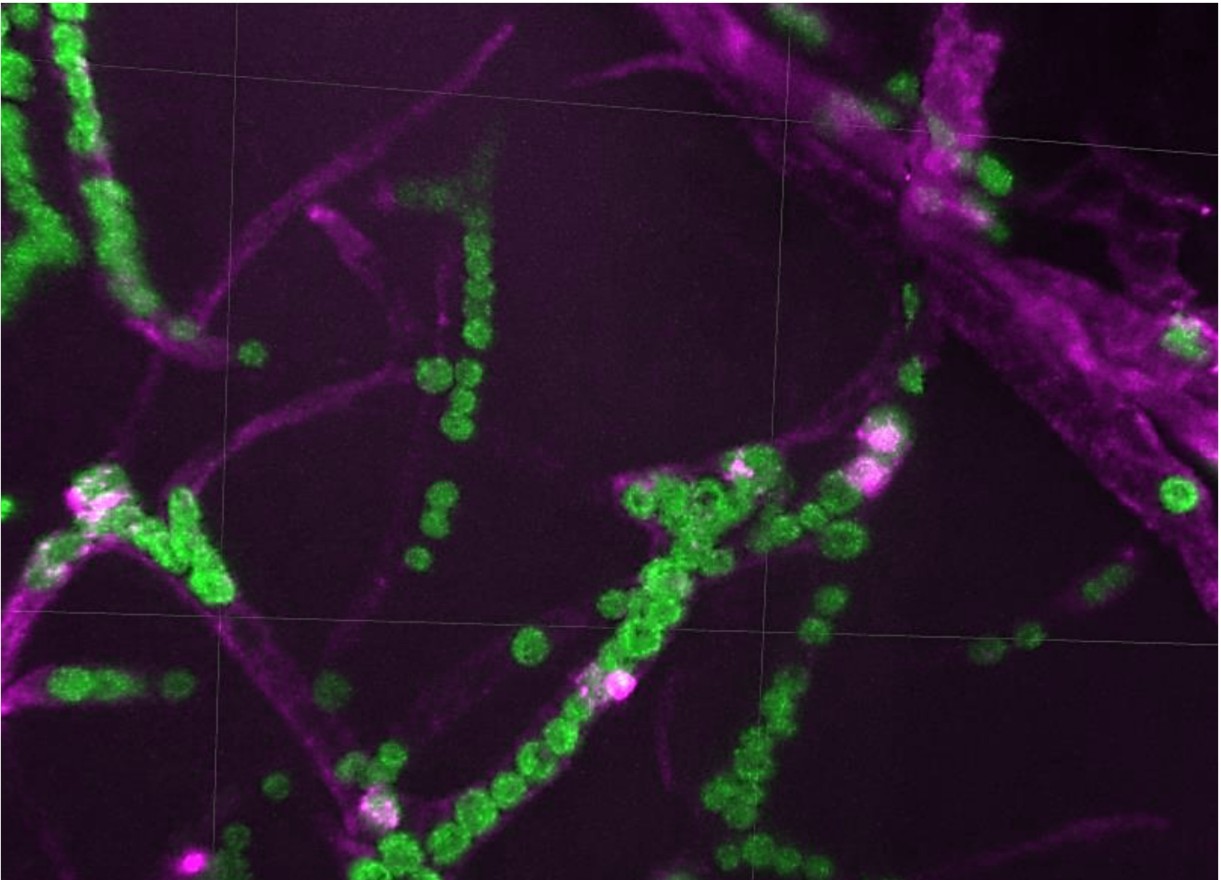
Injected green algae (green) sit inside the blood vessels (magenta) like a string of pearls. / Özugur et al./iScience
Fast and efficient method
Furthermore, revived nerves worked as well or even better than before oxygen depletion, showing that the technique was fast and effective.
“We proved that the method works. It was surprisingly reliable and robust and, from my point of view, a beautiful approach,” says Straka. “Working from the beginning doesn’t really mean it can be applied at the end, but it’s the first step to start other studies.”
While the authors believe their discovery could one day lead to new therapies for stroke-induced conditions or oxygen-deficient environments such as underwater or at high altitudes, they consider algae to be far from ready to enter. in our circulation.
While the authors believe their discovery could one day lead to new therapies for stroke-induced conditions or oxygen-deficient environments, they believe algae are far from ready to enter our bloodstream.
The team’s next step is to verify whether the injected algae can survive inside tadpoles living under normal conditions, producing oxygen without triggering an immune response that wreaks havoc on the animals.
Straka also thinks his research can benefit other laboratories that work with isolated tissues or organoids. The introduction of oxygen-producing algae can help these tissues to develop and increase their survival rates, potentially reducing the need to use live animals in these experiments.
“Must have new ideas and new concepts to explore; this is one of the ways to advance science”, says Straka, who concludes: “If you have an open mind and think about it, suddenly you can see all the possibilities from an idea”.
Rights: Creative Commons.
.