
Archean humans could have learned to sail across the sea to new lands nearly half a million years ago, much sooner than expected.
What were the ancestors of humans like nearly half a million years ago? Through its traces, we know that, for example, the Homo heidelbergensis it had a brain similar in size to modern humans and used various stone tools for cutting and scraping. It is also possible that he developed the ability to control fire. The surprise is that these ancestors of humanity could already be sailing.
According to a new analysis of Cybanian-era coastlines, there is no other way these ancient hominids could have reached what we now call the islands of the Aegean Sea. However, archaeologists have found ancient artifacts on the islands from before the first known appearance of the homo sapiensthat is, of modern humans.
This suggests that these ancient hominids must have found a way to cross large bodies of water and it was not necessary to use land bridges for human migration. This could have implications for how our ancestors and modern humans spread across the world.
The question of when hominids began to navigate is difficult to answer. Throughout history, boats have often been made of wood, a material that rarely survives the ravages of time intact, let alone tens of thousands, let alone hundreds of thousands of years. Therefore, there is no hope of finding a record of the first ships that sailed across the oceans.
Instead, what we have is a record of surviving artifacts and bones – stone tools that don’t decay, for example – and analysis tools that allow us to reconstruct how the world has changed over many millennia. This is how a team of researchers led by geologist George Ferentinos, from the University of Patras (Greece), was able to carry out the new analysis🇧🇷
The islands in the Aegean Sea are now considered one of the most beautiful places in the world. There are hundreds of islands that form an archipelago spread across the Aegean Sea, between Turkey, Greece and Crete. And they’ve been inhabited for a long time: the artifacts have been dated to 476,000 years ago.
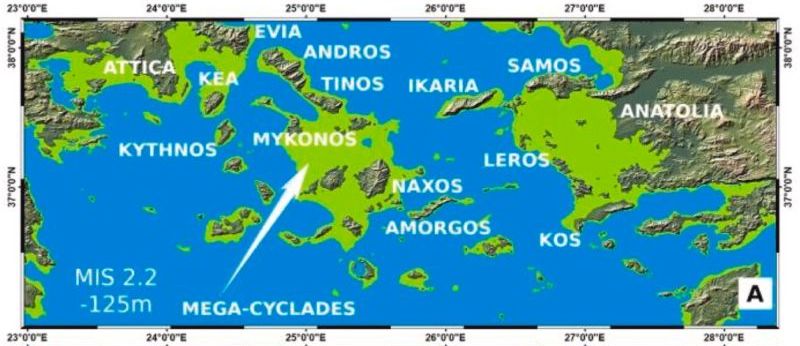
Aegean islands 450,000 years ago. Source: Ferentinos et al., Quat. Inter, 2022
Furthermore, these ancient tools from Lesbos, Milos and Naxos have been associated with the Acheulean style, developed around 1.76 million years ago and associated with the erectus in Africa and Asia. Several of these 1.2 million-year-old tools have been found in Turkey, Greece and Crete, so their appearance in the nearby archipelago makes some sense.
Previous studies have suggested that ancient humans crossed to islands on foot during ice ages. When the world freezes over, sea levels drop and humans can make journeys that in more temperate times would be covered by water.
To determine whether this is a possibility, Ferentinos and his colleagues reconstructed the region’s geography, including a reconstruction of the coastline around the islands in the Aegean Sea that dates back 450,000 years. To do so, they used ancient river deltas, which can be used to infer sea levels and rates of subsidence caused by tectonic activity. They found that earlier reconstructions were incorrect🇧🇷 At its lowest point in the past 450,000 years, sea level was approximately 225 meters below current level.
This means that although some of the islands in the Aegean Sea were connected to each other when the sea level was at its lowest, for the last 450,000 years the islands have always remained isolated from the surrounding landmasses🇧🇷 At the lowest point of sea level, you would still have to cross several kilometers of open sea to reach the nearest of the Aegean islands.
Other evidence, the researchers say, suggests this was not the first sea voyage. It is believed that between 700,000 and a million years ago, archaic humans traveled by sea through Indonesia and the Philippines.
These voyages combined suggest that sea travel was a skill developed not by homo sapiens, but by human ancestors and relatives who came before. That same skill would have allowed them to cross the Strait of Gibraltar between Africa and Europe.
This forces us to revise the generally accepted view of the peopling of southwestern Europe from the Sinai Peninsula and the Levantine plains through the Anatolian coastal zone and the Bosphorus land bridge in the mid-Middle Pleistocene, based on the consensus of that cognitive abilities to cross the sea were restricted to anatomically modern humans.
Quo Science Trips section sponsored by hyundai
REFERENCE