
Meta reports that Llama 2 has been trained with a whopping 40% more public data and it has the remarkable ability to handle twice the context compared to Llama 1.

On July 18 announced Meta and Microsoft their joint efforts to launch Llama 2, an open-source large language model that will be available on Microsoft’s Windows and cloud computing platform, Azure.
The new version, Llama 2, is free to use for both research and commercial use and is optimized to run on Windows. Meta confirms previous rumors that Llama 2 is intended for companies and researchers to develop applications on Meta’s AI tech stack.
According to Meta, Llama 2 is trained on 40% more publicly available online data sources and has twice the context power of its predecessor, Llama 1.
The company states that Llama 2 outperforms many competing open-source large language models (LLMs) in coding, skills, reasoning, and performance on knowledge tests. However, it recognizes that Llama 2 is not as efficient as its closed-source competitors, such as OpenAI’s GPT-4, as mention in one of his research reports.
Zuckerberg highlights the potential of Llama 2
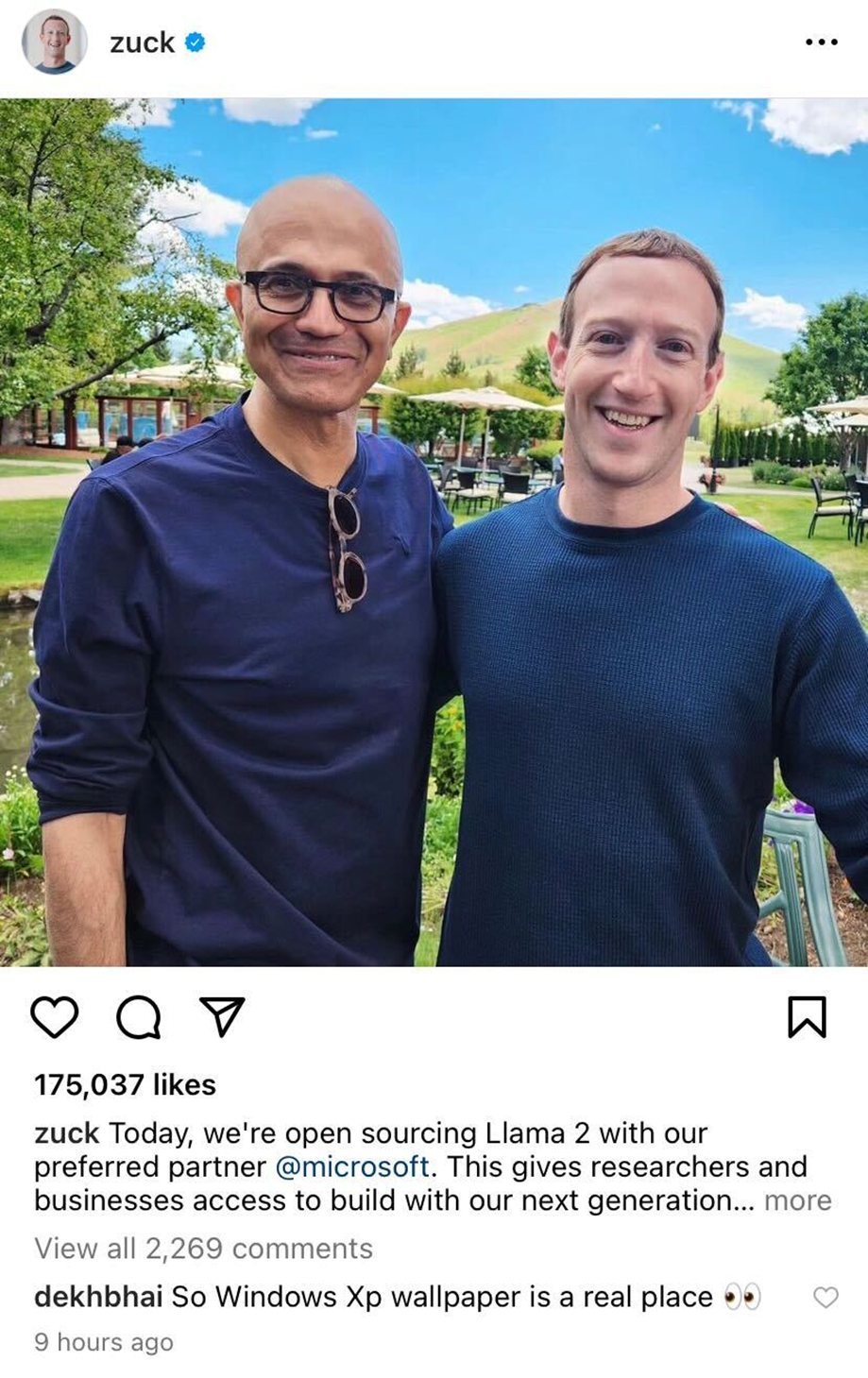
In an Instagram post on July 18, Mark Zuckerberg, CEO of Meta, emphasized that Llama 2 “gives researchers and companies access to build with our next-generation grand language model as the foundation of their work.”
Meta was pleasantly surprised by the immense demand for Llama 1 after its February limited release, receiving over 100,000 access requests. However, the model was soon leaked by a user on the imageboard website 4chan.
While Llama 1 enjoyed significant interest, its numbers were still a long way from ChatGPT’s. The latter model attracted an estimated 100 million or more users in the first three months, according to a Reuters report from February.
Through the recent partnership, Microsoft is now backing two major players in the AI world, with a total investment of $13 million in OpenAI over the course of 2023, as reported by Fortune in January.
In June, Meta’s decision to make Llama open source was met with criticism from two US senators. They claimed that the initial version of Llama offered “seemingly minimal” protection, raising the risk that malicious users would misuse the model for “criminal tasks.”