
The Galaxy S22 are the latest high-end smartphones introduced by Samsung. In Portugal, the equipment in this line comes with the Exynos 2200 processor, which has lower performance than the Snapdragon 8 Gen 1. But the Computer Base website went further in the comparison.
This media outlet put smartphones to the test on the Geekbench 5.1 benchmark platform. And as you can see from the shared graph, it falls far short of Apple’s single-core competition.
A closer look reveals that the A13 Bionic itself has a higher score (1329 points) than the Galaxy S22 Ultra with Exynos 2200 (1190 points). Which means that the iPhone 11 has a potentially higher performance than these new Samsung terminals.
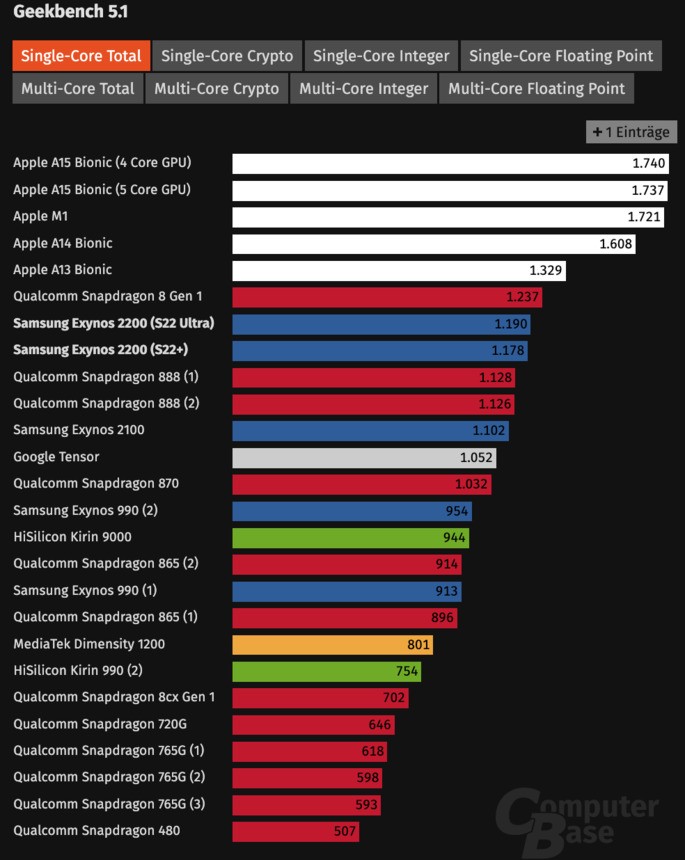
When we put the iPhone 13 to noise, the distance is even greater. This is because the A15 Bionic is presented with a score of 1740 points (with 5 GPU cores) and 1774 points (with 4 GPU cores).
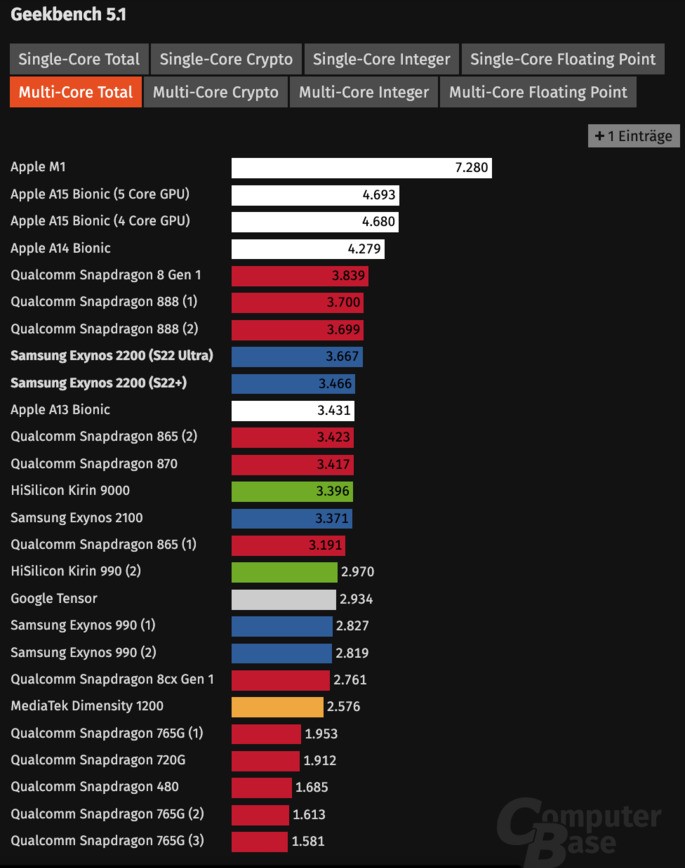
Even in multicore, the Exynos 2200 barely beats the A13 Bionic (3466 vs. 3431 points). In this situation, it also ends up losing to the Snapdragon 888, which has a minimum of 3699 points.
Exynos 2200 can still improve performance with updates
According to youtuber Erdi Özüag, the Exynos 2220 has practically the same GPU performance as its predecessor, and only 7% more CPU. However, this can still improve with future brand updates.
It’s no surprise that Apple’s processors manage to beat Samsung’s. But to see that the iPhone 11 (from 2019) will be able to equal or exceed the Galaxy S22 Ultra in raw performance is mind-boggling.