
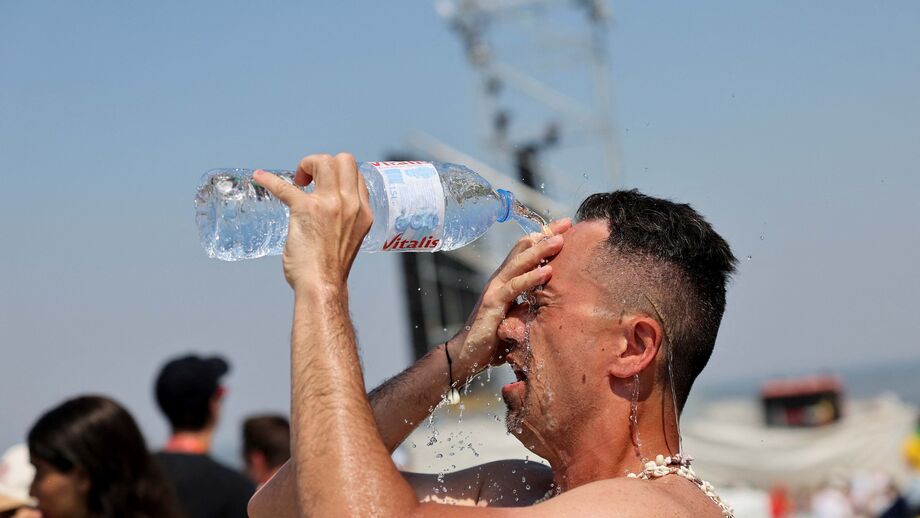
The summer sun beats down, turning football pitches into shimmering ovens. Players gasp for air, their jerseys soaked, their movements heavy. This isn’t just about winning or losing; it’s about pushing bodies to their limits in conditions that are becoming more and more common. Our planet is getting warmer. This means more extreme heat waves, and the beautiful game must find a way to adapt.
A new scientific study has just begun to tackle this very problem head-on. It started on Tuesday, July 29. The Players’ Union teamed up with FIFPRO and the Portuguese Football Federation (FPF) for this important work. Their main goal is to dig into how hot weather truly impacts football players. They want to provide clear information on how heat affects physical performance and body functions during a match.
To do this, athletes will be watched closely and tested twice. First, they will play in normal temperatures, below 25 degrees Celsius. Then, they will play in much hotter conditions, above 32 degrees Celsius. During both games, the researchers will check many things. They will record the weather, like temperature and humidity. They will also measure how far players run, their sprints, quick starts, and sudden stops. Heart rates and other body signals will be tracked. Scientists will also check for dehydration using urine samples and how much water players lose through sweat. Even internal body temperature will be monitored.
This groundbreaking study promises to be a big help. It will give coaches, team doctors, and athletes a clearer picture. They will better understand what happens to a player’s body when exercising in extreme heat. Beyond this, the project could spark new research. It will help grow our understanding of playing football in hot climates.
On the first day of the study, participants from the 23rd Player’s Camp took part in a 90-minute football game. The outside temperature that day was over 35 degrees Celsius.
Joaquim Evangelista, who leads the Players’ Union, spoke about the study’s importance. He stressed how worried the Union is about this issue. “Extreme heat waves are happening more often because of climate change,” he said. “Football really needs to change how it operates.” He mentioned what happened at the last Club World Cup, where conditions were very tough. “It’s never been more vital to use science,” Evangelista added. “We need to find ways to reduce these risks and protect our players’ health and safety.” He explained that FIFPRO asked them to use the unique setup at the Player’s Campus during the Camp. The FPF also stepped up to help make this new study happen. Evangelista thanked Dr. Vincent Gouttebarge, FIFPRO’s clinical director, for coming to Portugal. He also thanked Professor João Brito, the men’s national team physiologist, for his support.
João Brito, a physiologist with the FPF Health and Performance Unit and a researcher at the Portugal Football School, agreed. He highlighted the study’s importance, saying, “Thanks to global warming, we will play more football games in hot weather.” He explained, “In this project, we are trying to better understand how players’ bodies react when they play in the heat.” The goal is to develop the best ways to protect athletes. This includes changing training methods and how competitions are set up.
Vincent Gouttebarge, a doctor and clinical director for FIFPRO, also attended the study’s first session. It was his first visit to the Player’s Campus in Odivelas. He saw the Players’ Union facilities and met the athletes from the 23rd Player’s Camp. Gouttebarge explained why FIFPRO is involved in this research. “We know that high temperatures affect football players’ performance,” he stated. “It can harm a player’s health.” He warned that in some cases, too much heat can even lead to heatstroke. “So, this is clearly an area where FIFPRO must step in,” he concluded.