
New observations with the Atacama Large Millimeter/submillimeter Array (ALMA), operated by the European Southern Observatory (ESO) and other partners in Chile, have made the discovery possible Large Magellanic Cloud a young, massive star that grows, “accumulates” (accumulates) matter from its surroundings, and forms a rotating disk. It is the first time that a disk of this type, identical to those that form planets in our own Milky Way, has been found outside our galaxy.
“When I first saw evidence of a rotating structure in the ALMA data, I couldn’t believe that we had discovered the first extragalactic accretion disk. “It was a special moment,” he says. Anna McLeodAssociate Professor at Durham University (UK) and lead author of the study published in Nature.
“We know that disks are crucial for the formation of stars and planets in our galaxy, and now for the first time we see direct evidence of this process in another galaxy,” he emphasizes.

These disks are crucial to the formation of stars and planets in our galaxy, and now we are seeing direct evidence of this process in another galaxy for the first time

This study continues with the observations made with MUSE instrumentinstalled on ESO’s Very Large Telescope (VLT), which discovered a jet fired from a forming star, a system called HH 1177 within a gas cloud in the Large Magellanic Cloud.
“We have detected a jet emanating from this massive young star, and its presence is a sign of the disk’s ongoing accretion,” McLeod said. However, the team had to confirm the existence of the hard drive Measure the movement of dense gas What is around the star?
Matter attracted to a growing star does not fall directly onto it, but flattens out into a rotating disk around it. The closer it is to the center, the faster the disc rotates, namely Speed difference It is the irrefutable evidence that shows the astronomical community the presence of an accretion disk.
“The frequency of the light changes depending on how quickly the gas that emits the light gets closer or further away from us,” he explains. Jonathan Henshaw, researcher at Liverpool John Moores University (UK) and co-author of the study. “It is the same phenomenon that occurs when the sound of an ambulance siren changes as it drives past and the frequency of the sound changes from high to low,” compares the researcher.
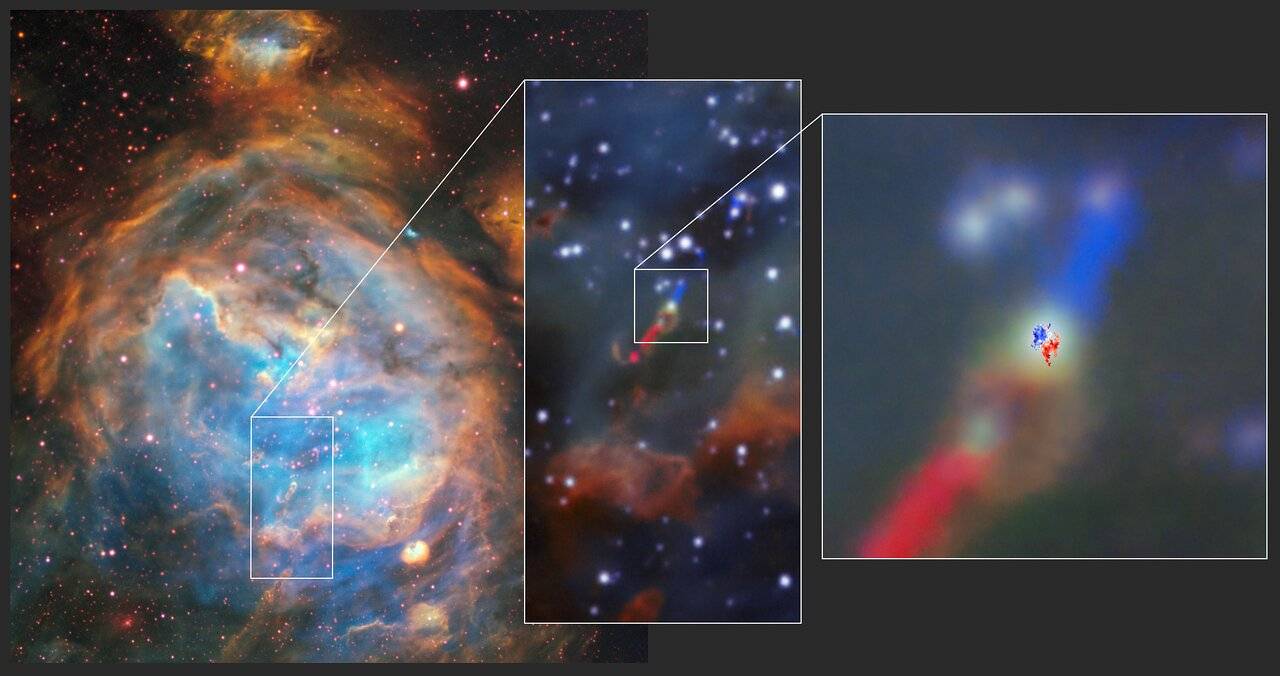
Parent cloud, LHA 120-N 180B (left), imaged by MUSE, where the HH 1177 system was first observed. The image in the middle shows the jets that accompany it (the part aimed at us is blue and shifted inward). red, the distance). Right, observed with ALMA. / ESO/SOUL (ESO/NAOJ/NRAO)/A. McLeod et al.
ALMA’s detailed frequency measurements allowed the authors to detect the characteristic spin of a disk, confirming the discovery of the first disk around a young extragalactic star.
The massive starslike the one observed, form much faster and have a much shorter lifespan than low-mass stars like our Sun. In our galaxy, these massive stars are quite difficult to observe and are often obscured by dusty material that forms as a disk is created around it.
However, there is a galaxy in the Large Magellanic Cloud 160,000 light years awayThe material from which new stars form is significantly different from that of the Milky Way. Thanks to the lower dust content, HH 1177 is no longer enclosed in its original bubble, giving astronomers an unobstructed, albeit distant, view of star and planet formation.
“We are in an era of rapid technological advances when it comes to astronomical facilities,” explains McLeod, and looks forward to “exploring how stars form at such incredible distances and in another galaxy.”
Reference:
Anna F. McLeod et al. “A probable Kepler disk feeding an optically visible massive young star.” Nature2023