
The compilation and analysis of human Y chromosomelinked to the male gender and the last of the 24 we have that has yet to be fully sequenced is featured in two articles in the journal this week Nature.
One of the studies is led by the Telomere-to-Telomere Consortium (T2T, funded by the US NIH National Institute for Human Genome Research). The authors present the new sequence, which fills in gaps in more than 50% of the previously used reference Y chromosome.
This advance reveals key genomic features that affect fertility, such as the factors involved in sperm production and diseases such as cancer.
The sample was contributed by “a single person to whom we addressed the.” IDHG002who have generously given their consent to the research,” one of the authors and a member of the T2T explains to SINC. Monika Cechovafrom the University of California at Santa Cruz (USA).
“There used to be 57,264,655 base pairs available, but about half, or 30,812,366, had an unknown sequence! So instead of sequences of four ACGT letters (adenine, cytosine, guanine, and thymine), we just had long, unspecified stretches,” points out the researcher, who emphasizes: “Now we have 62,460,029 base pairs and no gaps (although there have to be). It should be noted that the size of the Y chromosomes varies from individual to individual.
In addition to adding more than 30 million base pairs to the reference chromosome, complete structures of different gene families and identify 41 new protein coders. The results also correct assumptions about the microbiome, revealing previously unknown human Y-chromosome sequences that were incorrectly classified as bacterial.
Complete the least known chromosome
When the scientific community completed the first sequence of the human genome 20 years ago, gaps remained in the sequences of all 24 chromosomes. But unlike the small gaps scattered throughout the rest of the genome sequence – which was completed last year by the T2T consortium – more than half of the Y chromosome sequence remained a mystery.
All chromosomes have some repeating regions, but the Y is it unusually repetitivewhat makes up your sequence very difficult to complete. Compiling the sequencing data is like trying to read a long book that has been torn to pieces. If all the lines in the book are unique and different, it is easier to determine the order they are in. However, when the same sentence is repeated thousands or millions of times, the original order of the stripes is much less clear.
Although all human chromosomes contain repeats, about 30 million letters on the Y chromosome are repeat sequences. It’s like repeating the same sentences halfway through the book. To meet this challenge, the T2T consortium applied new DNA sequencing technologies and advanced sequencing methods.
“The biggest surprise was how organized the reps are,” says Dr. Adam PhilippyPrincipal investigator at the National Human Genome Research Institute and leader of the consortium.
“We didn’t know exactly what the missing sequence was,” he admits. “It could have been very messy, but instead almost half of the chromosome is made up of alternating blocks of two specific repetitive sequences known as satellite DNA.” forming a beautiful pattern. similar to a quilt.
Know genes involved in fertility
The full sequence of the Y chromosome also reveals important features from areas of medical interest, such as what is known as the ‘azoospermia factor’, a stretch of DNA that contains several genes involved sperm production. The new work thus provides new insights into the field of human fertility.
“Y chromosomes have been ignored or dismissed for years,” says co-author Melissa Wilsona geneticist at Arizona State University (USA), “although we play a crucial role in the development of the testicles, there is a whole other world we need to explore in terms of their importance to human health.”
For his part, Phillippy adds: “When a variant is found that has never been seen before, there is always hope that those genome variants are important in understanding human health. Medically relevant genome variants can help us to develop better diagnostics in the future.” “.

When variations are found that have never been seen before, there is always hope that these genomic variants are important in understanding human health.

Global diversity of the Y chromosome
In the other article published in Natureled by the researcher Charles Lee from the Jackson Laboratory of Genomic Medicine (also in the USA), the Sequences of 43 human Y chromosomes various, representative 21 world populations different.
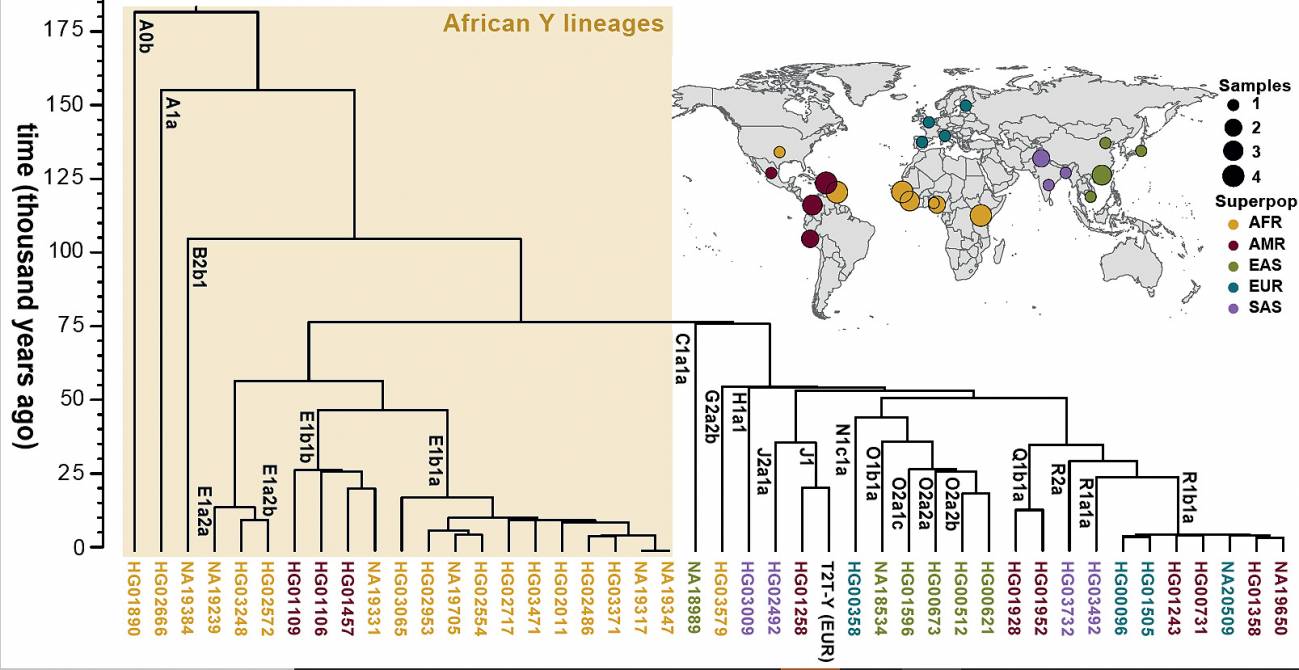
Map showing the origin of the study’s 43 Y chromosomes and the map provided by the T2T consortium. / Pill Hallast, Charles Lee et al./Nature
“The half of the Y chromosomes were from our study non-European descent (African, American and Asian), while the one sequenced by the T2T consortium was from a single individual of European descent,” Lee told SINC. “Thus, by analyzing multiple chromosomes of this type, we can closely monitor the genetic differences in diverse individuals.”
“Because the human Y chromosome has a lot of repetitive DNA, I suspected that when we compared it to that of many unrelated individuals, we would find a lot of structural genomic variation in it, and we did.”
The assemblies presented by this team provide a more detailed look at the genetic variation between Y chromosomes over 183,000 years human evolution. They also reveal new DNA sequences, signatures of conserved regions, and insight into the molecular mechanisms that contributed to their complex structure.
“There is research showing that proper gene function of the Y chromosome is incredibly important for overall male health,” Lee said, “and our study makes it possible to fully incorporate it into any future male genome sequencing work to.” to understand that.” health and sickness“.
Our study allows for the inclusion of the entire Y chromosome in future work in sequencing male genomes to understand health and disease
“An example of the importance of this work for medicine is the recent finding that the loss of the Y chromosome correlates with a poor prognosis in patients with bladder cancer and influences the response to therapies,” recalls the researcher.
“It’s unlikely that the entire Y chromosome is the cause. So if we have the full sequence of the Y chromosome (and understand the genetic variation between those of different individuals), we can analyze what specific Y chromosome sequences contribute to it.” Prognosis. and therapeutic response in these patients,” he concludes.
Why are there so many repetitive sequences on the Y chromosome?
“Good question that still remains unanswered in this area,” answers Monika Cechova from the T2T consortium and UCSC. Satellite DNA is behind the secret, consists of large fragments of non-coding DNA that are repeated in sequence:
“We know that many of these satellite sequences, or those rich in them, have important functions, for example for centromere or telomere biology. Others can introduce differences that drive speciation or affect the activity of neighboring genes because of their dense structure. There are also scientists who believe that much of the satellite DNA is largely non-functional.
For me personally, it is very exciting that we can now study these regions, as they were extremely difficult to localize a few years ago. This means we can finally begin to understand its structure and function.
For example, in the case of the Y chromosome, the q arm (which can vary by millions of base pairs from individual to individual) consists of two main satellites. These seem interspersed in a very specific pattern, more organized than expected and also devoid of other elements such as some transponables that would otherwise be fairly ubiquitous.
If we include in the repetitive sequences those organized in large inverted repeats or palindromes (they are read the same way from both directions) and containing genes, these are also on the Y chromosome. One of the main hypotheses is that the presence of “An A gene in a palindrome means that each gene is always present in two copies, so there is always a ‘reserve’ in case of mutation.”
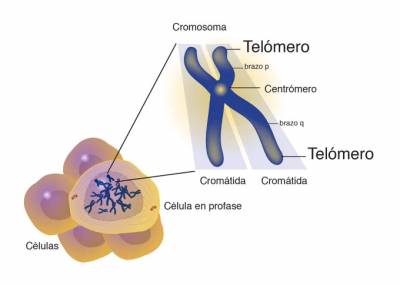
Diagram of a chromosome. /NIH
References:
Arang Rhie, Adam Phillippy et al. “The complete sequence of a human Y chromosome”. Pill Hallast, Charles Lee et al. “The assembly of 43 human Y chromosomes reveals great complexity and variation.” Nature2023