
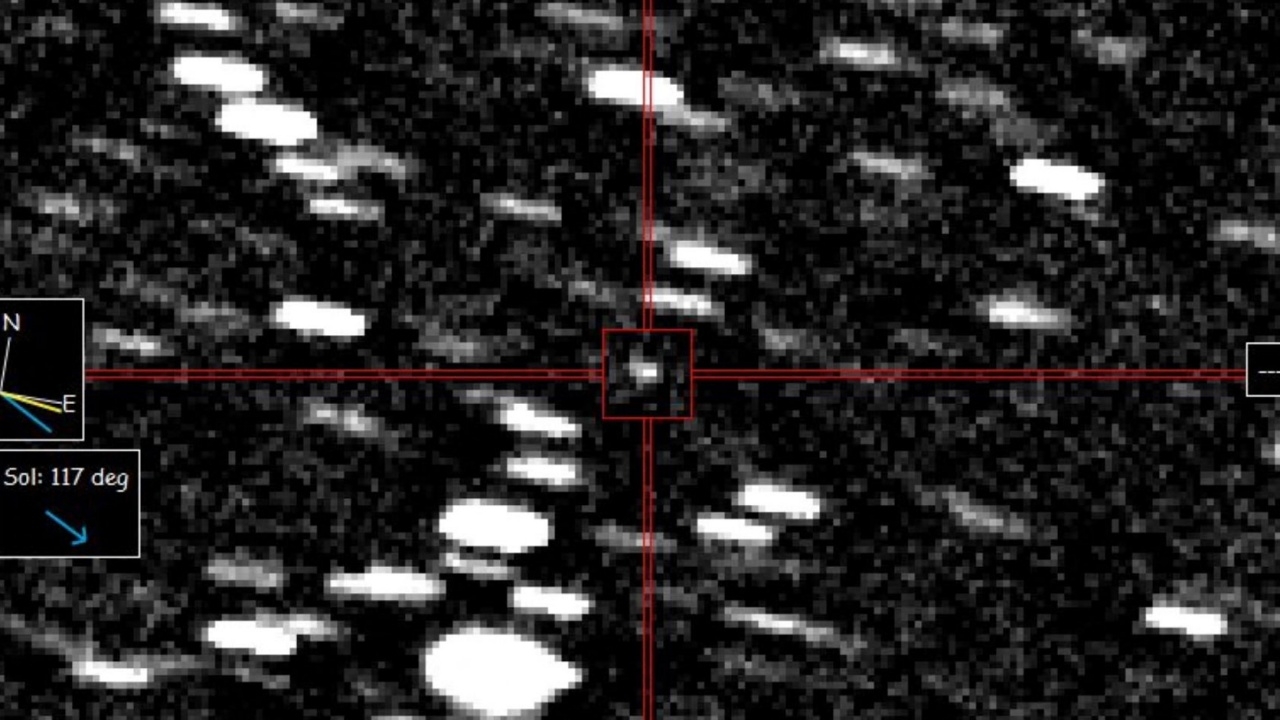
Imagine a traveler from a distant star, silently making its way across the vast emptiness of space. Now, that cosmic visitor has entered our own solar system. Scientists have confirmed the discovery of an object, likely a comet, that began its journey far beyond the sun’s reach. Don’t worry, though; this interstellar wanderer poses no threat to Earth or any other planet in our neighborhood.
This intriguing object was first spotted by the ATLAS (Asteroid Terrestrial-impact Last Alert System) telescopes in Rio Hurtado, Chile. NASA supports this important system, which helps us keep an eye on anything coming our way. After the initial detection, telescopes all over the world, including more ATLAS sites and the Zwicky Transient Facility in California, gathered more information. Their observations confirmed the comet’s existence and its path.
Scientists have named this new arrival “A11pl3Z,” or more formally, “3I/ATLAS.” Early reports from the Minor Planet Center show it has features like a faint haze, known as a “coma,” and a short tail. These are classic signs of a comet. Dr. Josep Trigo Rodríguez, an astronomer from the Institute of Space Sciences near Barcelona, Spain, says the comet is quite large, roughly 40 kilometers across.
This object is really moving, zipping through space at about 244,600 kilometers per hour. That kind of speed, along with its unique trajectory, tells astronomers it didn’t form in our solar system. It truly comes from another star system, heading our way from the direction of the Sagittarius constellation. Right now, it’s about 675 million kilometers from Earth.
This visitor will not pass close to our planet. It will stay at least 241 million kilometers away from Earth throughout its journey. The comet is expected to get closest to the sun on October 30th, reaching a point about 209 million kilometers away. That’s still well within the orbit of Mars. After that, it will briefly disappear behind the sun in November before reappearing in early December for more viewing.
This discovery is incredibly rare, marking only the third time astronomers have ever found an object from outside our solar system moving into its inner regions. The first such discovery was “Oumuamua” in 2017, a fast-moving object shaped like a cigar. Then came “2I/Borisov” in 2019, which was also a comet believed to have originated from another star. These discoveries offer a unique chance to study material from beyond our stellar neighborhood.
NASA plans to keep a close watch on this new comet. They will continue to study its size and other physical properties until September. After that, it will move too close to the sun for us to see it clearly from Earth. Each of these interstellar travelers gives us a rare glimpse into the distant cosmos.
Source: abcnews