
European research has analyzed the genome of about 10,000 old individuals to look for chromosomal trisomies. The work was published today in Nature communicationhas identified six cases of Down syndromeall as babies: five from 5,000 to 2,500 years ago and one from a more recent period.
The research was led by the Max Planck Institute for Evolutionary Anthropology in Leipzig (Germany) and took place with the participation of the Autonomous University of Barcelona (UAB), the University of Alicante (UA) and the Public University of Navarra (UPNA)..
According to the authors, this is one of the first systematic studies genetic screening in ancient human samples looking for conditions rare geneticsHow chromosomal trisomiescharacterized by the presence of three copies of a chromosome instead of the usual two.
One of these diseases is Down syndrome (trisomy 21)caused by an extra copy of chromosome 21 occurring approximately 1 in 1,000 births. It was carried out using a new statistical method of genome sequencing, complemented by an osteological study of the identified cases and the existing archaeological records.
Of the five prehistoric individuals with Down syndrome, three are included Navarrese sites Alto de la Cruz and Las Eretascorresponding to the Iron Age of Navarre (2,800 to 2,500 years ago), and two are from the Bronze Age (4,700 to 3,300 years ago). Greece and Bulgaria.
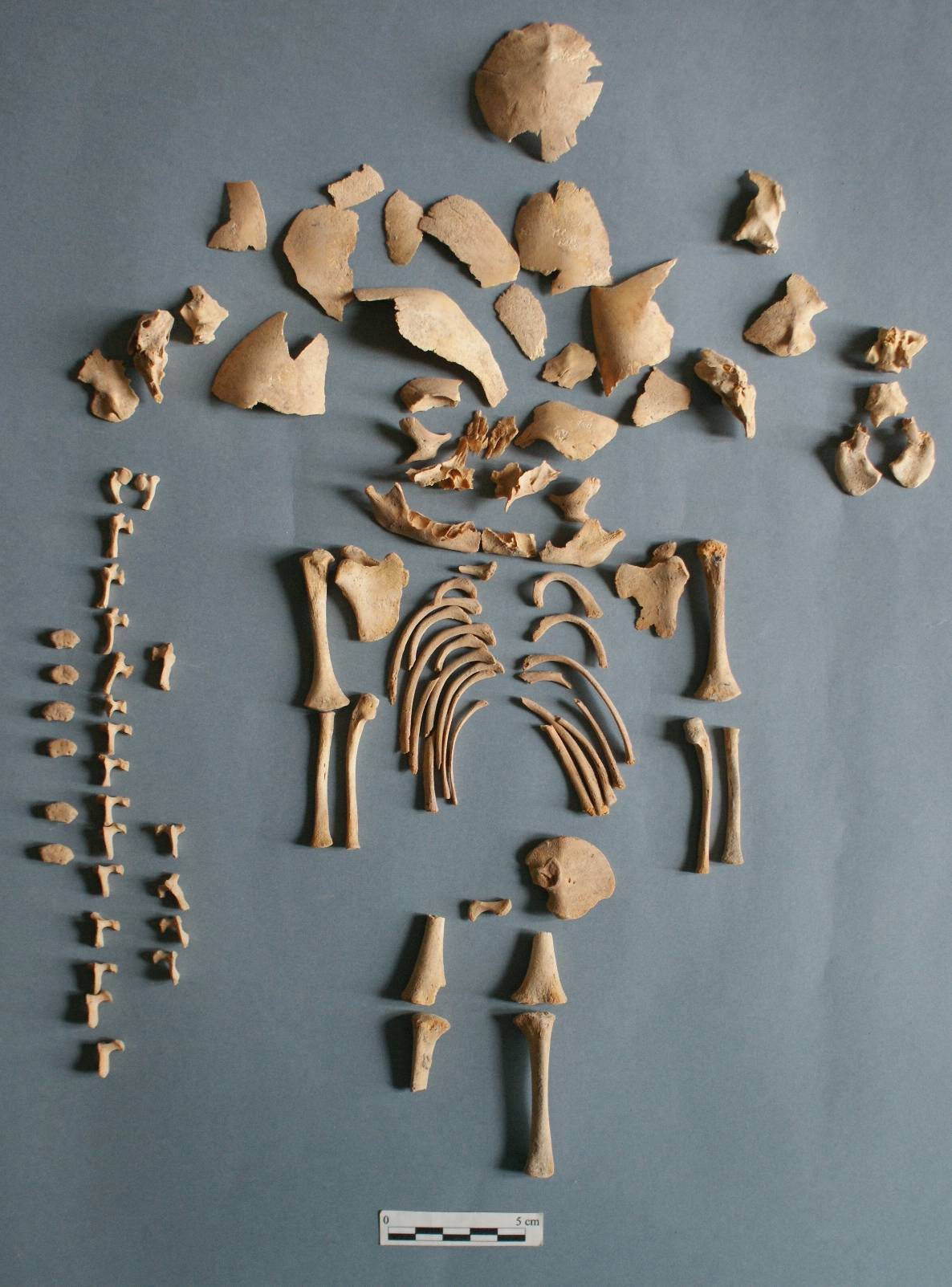
Remains of a child who bears the name “CRU001” / Government of Navarre / JL Larrion.
The sixth comes from the cemetery of a Finnish church from the 17th-18th centuries. Century. In addition, a case of Edwards syndrome (trisomy 18)rarer and more severe than Down syndrome, with an approximate disability rate of 1 in 3,000 births. It is the first in the world to be identified in an archaeological population.
According to analysis of the skeletal remains, all individuals died before or shortly after birth. Only the Greek case reached one year of life.
A surprising aspect that all the prehistoric cases studied have in common is that they were buried in houses or within settlements, some with trousseau, such as the cases in Greece and Bulgaria and a girl with Down syndrome from Alto de la Cruz, which was buried with a rich grave trousseau (a bronze ring, a shell and the remains of three sheep or goats), in a place that may have been a place of worship. “We believe these burials show that these individuals were cared for and valued as part of their ancient societies,” he says. Adam Ben RohrlachLead author of the study.
Specific burial rituals
Iron Age Iberian communities had a particular burial ritual: some contradicted the prevailing custom, cremation Premature babies and newborns They were buried in houses or places within the walls. Overall, the discovery of the four cases with genetic disorders in two nearby and present-day cities surprised the research team.
“At the moment we cannot say why this could be, but we know that they were among the few boys and girls who were given the privilege of being buried in the houses after their death.” This is already an indication of this that they were perceived as such special and valuable babies for the communitybut we need to expand research with individuals from the same period from other locations to formulate hypotheses about the rites that may have led to it,” he explains. Roberto RischArchaeologist at UAB and co-author of the work.
“It is possible that only babies who died of natural causes but are perceived by the community as special beings were buried in the living quarters,” he comments. Javier Armendariz, by UPNA. “It should definitely be noted that not all newborns buried in Iron Age houses were cases with genetic pathologies. “In the city of Las Eretas, we found a boy with Down syndrome in the same house and, next door, a second-degree relative girl who could have been his stepsister,” the researcher adds.

These first cases of trisomy in previous populations open the possibility of identifying possible osteological changes associated with this genetic anomaly.

As for them Osteological studiesResearchers have observed abnormalities in some of the individuals that may be consistent with their genetic condition, without being able to rule out other causes. “In any case, these first cases of trisomy in populations from the past open the possibility of identifying possible osteological changes related to this genetic anomaly, which would make it possible to identify it in large anthropological collections,” he emphasizes. Miguel’s PatxukaOsteoarchaeologist at UA.
The authors plan to further expand their research in the future as the number of DNA samples from ancient individuals continues to increase. “We want to know how ancient societies responded to individuals who may have needed help or were simply a little different,” says Kay Auditor, who coordinated the analysis of the gene sequences.
reference:
Adam Benjamin Rohrlach et al. “C“Aces of trisomy 21 and trisomy 18 among historical and prehistoric individuals discovered using ancient DNA”. Nature communication (2024).