
The appetite of institutional investors for Bitcoin continues to increase according to the latest Fidelity study entitled ” THE INSTITUTIONAL INVESTOR DIGITAL ASSETS STUDY “. 52% of respondents said they have a position in bitcoin or some other digital asset.
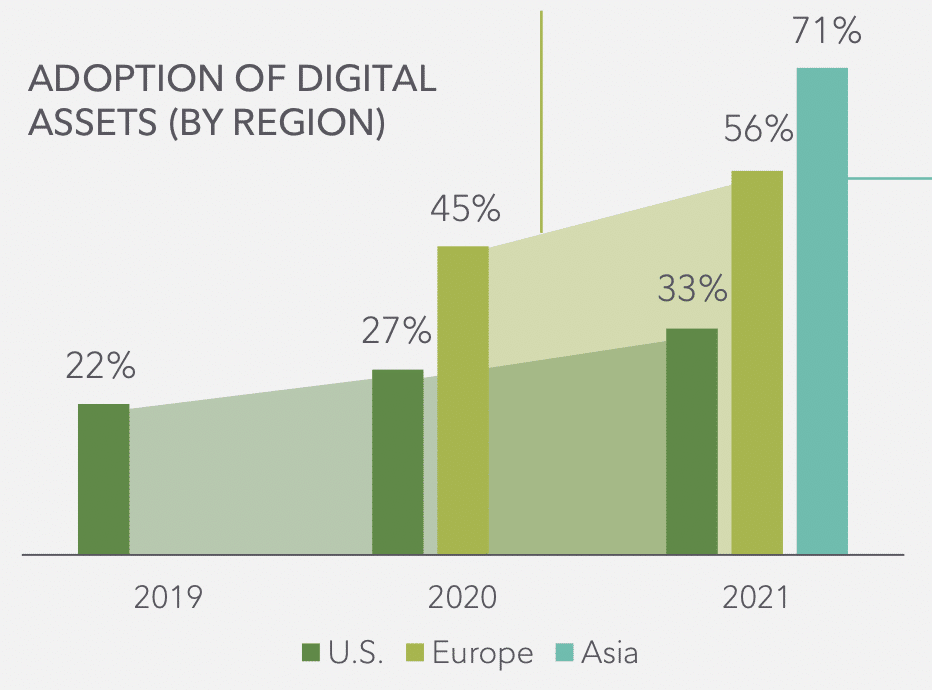
For most of these investors, current cryptocurrency market conditions have catalyzed their choice to invest in this asset class. According to the study report, European investors have a more progressive view of digital assets than American investors when comparing their responses to different categories of survey questions. But, Asians are far ahead of their Western counterparts in terms of acceptance of digital currencies. Almost 70% of them, invest in cryptocurrencies.

This study has just confirmed a global trend where institutions from all over the world are seriously starting to look into the possibility of buying bitcoin. According to the results of a survey conducted by the Russian Association of Forex Traders (AFD) of 502 investors to test their behavior vis-à-vis cryptocurrencies, 77% responded that bitcoin is a better investment than other other traditional asset classes.
The demand for bitcoin and cryptos is growing …
Adoption of bitcoin by institutional investors
The pace of digital asset adoption has increased to a fairly significant level over the past two years. The adoption rate of cryptocurrencies rose from 27% to 33% in the United States between 2020 and 2021. Even more growing in Europe, the adoption of cryptos has increased from 45% to 56 during this same period. In Asia, where data is only collected for this year, adoption is 71%.
The statistics are expected to be even bigger for years to come as investors are very vocal in their desire to keep investing in cryptocurrencies. According to the Fidelity report, the intention to purchase digital goods for the coming years is 60% for American investors, 75% for Europeans and 80% for Asians. The perception of institutional investors confirms this desire for investment. 70% of the 1,100 investors surveyed have a neutral to positive perception of digital assets.
As for the type of investment, the trend is contrasted between regions. The study tells us that in the United States, investors surveyed increasingly prefer investment products to direct purchases of digital assets. While in Europe and Asia, the opposite is true. Investors in these regions prefer the direct purchase of digital assets than investing in investment products.
Bitcoin is the most purchased cryptocurrency by investors. 21% of the 33% of US investors who hold cryptos own BTC wallets. In Asia and Europe, the digital asset portfolios of these investors are made up of 45% and 46% of bitcoin investments, respectively. Ethereum comes next with 10% Holders in the United States, 27% in Europe and 22% in Asia. After that, we have cryptocurrencies like Litecoin, XRP, Bitcoin Cash and Binance Coin.
Return as the main motive for investing
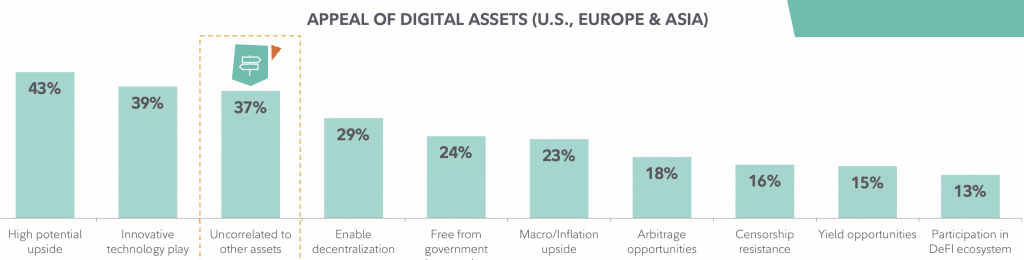
43% of respondents say they are attracted by the return on digital assets
Importantly, in this year’s survey, almost nine in ten respondents said they find digital assets attractive (86%). All this interest in cryptocurrencies is mainly due to one factor: the profitability of these products. 43% of investors said they were attracted to cryptocurrencies because they have a high potential for growth in the future.
The technological innovation at the base of these assets is driving profitability with nearly 39% of the interviewees who share this feeling. Its decorrelation with other financial assets completes the podium with 37% of the total survey participants.
Volatility: The biggest barrier to entry!
There is no doubt that volatility is the biggest scourge facing digital assets. This is something that makes investors a bit confused about investing in this asset class. According to data provided by the study, 54% of respondents find price volatility to be the biggest barrier to cryptocurrency adoption. After the volatility issue, the lack of fundamental data to assess an appropriate value is the second thorn that hinders the attractiveness of the sector with 44% of interviewees who think so.
Other elements that critics of bitcoin talk about quite often can be found in the list of barriers to entry. Regulatory framework, protection against loss, market manipulation are other repelling factors identified by the 1,100 survey participants.
In conclusion, bitcoin and other cryptocurrencies are in the process of becoming a normal class for investors even if the sector still has to resolve to improve some small negative points. But, when you consider that modern economies will not be immune to the scourge of inflation and that cryptocurrencies represent a good hedge, adoption should continue to increase in the years to come.