
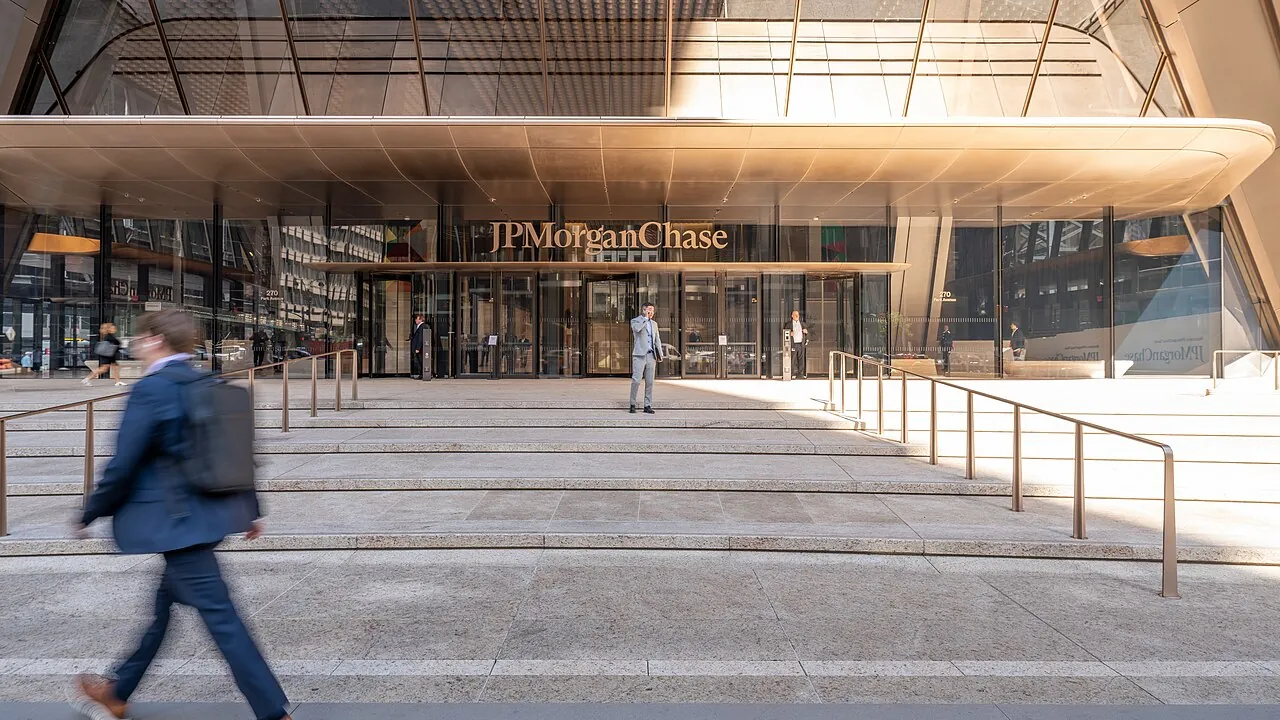
JPMorgan Chase, the largest U.S. retail bank with more than 86 million customers and over 10 percent of all U.S. deposits, blamed a software bug in its own server hardware for transaction delays that rippled across the U.S. banking system on Monday before normal processing resumed around 6:30 p.m. ET. Because JPMorgan Chase sits on one side of so many everyday transfers, customers at rival banks whose systems were working normally still ran into delayed payments and Zelle transfers whenever a Chase account was on the other end, while JPMorgan Chase shares fell 2.3 percent to close at $338.21.
Outage reports on the tracking site Downdetector began climbing around 9:30 a.m. ET on Monday across banks, credit unions, fintech apps, and credit card companies, peaking around 2 p.m. ET at roughly 5,000 reports before dropping to about 500 by 3:22 p.m. PT, Tom’s Guide reported. Just before 4 p.m. ET, JPMorgan Chase posted an update on X and sent a statement to WIRED explaining the cause of the slowdown.
“JPMorganChase has experienced a temporary issue related to a software bug in on-premise hardware systems—there is no evidence this is cyber-related,” JPMorgan Chase spokesperson Pablo Rodriguez told WIRED, referring to computing equipment the bank runs inside its own facilities rather than in the cloud. “It is taking longer than usual to service some customers.”
Rodriguez said the bank was not facing a “systemic issue” and noted that customers “still have access to their accounts and funds” while engineers worked on a fix. He added that “other banks may have been impacted by slowness in transactions only to the extent that they were a party to a transaction with us.” Around 6:30 p.m. ET on Monday, a Chase spokesperson told NBC News that customer transactions were back to posting normally, KARE 11 reported.
Why other banks and Zelle showed outage spikes
As online banking outage reports piled up on Monday morning, user submissions on Downdetector pointed to problems at Bank of America, Wells Fargo, U.S. Bank, Capital One, TD Bank, Navy Federal Credit Union, Visa, Mastercard, and Zelle. Downdetector tallies user complaints rather than internal bank status pages, so a customer at another bank whose transfer to a Chase account stalled could report their own bank or payment app as down.
Many of those complaints centered on Zelle, the peer-to-peer payment network run by Early Warning Services, an Arizona-based operator owned by Bank of America, Capital One, JPMorgan Chase, PNC Bank, Truist, U.S. Bank, and Wells Fargo. “Zelle is not down. Zelle is operating as it should,” a Zelle spokesperson said in a statement to WIRED. “Consumers use Zelle through participating banks and credit unions, which manage their accounts and hold their funds. Consumers do not have a separate Zelle account, and Zelle does not hold consumer funds.”
An Early Warning Services spokesperson told the Associated Press that “An issue at the financial institutions may be delaying Zelle payments for some of their customers,” while U.S. Bank spokesperson Jeffrey Shelman said U.S. Bank’s systems “are not directly impacted” even though “clients attempting to send or receive Zelle payments with another financial institution may experience transaction delays.”
Other major institutions also confirmed that their internal systems were running without interruption. A Bank of America spokesperson said its systems “have been operating normally today,” and told NBC News that customers seeing delays with another service provider should check with that institution. A Capital One spokesperson said the firm “has not been impacted and continues to operate normally at this time,” while spokespeople for Citigroup, PNC, and Truist also reported normal operations. At Mastercard, Senior Vice President of Communications Seth Eisen said, “Our network is operating normally,” adding that Downdetector was “not correct” in showing an issue for the card network, and a Visa spokesperson said Visa’s systems were operating normally as well. Wells Fargo told NBC Chicago earlier Monday that it was looking into reports of online banking issues, though Wells Fargo, TD Bank, and Navy Federal Credit Union did not immediately respond to WIRED’s requests for comment.
What customers and investors saw on Monday
During the peak of the disruption, some Chase mobile app users saw an alert banner stating, “Some services aren’t available. We’re working on them. Please try back later,” while an ATM at a Chase branch in Irving, Texas displayed an out-of-service screen, according to the Associated Press. Individual customers also reported temporary login failures and trouble completing check deposits at branches before service recovered in the evening. On Wall Street, JPMorgan Chase shares fell 2.3 percent on Monday to $338.21, while Bank of America slipped 1.8 percent and Wells Fargo declined 1.4 percent, Quartz reported.
Three infrastructure disruptions in five days
Monday’s banking slowdown followed two major U.S. technology and aviation disruptions late last week. On Thursday, Nov. 12, Microsoft 365 suffered a 24-hour global outage across Outlook, Teams, and other cloud services; Microsoft Executive Vice President Charles Lamanna wrote on X on Monday that the outage stemmed from a software update that began rolling out in July. On Friday, Nov. 13, the Federal Aviation Administration ordered a five-hour nationwide ground stop that canceled thousands of flights after data flooded its telecommunications network. “The FAA’s legacy equipment became unstable when data began flooding the FAA FTI network, at a rate of 1,000 connection attempts every 4 to 5 seconds,” the agency wrote in an online FAQ. “This disrupted the system and created instability with aircraft communications and radar feeds.”