
All passengers and crew aboard the docked paddlewheel cruise ship American Heritage survived on Friday afternoon after the tanker Atlantic Asphalt struck the vessel broadside on the Mississippi River in New Orleans, causing the five-story riverboat to roll onto its side and partially submerge.
New Orleans Mayor Helena Moreno said at a Friday news conference that zero passengers or crew members were missing or critically hurt following the 12:30 p.m. CST collision at the Port of New Orleans. Calling the outcome a “miracle on the Mississippi,” Moreno said that rescue crews accounted for everyone on board after the impact threw passengers into the cold, fast-moving river.
According to Port of New Orleans press secretary Kimberly Curth, the American Heritage was carrying about 129 passengers in addition to its crew when it was hit, roughly two hours after docking to begin disembarkation at the end of an eight-day cruise across Louisiana and Mississippi. Moreno and port officials placed the total number of passengers and crew on board at between 180 and 190 people, according to The Waterways Journal.
Thirty-two people were taken to local hospitals with non-critical injuries, consisting mainly of bumps and bruises. Moreno said the hospitalized included 30 cruise passengers and two New Orleans Harbor Police officers who entered the river to pull people to safety. Police and fire officials reported that 87 people were evacuated from the ship before it rolled onto its side.
How the Mississippi River Collision Unfolded
Vessel tracking data from MarineTraffic showed the Atlantic Asphalt navigating the sharp Mississippi River bend near the Algiers Point neighborhood before passing under the Crescent City Connection bridge, which links New Orleans’ central business district with Algiers and carries about 160,000 vehicles daily. Shortly after clearing the bridge, the tanker veered toward its starboard side and T-boned the docked American Heritage near the Ernest N. Morial Convention Center and the Port of New Orleans administration building.
Video provided to CBS affiliate WWL Louisiana by Mardi Gras World proprietor Barry Kern showed the tanker striking the side of the paddlewheeler, which slowly listed and rolled onto its side at the point of impact. Eyewitness Jamie Holford told NBC affiliate WDSU that it took 15 minutes “from impact to where it rolled over,” calling the scene “Surreal.” Speaking to CBS News, Holford added, “It looked like something off the Titanic,” and said of the collision, “It sounded like a war movie. Just imagine tons of steel crunching. That’s what it sounded like.”
As the ship took on water and tilted, images on social media showed passengers climbing onto stateroom balcony railings while chairs and tables slid across the decks. An unnamed employee at the adjacent Ernest N. Morial Convention Center told The Guardian that she noticed the tip of the ship tilting before hearing screams from the riverfront. “People were screaming for help,” the employee said, adding that convention center staff gathered wheelchairs and bottled water for survivors who were later brought inside the port’s administration building.
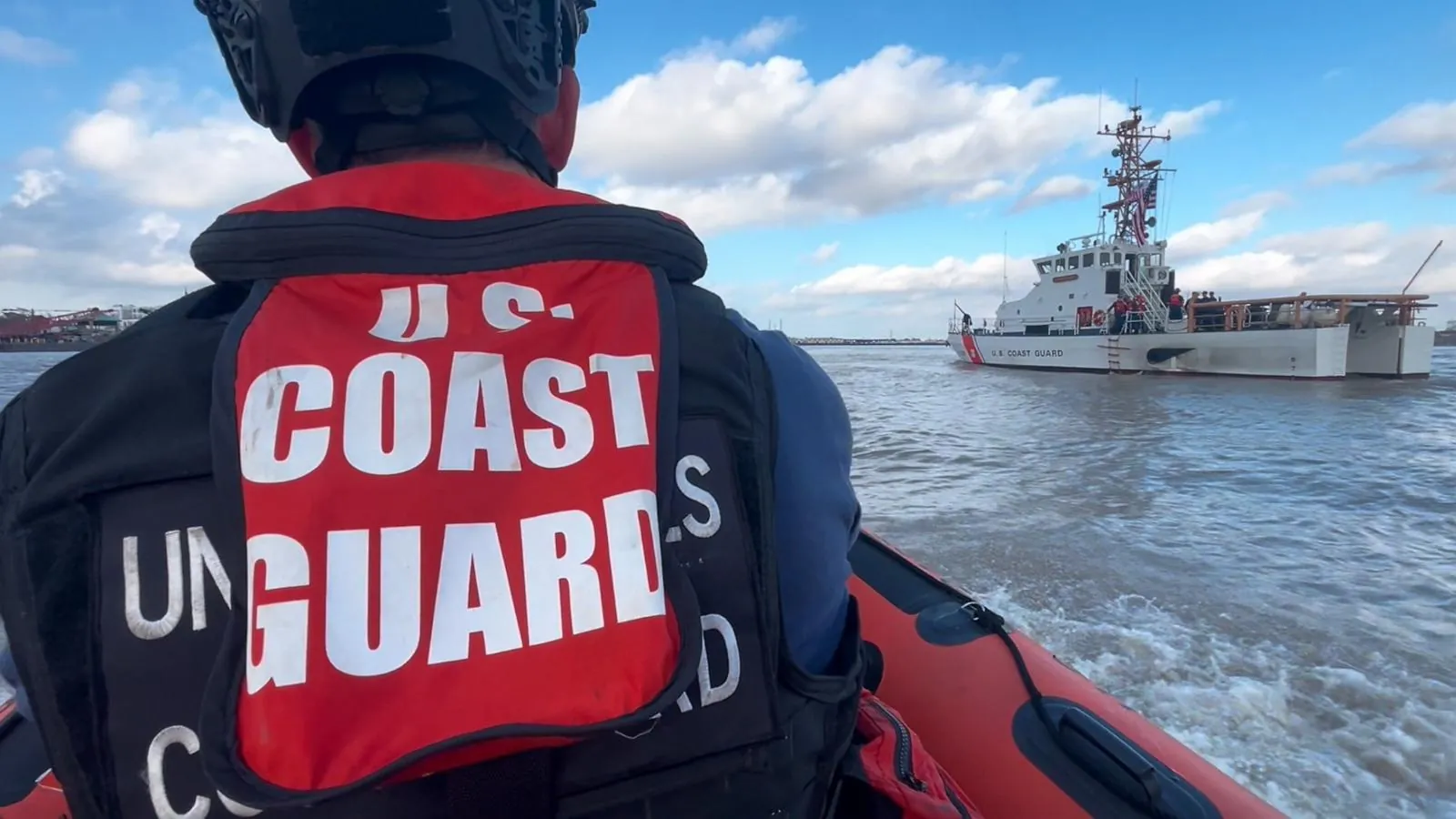
A multi-agency rescue effort deployed U.S. Coast Guard boat and helicopter crews, New Orleans firefighters, Harbor Police, city police officers and commercial tugboats to pull survivors wearing lifejackets or clinging to flotation rings from the roughly 66-degree Fahrenheit (19-degree Celsius) water. The historic riverboat Creole Queen also pulled at least 14 people from the river, WWL Louisiana reported.
River Closure and Federal Investigation
The collision forced the U.S. Coast Guard to close the lower Mississippi River to all commercial vessel traffic between mile markers 93 and 96 at Algiers Point starting at 2:24 p.m. CST on Friday. The New Orleans Regional Transit Authority also suspended cross-river ferry service, and organizers canceled a nearby riverfront festival for the remainder of the day.
At the Friday news conference, Louisiana Gov. Jeff Landry praised first responders and towboat crews for rescuing the ship’s predominantly senior passenger group, calling the survival of everyone aboard a miracle “when you think about the population that was on that cruise ship – and the ability for us to get them off and out of the water.” American Cruise Lines said in a written statement on Friday that “guests and crew were evacuated” from the vessel, adding, “We are deeply concerned for everyone involved.”
Officials have not yet confirmed the cause of the crash. U.S. Coast Guard Sector New Orleans Commander Capt. Melanie Burnham and Mayor Moreno said investigators are examining whether the Atlantic Asphalt experienced a loss of steering before veering into the cruise ship. Tulane University maritime law professor Martin J. Davies told Fox affiliate WVUE that the city avoided a wider disaster because the tanker missed the Crescent City Connection bridge moments earlier.
Built in 2015, the 300-foot American Heritage previously sailed as the Queen of the Mississippi and has more than 80 staterooms. The Atlantic Asphalt (IMO 9798428) is a 17,764 deadweight-ton, Marshall Islands-flagged tanker built to carry asphalt and bitumen, and Vortexa shipping data reported by Argus Media indicated the vessel was ballasting without cargo toward Louisiana when the crash occurred. Public records cited by WWNO list the tanker’s ownership under Chinese and Liberian companies, while The Waterways Journal reported the ship is owned by South Carolina construction entrepreneur Scott Owen Savage.
Friday’s collision recalled the Dec. 14, 1996 crash of the bulk freighter Bright Field, which lost propulsion power on the Mississippi River in New Orleans and struck the Riverwalk marketplace and a hotel, injuring more than 60 people with no fatalities, according to the National Transportation Safety Board (NTSB).
U.S. House Majority Leader Steve Scalise announced Friday that the NTSB will investigate the American Heritage collision alongside the U.S. Coast Guard, while Landry announced a separate state investigation. An NTSB investigative team was assembled Friday to travel to New Orleans, though The Waterways Journal reported their departure was initially delayed by a nationwide Federal Aviation Administration flight ground stop. Burnham said Coast Guard crews are now working to reopen the three-mile stretch of the Mississippi River to commercial navigation.