
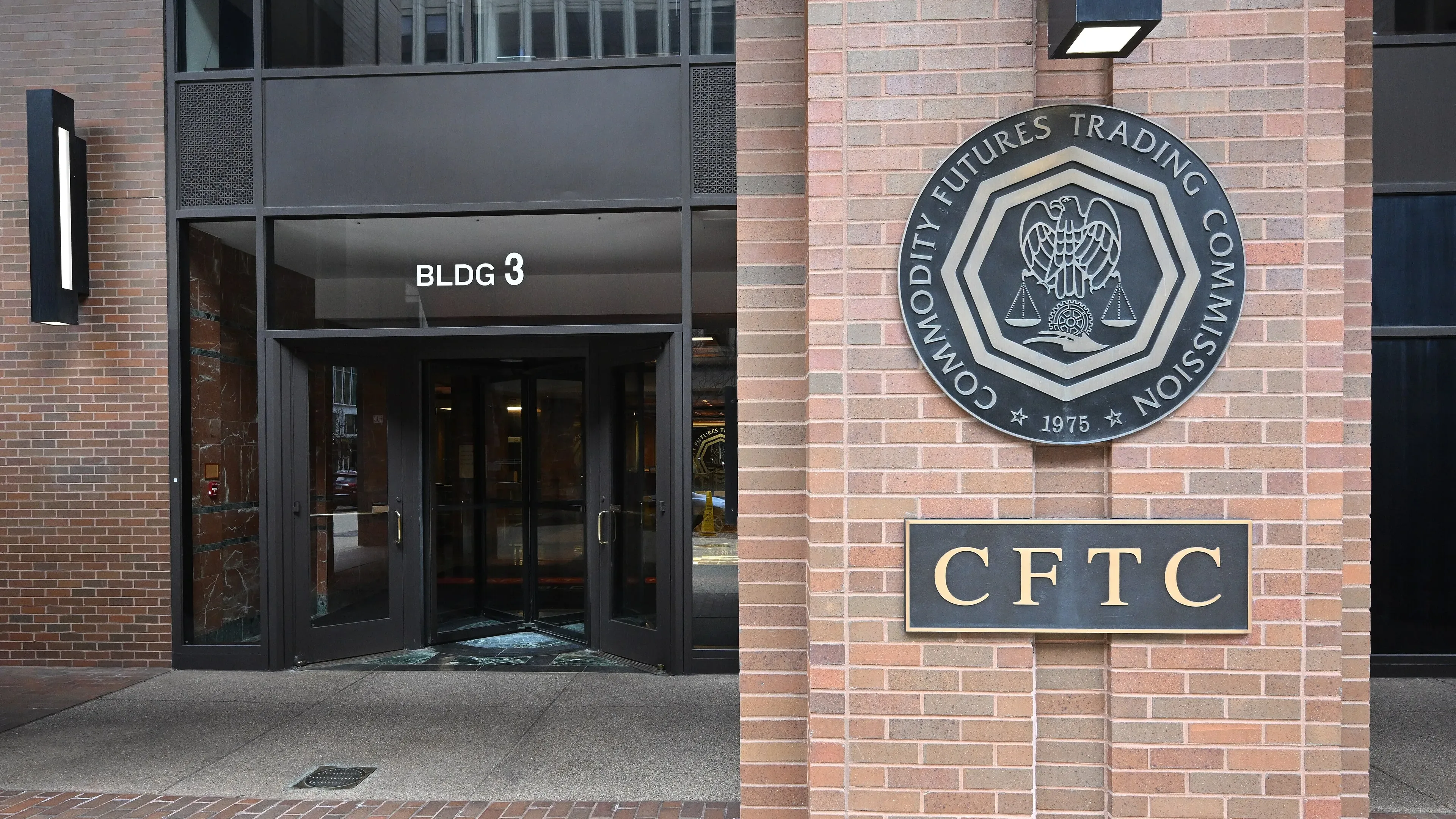
Suppose you want to take a financial position on whether the Federal Reserve will keep interest rates at or above 4.00% at its next meeting, and the contract is trading at $0.40. In the United States, CFTC event contracts on regulated prediction markets let you trade that yes-or-no outcome directly as a federal commodity derivative. A standard contract trades between $0.01 and $0.99 to reflect the market’s implied probability, settles at $1.00 if the event happens or $0.00 if it does not, and caps your maximum possible loss at the cash you put up when you enter the trade.
What makes an event contract a CFTC-regulated derivative?
Under the Commodity Exchange Act, the Commodity Futures Trading Commission regulates prediction market contracts as commodity derivatives rather than wagers. Although the phrase event contract does not appear in the statute itself, the agency has used the term since its May 2008 Concept Release (73 FR 25669) to describe derivative contracts whose payoff is tied to an underlying occurrence or contingency.
The legal hook sits in Section 1a(47)(A)(ii) of the Commodity Exchange Act. That provision defines a swap to include agreements that pay out based on whether an event with a potential financial, economic, or commercial consequence occurs. In the CFTC’s statutory framework, intangible occurrences such as inflation readings, central bank rate decisions, temperature measurements, and political outcomes fall under the category of an excluded commodity.
Any exchange that offers event contracts structured as swaps or futures to the US general public must register with the CFTC as a Designated Contract Market (DCM). Retail participants in the United States may only trade swaps on a registered DCM, such as Kalshi or CME Group. According to the CFTC’s June 2026 Notice of Proposed Rulemaking in the Federal Register, total trading volume across CFTC-registered prediction markets exceeded $25 billion in 2025, operating alongside roughly $31 trillion in total notional value across all CFTC-regulated derivatives markets in 2025.
How are CFTC event contracts priced on prediction markets?
Most CFTC event contracts on prediction markets work like European-style binary options with a fixed payout of $1.00 if the outcome resolves Yes and $0.00 if it resolves No. Contracts trade in $0.01 increments, and every market has two sides whose prices add up to $1.00 before exchange fees. Because the winning payout is fixed at $1.00, the market price in cents translates directly into the crowd’s implied probability: a Yes contract trading at $0.65 (paired with a No contract at $0.35) signals a 65% market-implied probability that the event will happen.
Unlike traditional stock options, where your profit scales with how far an asset’s price moves past a strike price and depends on variables like delta, theta, and implied volatility, a binary event contract pays the exact same fixed amount whether the condition clears the threshold by a fraction of a percent or by a wide margin. While $1.00 is the standard payout on prediction market swaps, CFTC-regulated exchanges also list binary event contracts on futures with larger fixed payouts, such as $20 or $100 per contract on CME Group.
Every position on a CFTC-regulated exchange uses full-value margining, also called full collateralization. Neither the buyer nor the seller trades on borrowed funds, and neither side can ever receive a margin call. According to the 2026 CME Group clearing guidelines for event contract swaps, here is how the math works on a $1.00 binary contract asking whether the lower bound of the Federal Funds target rate range will meet or exceed 4.00% after a Federal Open Market Committee (FOMC) meeting:
| Trade Role | Execution Price | Upfront Cash Outlay (Max Loss) | Payout if Outcome is Yes ($1.00 Settlement) | Payout if Outcome is No ($0.00 Settlement) |
|---|---|---|---|---|
| Buyer (Long Yes) | $0.40 | $0.40 premium paid | Receives $1.00 ($0.60 net profit before fees) | Receives $0.00 ($0.40 net loss) |
| Seller (Short Yes / No) | $0.40 | $0.60 net ($1.00 margin minus $0.40 premium collected) | Loses $1.00 margin ($0.60 net loss) | $1.00 margin returned ($0.40 net profit before fees) |
If the trade executes at $0.40, the buyer pays a $0.40 premium, which is the most the buyer can lose. The seller collects that $0.40 premium and posts $1.00 in initial margin with the clearinghouse, resulting in a net cash outlay of $0.60, which is the seller’s maximum possible loss. Unlike CME FedWatch rate probabilities, which derive implied odds mathematically from 30-Day Fed Funds futures prices, an event contract lets you trade the binary probability directly in dollars and cents.
How does an event contract go from listing to settlement?
Before you can trade a market, a Designated Contract Market must take the contract through four operational stages under CFTC rules:
- Contract filing and self-certification: Under Section 5c(c) of the Commodity Exchange Act and CFTC Regulation 17 CFR 40.2, a registered DCM can list a new event contract by submitting a written self-certification to the CFTC before the open of business on the business day preceding the initial listing. Alternatively, the exchange can voluntarily submit the contract for prior CFTC approval under 17 CFR 40.3. The filing must specify the exact underlying question, expiration timestamp, position limits, and an objective settlement source, such as an official central bank release or certified government data.
- Order-book matching and collateral lock: Once listed, participants submit bids and offers to an electronic central limit order book that matches trades by price and time priority. When a Yes buyer and a No buyer (or Yes seller) match, the clearinghouse locks in the full $1.00 of combined collateral per contract.
- Continuous trading before expiration: You do not have to hold an event contract until the event occurs. As news breaks and probabilities shift, you can sell your contract on the order book (or buy the opposing side) at the current market price to lock in a gain or limit a loss before expiration.
- Verification and cash settlement: At expiration, the exchange clearinghouse checks the outcome against the authoritative data source named in the contract rulebook. The clearinghouse credits $1.00 per contract to the winning side, settles the losing side at $0.00, and releases any remaining margin.
Which event contracts are prohibited or restricted by the CFTC?
Self-certification does not give an exchange a blank check to list any topic. Under Section 5c(c)(5)(C) of the Commodity Exchange Act and CFTC Regulation 17 CFR 40.11, exchanges are barred from listing event contracts that involve five enumerated activities—terrorism, assassination, war, gaming, or any activity that is unlawful under federal or state law—if the commission determines those contracts are contrary to the public interest.
If a newly certified contract appears to touch one of those prohibited categories, the CFTC can stay the listing or trading of the contract under 17 CFR 40.11 for a 90-day public-interest review. Exchanges also screen out contracts that lack an objective verification source or can be easily manipulated by a single individual, such as what a speaker will say during a live broadcast.
Because event contracts are regulated swaps under federal law, DCMs must enforce Know Your Customer (KYC) identity verification, maintain audit trails, set position limits, and run automated market surveillance. Both the CFTC and the US Department of Justice prosecute insider trading and market manipulation on event contracts when traders misuse material non-public information or attempt to rig an outcome.
What do traders get wrong and how do rules vary by jurisdiction?
Even experienced options and futures traders run into structural surprises when they move to binary event contracts:
- Expecting a stop-loss order to protect you at expiration: While you can sell early in an active order book, an event contract does not glide smoothly toward zero at settlement. Once the official outcome is announced, the contract price jumps immediately to $1.00 or $0.00, meaning a stop-loss order cannot save a losing position held into resolution.
- Assuming CFTC registration means every contract was pre-approved: Because 17 CFR 40.2 allows exchanges to self-certify contracts one business day before listing, many contracts begin trading without prior CFTC sign-off, though the agency retains authority to stay or suspend them afterward.
- Confusing regulated US exchanges with offshore crypto markets: Onshore DCMs clear trades centrally in US dollars with mandatory KYC checks. By contrast, offshore blockchain prediction markets settle peer-to-peer on-chain using automated market makers and smart-contract oracles outside US retail registration. Polymarket, for instance, paid a CFTC penalty in 2022 for operating unregistered event markets before receiving an amended CFTC order of designation for a regulated US venue in November 2025.
Legal access and classification also change sharply depending on where you live as of 2026:
- United States federal circuit split on sports contracts: While the CFTC asserts exclusive federal jurisdiction over swaps on registered DCMs, US federal appeals courts split in 2026 over whether sports-related event contracts preempt state gambling laws. In April 2026, the Third Circuit ruled in favor of federal preemption, whereas the Ninth Circuit (August 2026) and Sixth Circuit (September 2026) held that sports-event contracts are not swaps under the Commodity Exchange Act and remain subject to state gambling restrictions.
- United Kingdom and European Union: In the UK, the Gambling Commission classifies non-financial prediction markets as betting that requires a betting intermediary license, while financial event contracts fall under the Financial Conduct Authority’s 2019 ban on selling binary options to retail consumers. Across the EU, the European Securities and Markets Authority (ESMA) similarly bans retail binary options, and national gaming regulators in countries such as France and Spain block unlicensed prediction market platforms as unauthorized gambling.
- Canada: Event contracts are not listed on Canadian derivatives exchanges, and under Canada Revenue Agency rules, they do not qualify as eligible investments for tax-advantaged registered accounts such as Tax-Free Savings Accounts (TFSAs) or Registered Retirement Savings Plans (RRSPs).
Because event contracts carry a binary all-or-nothing payoff at expiration and regulatory treatment varies by state and country, treat this overview as general educational information rather than financial or legal advice. Check the specific exchange rulebook, fee schedule, and a licensed tax or financial advisor before committing capital.