
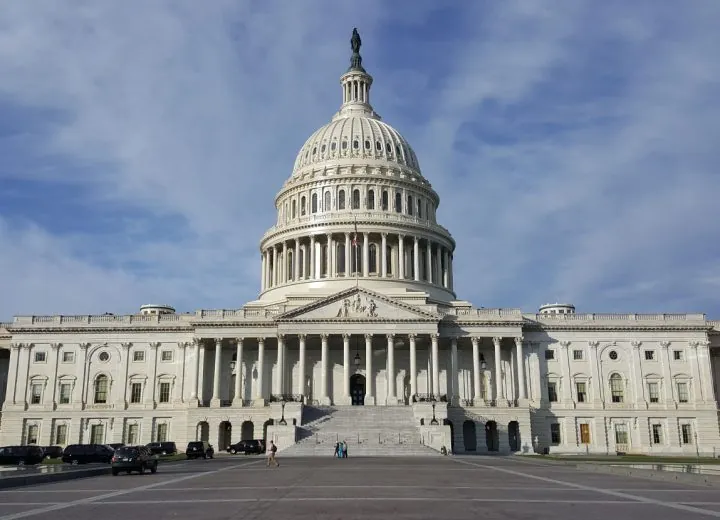
President Trump formally agreed to an ethics provision for the Digital Asset Market Clarity Act on Monday evening, removing the final roadblock before a full Senate floor vote. The conflict-of-interest clause strictly restricts how the president, vice president, and members of Congress can profit from digital assets while holding federal office.
Senate Majority Leader John Thune now faces a tight legislative window. He must schedule the floor vote before the Senate adjourns for its August 8 recess. The bill requires 60 votes to overcome a filibuster. Bipartisan support is a mathematical necessity.
This development follows a decade of regulatory ambiguity that drove many American digital asset firms offshore. The legislative push accelerated with the passage of the GENIUS Act in July 2025. That previous legislation established a federal legal framework for payment stablecoins, setting the foundation for broader market structure reforms that traditional banks are now watching closely.
The CLARITY Act, formally known as H.R. 3633, has a long voting record. The bill previously passed the House of Representatives on July 17, 2025. That was a 294–134 bipartisan vote. It then cleared the Senate Banking Committee 15–9 on May 14, 2026. Coinbase Vice Chair Ryan Vangrack recently stated the legislation is “on the one-yard line.”
Traditional financial institutions are already positioning themselves for the incoming rules. Morgan Stanley’s E*Trade recently opened spot trading for major tokens. That rollout gave 8.6 million retail clients direct access with 0.50% fees.
The 1933 Comparison and the ‘Mature Blockchain Test’
Legal experts are comparing the CLARITY Act to the Securities Act of 1933. They argue it enforces a structural reorganization to standardize the United States digital economy. The core of this reorganization relies on a specific mechanism: the mature blockchain test.
This test establishes strict decentralization criteria to determine exactly when a digital asset transitions from an “investment contract asset” overseen by the SEC to a “digital commodity” governed exclusively by the CFTC. You can review a full breakdown of the mature blockchain test to understand the agency split. The legislation also introduces a specific activity exemption for non-custodial decentralized finance software developers and node operators.
The White House sign-off on July 20 removes the executive branch’s final objection, according to Disruption Banking. Attention now moves entirely to the Senate floor and Thune’s scheduling block before the August recess.