
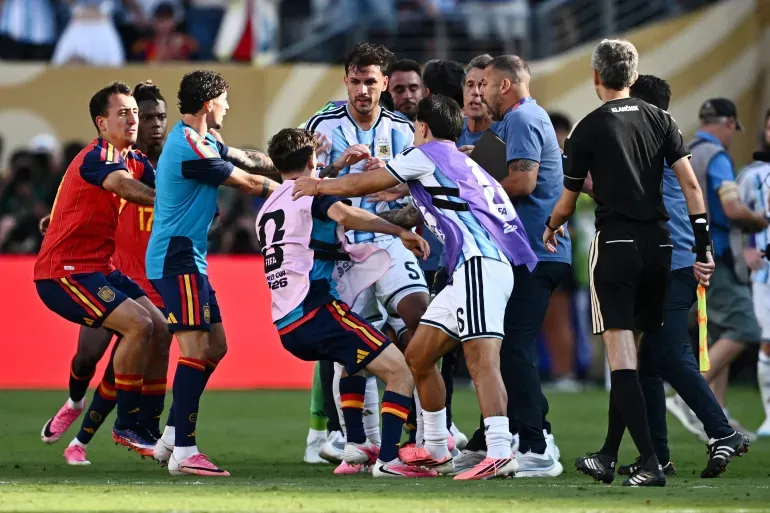
Spain secured a 1-0 extra-time victory over Argentina to win the 2026 World Cup final at MetLife Stadium. But the football world is completely focused on the chaotic violence that erupted immediately after the final whistle. FIFA just appointed a disciplinary and ethics prosecutor to investigate a severe post-match brawl involving multiple Argentine players and coaching staff.
Tensions peaked late in regulation when Argentina midfielder Enzo Fernández received a red card in the 93rd minute. Once Ferran Torres’s goal held up as the winner and the match ended, the frustration spilled over physically. Footage captured Leandro Paredes grabbing Spain’s Eric García by the neck before shoving substitute Gavi straight to the ground. Defender Nahuel Molina then lunged at Rodri. The altercations even pulled in Argentina assistant coach Roberto Ayala, who allegedly attempted to strike Dani Olmo in the middle of the scrum.
The independent disciplinary committee is currently reviewing referee reports and broadcast angles. Authorities will evaluate the conduct under Article 13 of the FIFA Disciplinary Code, while also officially opening a specific Article 36 investigation to determine potential multi-game suspensions and severe financial penalties for the Argentine Football Association.
This collapse on the pitch mirrors the collapse of a historic run. Argentina failed to match Brazil’s 1962 achievement of winning consecutive World Cup trophies. Head coach Lionel Scaloni attempted to downplay the physical confrontations entirely. “Today, we are showing that we know how to lose,” Scaloni told reporters.
Pundits strongly disagreed. Former England goalkeeper Joe Hart called the team’s reaction a “disgusting act.” BBC commentator Alan Shearer took direct aim at the physical lunges from Paredes. “There is no place for such behavior in football,” Shearer said.
The AFA was already under intense regulatory scrutiny arriving at MetLife Stadium. Following their semi-final win over England, Argentine players sparked international political outrage by waving a flag reading “Las Malvinas son Argentinas.” That incident triggered a separate, ongoing FIFA review regarding strict bans on political messaging. Now, the federation faces compounding sanctions from two distinct controversies on the game’s biggest stage.