
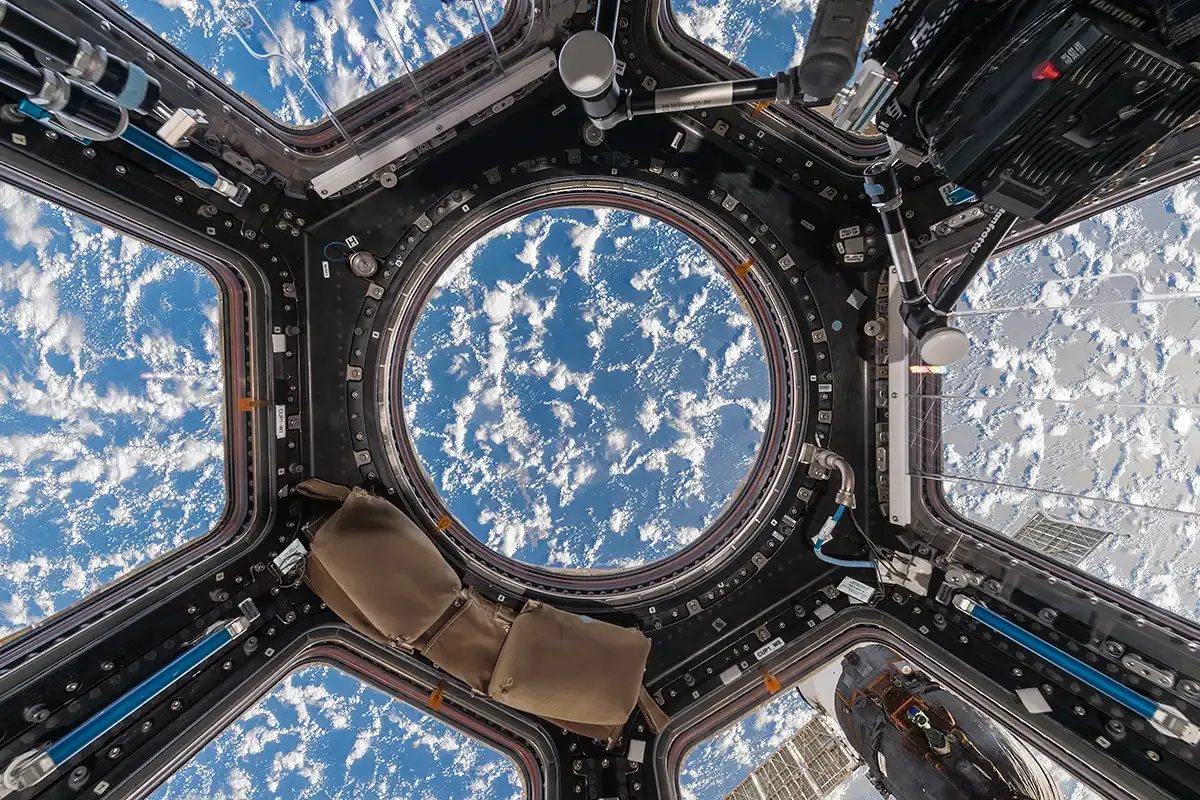
A spacecraft maintains air pressure by sealing its hull tight and constantly injecting a precise mix of gases from high-pressure storage tanks. On board the International Space Station, the environment matches Earth exactly, held firmly at 14.7 psi. But keeping the pressure up is only half the job. The engineering systems must also continuously scrub exhaled carbon dioxide, monitor dangerous trace gases, and split recovered wastewater into fresh oxygen to keep the crew alive in the dead vacuum of space.
The Science Behind Spacecraft Pressurization
Spacecraft engineers design modern life support systems around a very strict sea-level standard. Modern space stations pump a dual-gas atmosphere of nitrogen and oxygen directly into the main cabin. This 14.7 psi (101.3 kilopascals) mix entirely mirrors the air we breathe on Earth.
Early space programs relied on 100% pure oxygen environments at much lower pressures to save launch weight. But pure oxygen makes accidental fires burn incredibly fast. Adding nitrogen provides a stable buffer, eliminating extreme fire hazards while keeping astronauts physically comfortable.
The air inside a sealed spacecraft gets dirty remarkably fast. Every single breath adds carbon dioxide to the cabin. Sweat, off-gassing computer equipment, and biological waste add methane, hydrogen, and trace chemicals. To fix this, an array of sensors constantly pulls air samples from the ventilation shafts. A device called the Major Constituent Analyzer watches the exact ratio of oxygen, nitrogen, carbon dioxide, methane, hydrogen, and water vapor in real time.
When the sensors detect too much carbon dioxide, the air revitalization subsystem kicks into high gear. Fans pull the cabin air through molecular sieves. These are specialized porous materials engineered to catch gas molecules based solely on their atomic size. The carbon dioxide gets trapped inside the sieve, while the clean breathable air passes back out into the cabin.
Astronauts consume oxygen continuously. You simply cannot launch enough compressed air from Earth to supply a crew for a six-month mission. Instead, the spacecraft makes its own. The Oxygen Generation Assembly relies on a standard chemical process called electrolysis.
Solar panels mounted on the exterior of the station generate electricity. The system runs that electrical current through recovered water, physically ripping the water molecules apart. This splits the water into hydrogen gas and breathable oxygen, according to a NASA technical document. The fresh oxygen vents directly into the cabin for the crew to breathe.
Meanwhile, the station slowly leaks gas. No mechanical seal is absolutely perfect in the vacuum of space. To compensate, high-pressure tanks mounted on the outside of the station hull store pure nitrogen and backup oxygen. Pressure control valves open automatically, feeding small bursts of gas into the cabin to maintain the strict 14.7 psi baseline.
Real-World Examples or Applications
Life support technology changed radically over the decades. The earliest human spaceflights used strictly “open-loop” systems. The Mercury, Gemini, and Apollo capsules carried expendable lithium hydroxide canisters to scrub the air. All of their breathing oxygen sat in limited liquid storage tanks. Once the canisters saturated and the tanks emptied, the crew had to come home.
Long-duration spaceflight requires a closed-loop approach. Launching mass into orbit costs a fortune. Sending just one kilogram of water or supplies to the space station costs roughly $21,000. Engineers solved this extreme cost barrier by upgrading the Life Support System with a piece of hardware called a Sabatier reactor.
The Sabatier reactor is a large chemical recycling plant. It takes the hydrogen gas left over from the water electrolysis process and combines it with the carbon dioxide trapped by the molecular sieves. Under high heat, these two waste products chemically react to form methane gas and brand new water. The spacecraft vents the methane overboard into space and dumps the water back into the system. The electrolysis machine then splits that newly created water to make even more oxygen.
Operating different types of spacecraft together creates severe engineering hurdles. In 1975, the United States and the Soviet Union launched the Apollo-Soyuz Test Project. The two nations successfully docked their ships in orbit. But they used completely different atmospheres.
The Soviet Soyuz ran at a normal 14.7 psi with a nitrogen-oxygen mix. The American Apollo module used 100% pure oxygen at a much lower pressure of 5 psi. If astronauts just opened the hatch between the two ships, the sudden pressure shift would cause severe physical trauma.
Engineers built a heavy, specialized docking module to bridge the gap. It worked as an airlock and an acclimatization chamber. Astronauts entered the module, sealed the door behind them, and waited for the pressure to slowly equalize before crossing into the other spacecraft.
What Scientists Still Don’t Know / Current Research
Engineers know exactly how to build a pressurized metal tube in low Earth orbit. Pushing humans into deep space, however, forces physiological limits to the absolute breaking point. The human lung requires strict minimum pressures to function properly.
If the ambient pressure drops below a threshold of roughly 1.68 to 3.46 psi, the lungs physically cannot exchange gases. Worse, at those extremely low pressures, water begins to boil out of human physiological fluids right at normal body temperature. Operating anywhere near this physiological limit requires the immediate use of a fully pressurized spacesuit.
The Soyuz 11 tragedy demonstrated exactly how fragile spacecraft pressurization really is. In 1971, cosmonauts Georgi Dobrovolksy, Vladislav Volkov, and Viktor Patsayev perished during their reentry sequence. A post-flight investigation found that a pressure equalization valve opened inadvertently while the ship was still at an altitude of over 100 kilometers.
The mechanical failure ripped the breathable atmosphere right out of the cabin, venting it into the vacuum of space in seconds. The underlying cause was a mechanical error back in the factory. Technicians installed two redundant pressure relief valves entirely in reverse. This backwards installation caused the automatic shutter to fire prematurely the exact moment the capsule separated from its service module, according to a Federal Aviation Administration report.
Common Myths Debunked
Space movies constantly show astronauts jumping into their spacesuits, throwing open the airlock, and floating outside. This fiction completely ignores how pressure actually works in a vacuum. A very common myth assumes that spacesuits operate at the exact same 14.7 psi pressure as the cabin.
They absolutely do not. A spacesuit is essentially a human-shaped balloon. If you inflated it to 14.7 psi in the vacuum of space, the fabric would become completely rigid. The astronaut would barely be able to bend their elbows or close their fingers around a tool. To stay flexible and useful, modern spacesuits operate at a much lower pressure.
This drastic pressure difference creates a severe physical hazard called decompression sickness, commonly known as the bends. If an astronaut moves straight from the 14.7 psi cabin into a low-pressure suit and steps outside, the sudden pressure drop causes nitrogen gas trapped inside their bloodstream to come out of solution. This forms physical gas bubbles inside their blood vessels and joints.
To prevent decompression sickness, astronauts must follow a strict pre-breathing protocol. They put on oxygen masks and breathe 100% pure oxygen while aggressively exercising inside the airlock. This physically flushes the nitrogen out of their body over several hours. To speed up the process, mission controllers sometimes lower the entire space station’s cabin pressure down to 10.2 psi hours ahead of a planned spacewalk, allowing the crew’s bodies to slowly adjust before they ever open the outer hatch.
Frequently Asked Questions
What is the normal air pressure on the International Space Station?
The internal air pressure on the ISS sits firmly at 14.7 psi (101.3 kilopascals). This creates an environment mathematically identical to the atmospheric pressure found at sea level on Earth.
How do spacecraft generate oxygen in a vacuum?
They make oxygen chemically through a process called electrolysis. The Oxygen Generation Assembly takes electrical current generated by the station’s external solar panels and runs it directly through recycled wastewater. The intense electrical current breaks the water molecules apart into hydrogen gas and fresh, breathable oxygen.
What happens if a spacecraft loses air pressure?
A sudden pressure drop rapidly vents the cabin air into the vacuum of space. Without sufficient ambient pressure, the human lungs cannot exchange gases, causing immediate hypoxia. This specific mechanical failure caused the death of the entire Soyuz 11 crew in 1971 when a faulty valve opened at 100 kilometers altitude.
How do astronauts deal with decompression sickness when doing spacewalks?
Spacesuits operate at much lower pressures than the 14.7 psi spacecraft cabin. To stop dangerous nitrogen bubbles from forming in their bloodstream during this extreme transition, astronauts pre-breathe 100% pure oxygen and perform exercise routines. This physically purges the nitrogen gas from their bodies before they exit the airlock.