
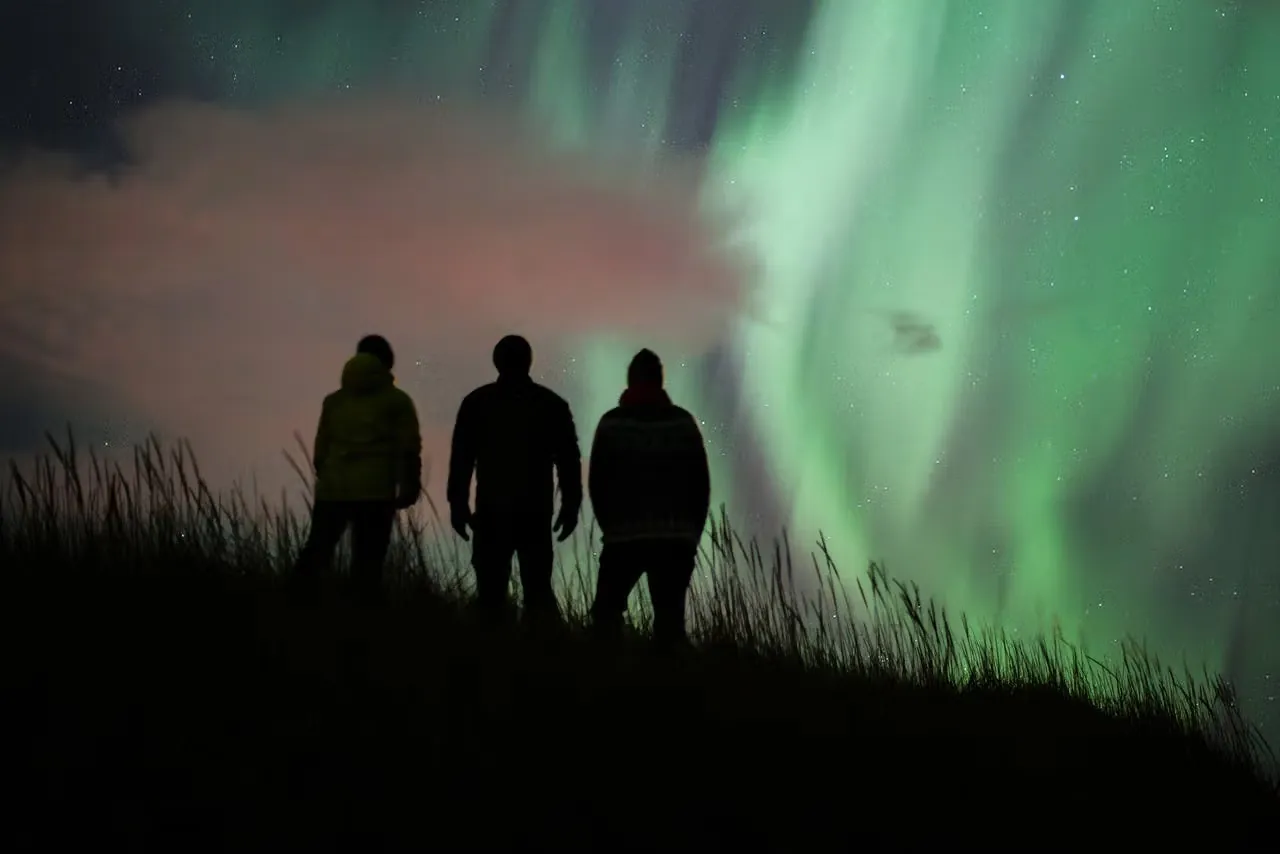
The Northern Lights happen when charged particles from the Sun smash into Earth’s upper atmosphere at high speeds. During periods of high magnetic activity, the Sun ejects massive clouds of magnetized plasma and energetic particles. Most of this material simply bounces off our planet’s magnetic shield. But some of it leaks through, funnels toward the North and South Poles, and collides with oxygen and nitrogen atoms in the air. These collisions transfer energy to the atoms. As the atoms return to their normal state, they release photons of light, creating the glowing auroras we see from the ground.
The Science Behind the Auroral Oval
The Sun constantly blows a stream of charged particles called the solar wind out into the solar system. Sometimes, the Sun gets much more aggressive. It erupts with intense bursts of energy known as solar flares. During these active periods, it also shoots out massive clouds of magnetized plasma called Coronal Mass Ejections, or CMEs.
When a CME heads in our direction, it hits Earth’s magnetosphere. This is our planet’s protective magnetic bubble. The magnetosphere deflects the vast majority of the incoming energy. However, some energetic particles slip past the shield.
These particles get caught in our magnetic field lines. They accelerate downward toward the poles at nearly one-tenth the speed of light. They slam into the thin upper atmosphere in a ring-shaped zone around the poles known as the auroral oval.
The fast-moving electrons travel down magnetic lines to excite atmospheric gases upon impact. The atoms absorb this energy, entering an excited state. They cannot stay in this state forever, so they release the excess energy as photons of light.
The specific colors you see in the sky depend entirely on two factors. The first is the type of gas molecule involved in the collision. The second is the altitude at which the impact occurs.
The most common color for an aurora is a pale green. This happens when the incoming solar particles strike atomic oxygen roughly 60 miles above the Earth’s surface. At this height, the concentration of oxygen is just right to produce that distinct green glow.
Red auroras are much rarer. They also come from excited oxygen, but they occur at much higher altitudes, typically above 300 kilometers. Up there, the atmosphere is incredibly thin. This lack of density allows the excited oxygen atoms to survive longer before they finally emit a red photon.
Blue and purple colors appear when the solar particles interact with nitrogen molecules. These colors usually only show up during periods of particularly strong solar activity. The energetic particles need extra force to penetrate deeper into the atmosphere where nitrogen is more abundant.
Real-World Examples of Extreme Space Weather
Space weather directly affects our technology, and history shows exactly what happens when a major storm hits. The Carrington Event of September 1859 remains the strongest space weather event in recorded history. A huge CME collided directly with Earth’s magnetosphere.
The resulting geomagnetic storm was so intense that the auroral oval expanded far beyond its normal boundaries. People observed the Northern Lights near the equator. Sightings were recorded in Cuba, Hawaii, south-central Mexico, and Colombia.
The storm caused immediate infrastructure failure long before the modern electrical grid existed. The geomagnetically induced currents disrupted global telegraph systems. The surge of electricity shocked telegraph operators, and some telegraph pylons threw sparks and caught fire.
More recently, Earth experienced an extreme geomagnetic storm in May 2024. This storm reached a G5 rating, which is the highest on the NOAA space weather scale. It was the most powerful storm to impact Earth since the Halloween Storms of 2003.
Between May 3 and May 9, 2024, NASA’s Solar Dynamics Observatory recorded an unusual barrage of eruptions. They tracked 82 notable solar flares during that week. These largely originated from two highly entangled sunspot regions designated as AR 13663 and AR 13664.
Several CMEs from these flares bunched up in waves to strike the Earth directly. The intense storm compressed the magnetosphere. This pushed the Northern Lights down to unusually low latitudes once again. Observers captured photos of auroras across the southern United States, including the Florida Keys, as well as northern India and the Yucatán Peninsula.
Current Research and Forecasting Space Weather
Agencies like NOAA and the European Space Agency actively monitor sunspot regions today. They track solar wind speeds and check the orientation of the interplanetary magnetic field. They use this data to issue localized watches and warnings for incoming space weather.
Forecasters still face challenges predicting exact arrival times. The light and radiation from a solar flare reach Earth in just over eight minutes. The physical clouds of plasma from a CME travel much slower, taking anywhere from one to five days to make the trip.
Tracking these incoming storms is an essential task because strong geomagnetic storms heat the Earth’s outer atmosphere. This heating causes the atmosphere to expand outward. The expansion increases drag on low-orbiting satellites, degrading their hardware and shortening their lifespan.
These storms also disrupt high-frequency radio communications. They degrade the precision of GPS measurements, which affects everything from commercial aviation to agricultural machinery.
Astronaut safety is another major focus of current research. Earth’s atmosphere and magnetic field act as an impenetrable shield for humans on the ground. Astronauts aboard the Space Station, or those on future lunar missions, do not have this natural protection. They face significant radiation risks from high-energy particles if they are outside their protective habitats during a flare or CME.
Common Myths Debunked
Many people believe that a solar flare alone causes the Northern Lights. Flares are intense bursts of electromagnetic radiation. While they happen at the same time as CMEs, the Coronal Mass Ejections are the actual massive clouds of plasma that trigger severe auroral displays.
Another frequent misunderstanding is that solar flares and geomagnetic storms physically harm humans on Earth. Our thick atmosphere and robust magnetic field protect terrestrial life. You are completely safe from the high-energy radiation and charged particles generated by the Sun while standing on the Earth’s surface.
Frequently Asked Questions
How long does it take for a solar flare to reach Earth?
The electromagnetic radiation from a solar flare travels at the speed of light, reaching Earth in just over eight minutes. However, the Coronal Mass Ejections (CMEs)—the massive clouds of plasma that trigger severe auroral displays—travel much slower. They typically take anywhere from one to five days to reach Earth. This delay gives scientists time to issue space weather forecasts and warn grid operators.
What causes the different colors in the Northern Lights?
The colors of an aurora are dictated by the type of atmospheric gas colliding with solar particles and the altitude of the collision. Oxygen causes the common green glow at roughly 60 miles up. It also produces rare red hues at much higher altitudes. Nitrogen creates blue and purple colors, which are usually visible only during intense solar storms when particles penetrate deeper into the atmosphere.
Can solar flares affect human health on Earth?
No. For individuals on the surface of the Earth, major space weather events and solar flares are not directly dangerous. Earth’s robust magnetic field and thick atmosphere shield terrestrial life from the high-energy radiation and charged particles generated by the Sun.