
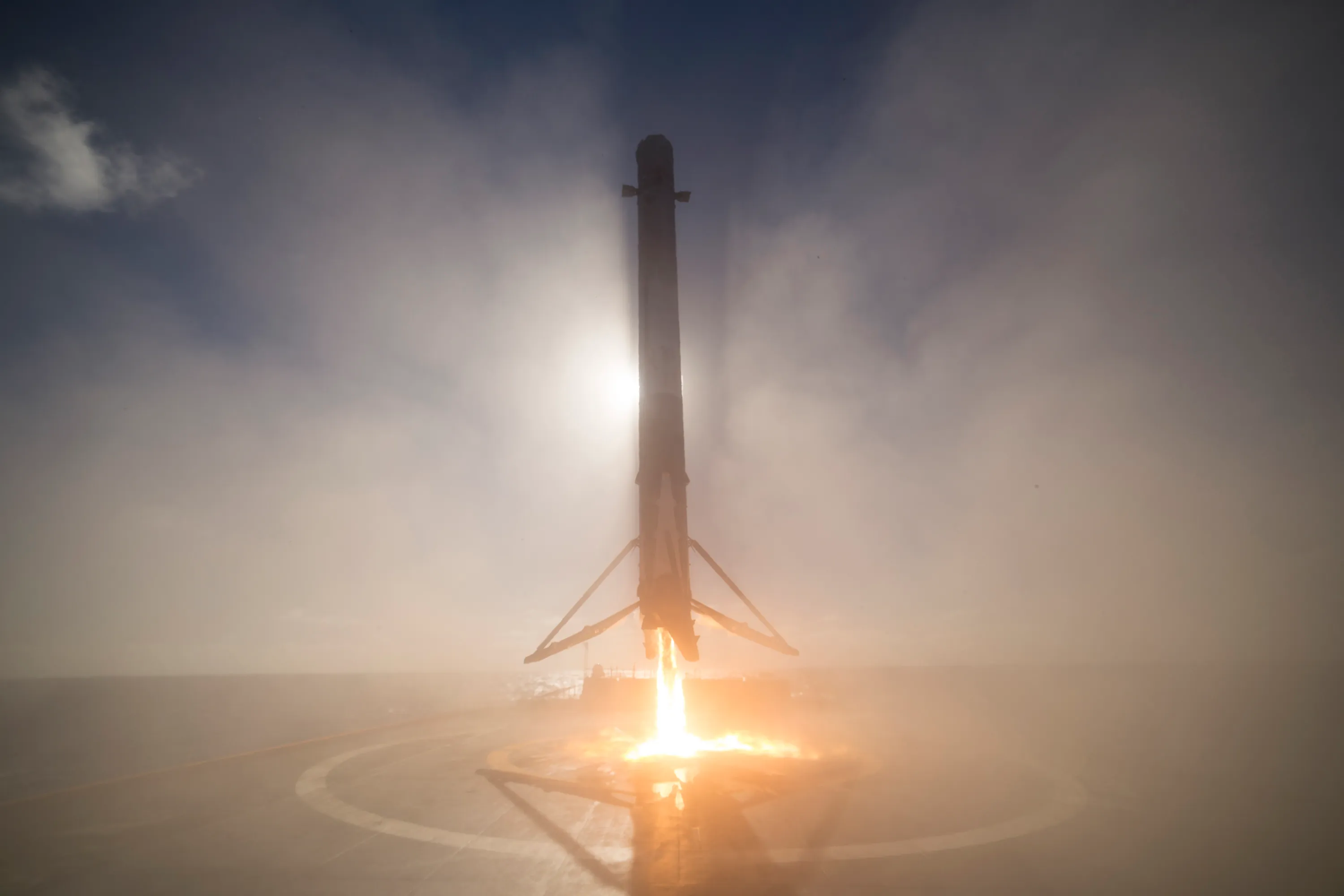
A reusable rocket lands back on Earth through a highly coordinated sequence of engine firings, aerodynamic steering, and specialized capture hardware. Instead of falling into the ocean as trash, the booster detaches from its payload, flips around in space, and fires its engines to reverse course. As it falls back through the atmosphere, hypersonic fins steer its descent. In the final seconds, a final engine burn scrubs off all remaining speed so the rocket touches down gently on a concrete pad, an ocean drone ship, or into the mechanical arms of a launch tower.
For decades, aerospace engineers treated rockets like single-use packaging. You built a highly complex, multi-million dollar machine, flew it once, and let it burn up or crash into the sea. Reusability completely changed how the aerospace industry approaches orbit. But making a multi-ton metal cylinder fall from space and land upright on a target the size of a helipad requires extraordinary precision.
The Science Behind Reusable Rocket Landings
Getting a booster back to the ground intact requires hardware that traditional, expendable rockets never needed. First, the vehicle needs robust thermal protection. Plunging through the atmosphere from the edge of space creates extreme heat and air pressure. Engineers apply ablative coatings and heavily reinforce external parts. Antennas and steering mechanisms must stay attached in the face of supersonic winds.
Next, the rocket needs a way to fly through the air. You cannot steer a falling metal tube with engines alone. Engineers equip boosters like the Falcon 9 with four hypersonic grid fins near the top of the booster, right at the interstage base. These metal grates deploy outward after the rocket separates from its upper stage. The fins change the rocket’s center of pressure so onboard flight computers can control the aerodynamic reentry with exact precision.
The actual descent relies on a sequence of three specific engine firings. Timing is everything.
- The Boostback Burn: About two to three minutes into flight, the first stage separates from the upper stage. The booster flips over and ignites a subset of its engines. This stops its forward momentum and pushes the rocket back toward the spaceport.
- The Entry Burn: Falling from the edge of space means picking up extreme speed. Between 70 and 40 kilometers (43 to 25 miles) above Earth, the rocket fires engines again. This slows the booster down before it hits the thickest, densest parts of the atmosphere. Without this burn, the rocket would burn up from intense atmospheric friction.
- The Landing Burn: Right before touchdown, the rocket fires its engines one last time. This final deceleration scrubs off all remaining terminal velocity. The goal is to reach exactly zero altitude at exactly zero velocity just as the rocket meets the landing pad.
For the actual touchdown, the rocket must have capture hardware. The Falcon 9 uses four extensible landing legs attached around the base that fold out at the very last second. Newer, heavier designs take a different approach entirely to shed the extra weight of metal legs.
Real-World Examples and Economics
SpaceX pushed rocket reusability into standard practice with the Falcon 9. This 41.2-meter booster creates a distinct triple sonic boom as it comes back through the atmosphere. The system works so consistently that the Falcon 9 fleet routinely logs well over a hundred flights a year. They land autonomously on terrestrial concrete pads or on robotic drone ships stationed out at sea.
The economics drive this entire engineering effort. Traditional, expendable rockets cost taxpayers and companies billions. NASA’s Space Launch System, for example, costs over $2 billion per single launch. By flying the most expensive part of the rocket back to Earth, companies want to drop the price tag to just a few million dollars per flight.
The newer Starship Super Heavy shows how engineers are scaling this technology. Standing over 400 feet tall when fully stacked, the Starship system pushes reusability to a new extreme. The long-term target for this system is to bring launch costs down to roughly $2 to $10 million per launch.
In late 2024, SpaceX managed to catch a returning Super Heavy booster in mid-air using large mechanical “chopstick” arms built onto the launch gantry. This design drops the heavy landing legs entirely to save weight. During a recent May 2026 test flight, a redesigned 407-foot version of the Starship successfully executed a controlled return, opting for a precise ocean splashdown rather than a tower catch to test upgraded grid fins and fuel systems.
Because these flights are cheaper, companies can launch rockets frequently. This high launch cadence allows companies to build mega-constellations of satellites. The Starlink network alone aims to eventually deploy up to 42,000 satellites into low Earth orbit.
What Scientists Still Don’t Know / Current Research
Reusable rockets solve a major space debris problem. Because the boosters are not thrown away, fewer dead rocket parts end up littering Earth’s orbit or sinking to the bottom of the ocean. This limits the amount of spacefaring cleanup needed. But the rapid increase in launch frequency creates new environmental questions.
Scientists are currently studying how high launch volumes impact the atmosphere. Some climate models suggest that a high cadence of hydrogen-fueled reusable rockets could push more water vapor into the stratosphere. Current research points to a potential increase in stratospheric water vapor of around 10 percent.
This extra water vapor could enhance polar mesospheric clouds. Researchers also want to know if these emissions might reduce the globally averaged ozone column. The aerospace industry and atmospheric scientists continue to measure exactly how these exhaust plumes behave at high altitudes over time, as this might offset some of the initial sustainability benefits of reusability.
Common Myths Debunked
Many people think a returning rocket just falls out of the sky like a rock until the engine turns on at the last second. The booster actually flies like an airplane for much of its descent. Even without the engines firing, the grid fins use aerodynamic pressure to steer the rocket miles across the sky to perfectly align with the landing pad.
Another myth is that rockets always do the full three-burn sequence. If a rocket is launching a heavy payload into a high orbit, it might not have enough leftover fuel to turn around and fly back to land. In these cases, engineers skip the boostback burn. The rocket simply continues on its forward trajectory and lands on an autonomous drone ship waiting out in the ocean.
Frequently Asked Questions
Why do rockets do a boostback burn?
A boostback burn is executed shortly after stage separation to halt the booster’s forward momentum and reverse its trajectory. This guides the rocket back toward its original spaceport on land. If the rocket is instead aiming for a drone ship stationed out in the ocean along its flight path, the boostback burn may be skipped or shortened to save fuel.
Why does the Falcon 9 perform a burn high up in the atmosphere?
This is known as the entry burn. It occurs between 70 km and 40 km above Earth to drastically slow the booster down before it hits the thickest, densest parts of our atmosphere. If the rocket hit the dense air at full speed, the aerodynamic friction and heat would destroy the vehicle.
Does the rocket just fall until the very end?
Between the entry burn and the landing burn, the rocket effectively falls, but it is never out of control. It uses its deployable grid fins to “fly” and actively steer itself through the air. The booster utilizes this aerodynamic guidance to precisely target the landing zone before firing the final landing burn to scrub off the remaining speed.