
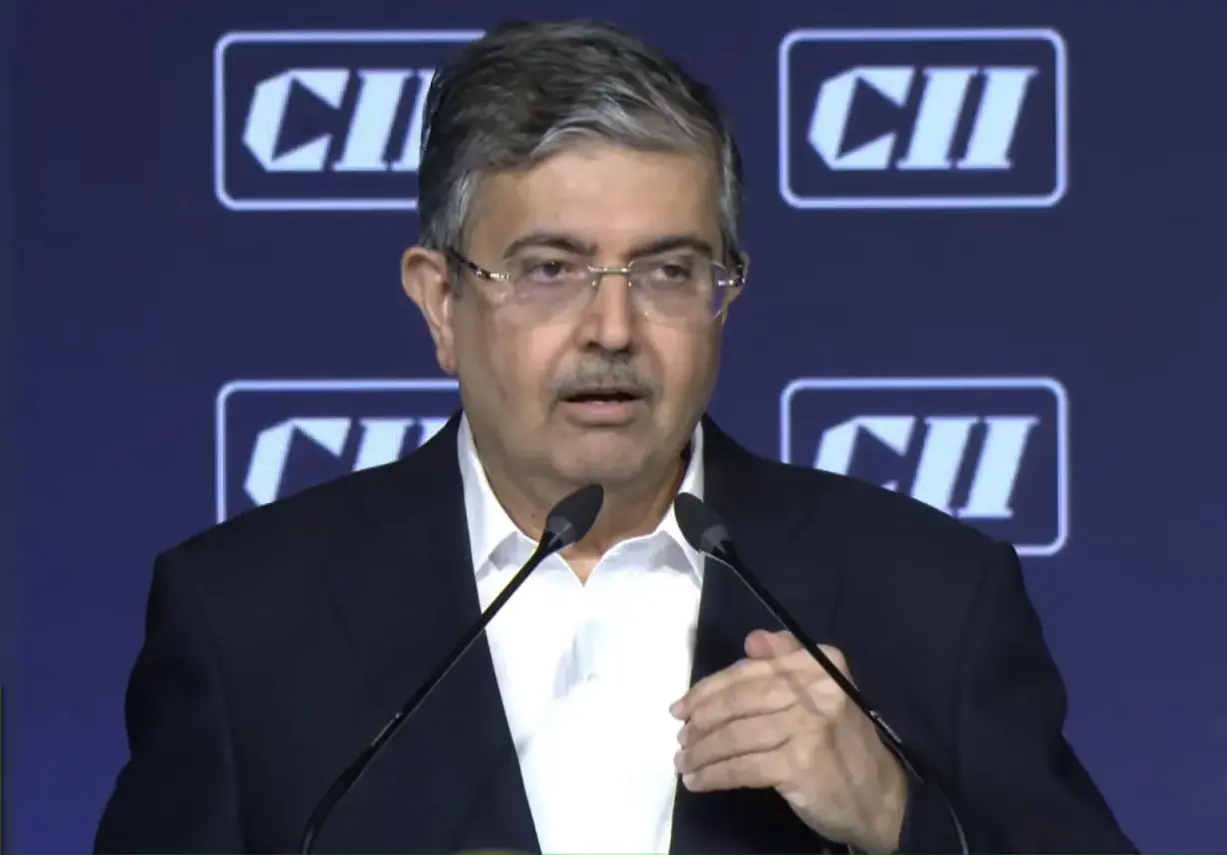
India must prepare for a severe economic shock as the escalating US-Iran war tears through global energy markets and upends decades of trade stability. Kotak Mahindra Bank founder Uday Kotak issued this stark warning during the CII Annual Business Summit, noting that the nation is currently in a false sense of security. While domestic consumers have not yet felt the full impact of surging crude prices, Kotak signaled that the “comfort zone” for Indian business leaders and policymakers is officially over.
The macro-economic catalyst is a direct result of the military conflict in the Middle East, which has pushed crude oil benchmarks toward $115 per barrel. Kotak explained that the current stability at Indian petrol pumps is artificial and unsustainable. He highlighted that older inventories and government-backed price suppression have acted as a temporary buffer. But that buffer is evaporating fast. If oil remains above the $100 mark, India’s Current Account Deficit (CAD) is projected to balloon to 2.5%, a massive jump from the stable 1% seen when prices hovered around $60.
Oil Marketing Companies Face Massive Daily Losses
The financial strain is already visible behind the scenes of the state-run energy sector. Union Petroleum Minister Hardeep Singh Puri confirmed the gravity of the situation at the same summit. He revealed that Indian oil marketing companies are losing ₹1,000 crore every single day to keep fuel prices from skyrocketing for the general public. These under-recoveries are expected to reach nearly ₹2 lakh crore for the current quarter alone. While the government maintains a 60-day strategic crude reserve and $703 billion in forex, the rate of depletion is a growing concern for the industry at large.
Political tensions are rising alongside the economic metrics. Opposition leaders have criticized the government for delaying these warnings until after key state elections. They claim the sudden talk of austerity is a precursor to a massive fuel price hike that will disproportionately affect middle-income families. Prime Minister Narendra Modi has already called for national austerity, urging citizens to reduce gold consumption and work from home where possible to save energy. Kotak supported this move, suggesting India must now be managed with the disciplined mindset of a corporate balance sheet.
The End of the Davos Mindset
Kotak believes this conflict marks a permanent shift in how the world operates. He argues that the global order is abandoning the collaborative Davos mindset in favor of a pre-1945 tribal world order. In this new era, nations are aggressively competing for physical assets and geographic chokepoints. This fragmentation makes global supply chains fragile and predictable growth a thing of the past.
To survive this transition, Kotak urged Indian executives to adopt “strategic paranoia.” This involves preparing for worst-case scenarios even when the current data looks manageable. He advised companies to move away from purely “preserving” value and instead focus on creative destruction. Reliance on old models of growth will not work in a world where the Strait of Hormuz is a volatile combat zone.
The Death of Global Cooperation and India’s New Strategic Paranoia
The warning from Uday Kotak signals more than just a temporary spike in inflation; it marks a fundamental break from the globalization era that defined the last thirty years. By comparing the current geopolitical climate to the “tribal” world order of the pre-1945 era, Kotak is highlighting a specific historical connection where physical control of resources overrides digital or financial connectivity. For the Indian reader, the clear takeaway is that the “soft landing” narrative often used by central banks is likely dead. Businesses can no longer rely on the “Vishnu” mindset of preservation. The paradigm shift required now is one of radical adaptation. If India’s CAD hits the projected 2.5%, the rupee will face immense downward pressure, forcing a complete rethink of import-heavy growth strategies. This is no longer a localized energy glitch; it is the beginning of a prolonged era of resource nationalism where “strategic paranoia” becomes the only viable corporate defense.