
The struggle to find truth in the aftermath of a tragic accident often runs into roadblocks. But what happens when the very technology involved holds the key, and its maker seems to guard it closely? This is exactly what unfolded in a Florida courtroom. The story involves a fatal Tesla accident, hidden data, and an unlikely hero: a hacker who broke through digital barriers to reveal crucial evidence.
A Life Lost, Data Vanished
On the night of April 25, 2019, tragedy struck in Key Largo, Florida. A Tesla vehicle hit Naibel Benavides Leon, 22, and her boyfriend. Naibel died, and her boyfriend suffered severe injuries. To understand the crash, investigators needed a “collision snapshot.” This detailed electronic record, stored on the Autopilot computer, captured the moments of impact. It was the digital memory of what the car “saw.”
Yet, getting this information proved almost impossible. Court papers showed a strange practice by Tesla. After an accident, the critical data went straight to Tesla’s servers. The company confirmed they got it. But the local copy on the car was immediately marked for deletion. This made recovering the data a huge challenge. For months, Florida authorities and the victim’s legal team tried without luck to get this vital information.
A Tesla service technician looked at the navigation unit instead of the Autopilot computer. He gave investigators files he called “corrupted” before anyone could really analyze them. Experts and even people inside Tesla warned against plugging in the Autopilot unit. They feared it could trigger software updates, which would permanently erase any stored evidence. This left a huge hole in the investigation, creating a digital wall around the truth.
The Hacker Who Cracked the Code
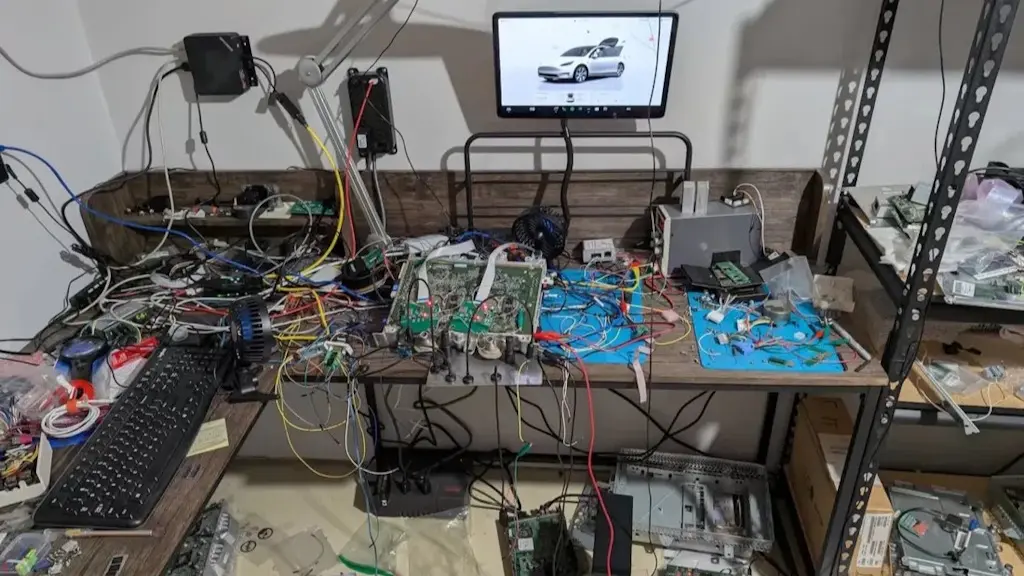
With the court case looming and no data in sight, the prosecution turned to an unusual helper. They called “greentheonly,” a hacker famous for reverse engineering Tesla’s driver assistance systems. His warning to the legal team was stark: connecting the units the usual way would be a “fatal error.” He bluntly stated in court, “It’s exactly the advice I would give if I wanted to destroy evidence.”
The legal team managed to get the original hardware from the Florida Highway Patrol. “greentheonly” then examined it under careful control. Working from a forensic copy of the Autopilot unit’s contents, and even from a Miami café, he found the collision data in minutes. The information, though marked for deletion, was never truly erased.
This discovery was a breakthrough. It proved the system had recorded pedestrians just before the crash. It also confirmed that Tesla had received the full record almost instantly. Based on this data, a video was created. It showed exactly what the car “saw” in the seconds before the collision, including how it detected the pedestrians at specific distances. This changed everything. The digital ghost was finally laid bare.
Justice and a Costly Lesson
In court, the technical evidence became the heart of the matter. Joel Smith, Tesla’s lawyer, called the company’s data handling “clumsy.” But he denied any plan to hide information. He said, “We thought we didn’t have the data, and then we found out we did.” Tesla’s defense argued the crash was due to a “distracted driver,” not a tech glitch. They insisted their systems were aids, not replacements for human drivers.
However, the prosecution saw things differently. Lead attorney Brett Schreiber argued that Tesla’s failure to provide such critical data suggested more than a simple mistake. He pointed to deep flaws in both the technology and the company’s openness. Schreiber accused Tesla of “misleading investigators” for years, noting their internal systems held the electronic record all along.
The jury found Tesla 33% responsible for the accident. They ordered the company to pay $243 million in damages. Federal Judge Beth Bloom did not find proof that Tesla intentionally hid data. But she ordered the company to cover the data recovery costs. This was because of the unnecessary difficulty the whole process involved. The verdict sent a clear message about responsibility in the age of smart cars.
“greentheonly,” whose work was key to this outcome, shared a somber warning. Tesla has since made its digital systems much more secure. This makes accessing such data far more complex now. The hacker admitted, as reported by The Washington Post, “If an accident like this happened today, I would no longer be able to extract the data.” This suggests that future battles for data transparency might be even harder to win.