
The first private trade mission to be considered fully European (although there is a Spanish-American and another Turkish astronaut among them) on the way to International Space Station (ISS) successfully launched this Thursday from NASA's Kennedy Space Center in central Florida (USA).
The so-called Ax-3 missionfrom the American company Axion space and commanded by the astronaut Michael López-Alegría (of American and Spanish nationality) launched from Cape Canaveral at 4:49 p.m. local time with four crew members on board and will aim to conduct more than thirty scientific experiments in microgravity on the ISS, some of them related to cancer research.
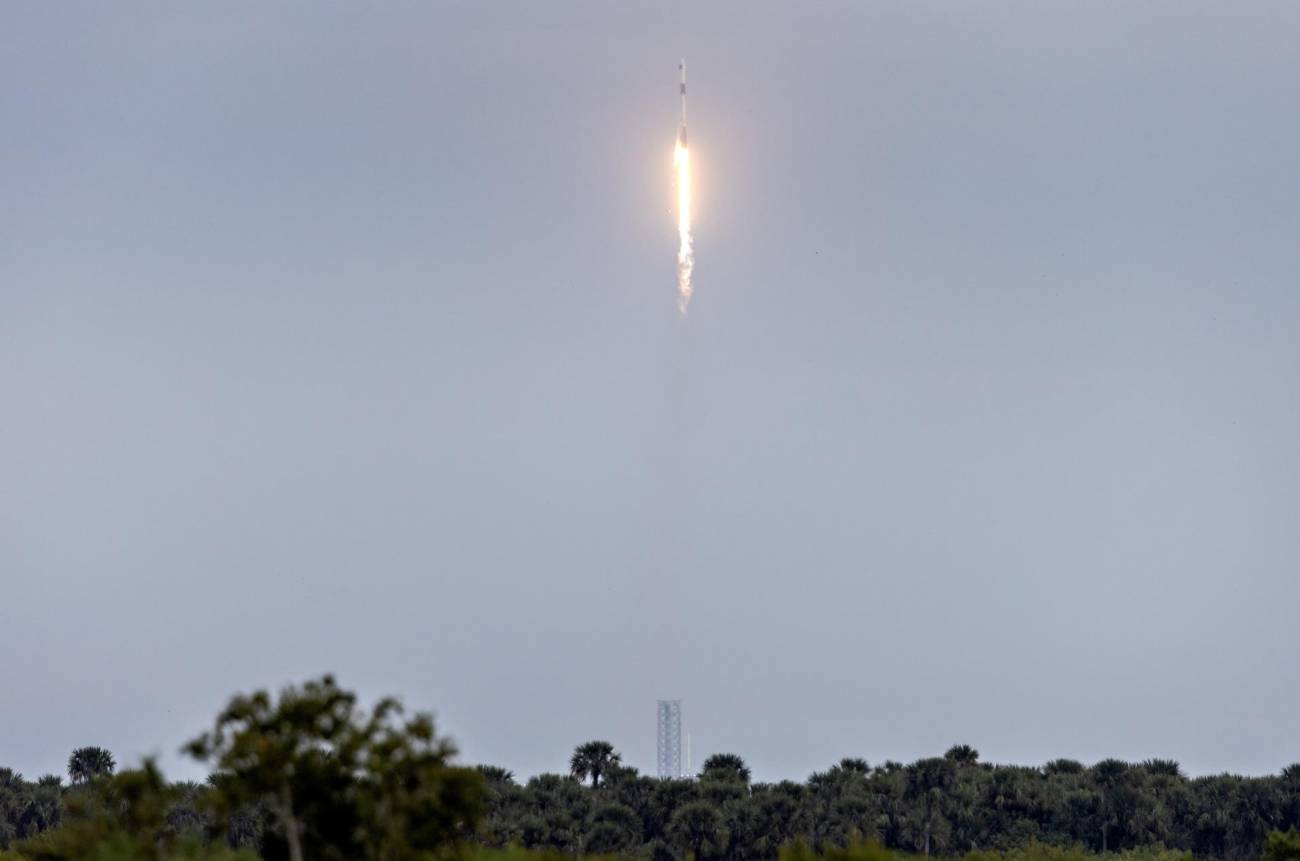
SpaceX's Falcon 9 rocket will launch this Thursday with the crew of the Ax-3 mission. / EFE/EPA/Cristobal Herrera-Ulashkevich
This is the first time that the crew, the stay 14 days in the orbital complex it is European. In addition to López-Alegría, the Italian is also in action Walter Villadei (pilot) and mission specialists Alper Gezeravcithe first Turk to travel into space and the Swede Marcus Wandt the European Space Agency (ESA).
Dragon capsule on a Falcon 9 rocket
The Ax-3 took off at the scheduled time on Dragon Capsule 8 meters high powered by a Falcon 9 rocket reusable two-stage and 70 meters, both from private trading company SpaceXby Elon Musk.
The precise launch of the rocket after completing the engine cooling, retraction and launch phases was met with cheers and applause in the control room.
Just three minutes later, the ship flew into space at a speed of 3,500 km/h and separated from the reusable stage one, completing its return flight to successfully land on a floating platform in the Atlantic Ocean off the coast of Florida.
And about 15 minutes later, the rocket's second stage was fired, after which the four astronauts smiled and gave their thumbs up.
“Congratulations to Axiom and SpaceX on a successful launch! Together with our commercial partners, NASA supports a growing commercial space economy and the future of space technology,” the NASA administrator said in a statement Thursday. Bill Nelson.

Together with our commercial partners, NASA supports a growing commercial space economy and the future of space technology

Nelson emphasized that “it is first purely European commercial astronaut mission to the Space Station,” proof that “the possibility of space connects us all.”
The crew of the commercial mission, sponsored by ESA, will conduct scientific research in the areas of life sciences, human psychology and industrial technological advances.
Some of the results could be used to identify new therapies in the fight against cancer, for example, at an early stage when it is still curable.
Saturday arrival to the ISS
If all goes well, the capsule will dock 36 hours after liftoff from Cape Canaveral at 4:49 a.m. local time (09:49 GMT) on Saturday with the space station, which has been in orbit since 1998 and will operate until 2030. .
The hatches between Dragon and the ISS are expected to open after 11:00 GMT, allowing the Axiom crew to enter the station to be greeted by its seven occupants with a welcoming ceremony and begin their stay in the orbital laboratory.
The Ax-3 astronauts will leave the space station next February 3rdas planned, depending on weather conditions, to return to Earth and land off the coast of Florida.
The private mission will also help advance the development and private use of the International Space Station in this new era, creating a robust and sustainable market low Earth orbit (LEOin English).
This is the fifth flight of the Falcon 9 first booster stage and the third of the Dragon spacecraft, which can accommodate seven passengers and carry significant cargo to Earth.
The reusable Falcon 9 rocket costs $67 million, and SpaceX is offering discounts on multiple launch purchases as well as crew transportation services to commercial customers looking to carry astronauts to LEO.
Axiom Space was founded in 2016 to capitalize on the emerging market for commercial activities in low Earth orbit, from tourism to manufacturing.
Future private space station
The private commercial company plans to operate its own space station, the construction of which it will begin as part of the ISS, with the aim of launching its first module in 2026.
The Ax-3 mission was scheduled to launch this Wednesday, but officials postponed the launch until today to complete a final review and data analysis of the vehicle.
NASA's efforts, including private astronaut missions, open up access to low Earth orbit for private industry and allow the American agency to become one of many customers of a thriving commercial space economy.
Former NASA astronaut López-Alegría, 65, had already led Axiom's first commercial mission in 2022, when he spent 17 days on the ISS. On this occasion it will remain in the orbital complex for two weeks.