
The complex and diverse activities of Brains of mammals, including humans, are controlled by highly specialized neural circuits consisting of numerous Cell types with variable functional properties. To understand how this complex organ works, it is necessary to know in detail the organization and function of this multitude of brain cells and circuits.
Until this year, attempts to study the brain were limited to selected different regions, but the BRAIN Initiative Cellular Census Network (BICCNfor its acronym in English) recently published the first draft of the human brain cell map and now in the journal Nature, Nine articles that provide a detailed analysis of the mouse brain and its cellular diversity.
The package of articles represents the most comprehensive and detailed characterization and classification of cell types of this rodent organ to date. The results allow us to better understand the situation Structure and organization of the brain.
The work provides a tool to continue research into the development and evolution of the mammalian brain in general, including how the organization of different cell types may contribute to neurological disorders that affect humans.
Spatial transcription
In one of the articles, the researchers Zizhen Yao And Hongkui Zeng from the Allen Institute for Brain Sciences (USA) and his colleagues describe how they created the high-resolution brain map from a combination of single-cell RNA sequencing of about 4 million cells transcriptomic data (RNA transcripts or copies of the DNA sequence of a gene) Space of about 4.3 million cells.
This spatial transcriptomics, which allows positioning the different cell types within the brain map, is one of the novelties of the work, an advance made possible thanks to new microscopy techniques applied to histological sections in the brains of mice.
The atlas of cell types is shown in four levels of classification hierarchically organized: 34 classes, 338 subclasses, 1,201 supertypes and 5,322 groups or Clusters.
The results reveal unique features of the organization of cell types in different brain regions: dorsal part contains few but very different cell types, while the ventral part It contains more numerous and more closely related neuronal types. Transcription factors are found to play a role in classifying cell types throughout the brain.
Also through spatial transcriptomics and a technique called Slide-seq (allows RNA transcripts to be positioned using DNA barcodes), another team led by the researchers Evan Macosko And Fei Chen The Broad Institute (MIT and Harvard) discovered approximately 90% of all cell populations in the mouse brain, revealing the remarkable cell diversity in little-understood brain regions, particularly the midbrain, pons, medulla, and hypothalamus.
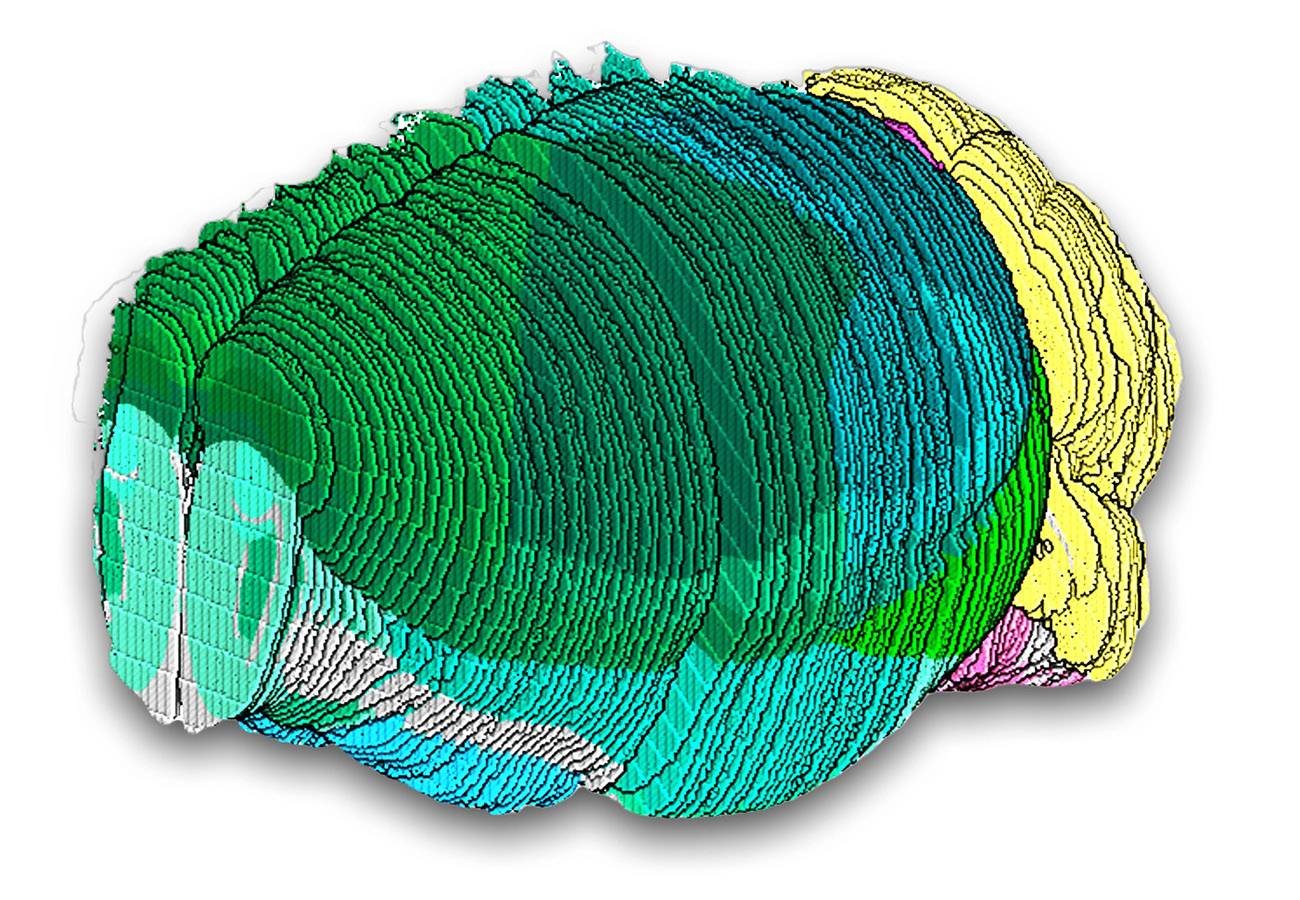
The researchers analyzed 101 slices of mouse brain, gaining a deep and comprehensive look at the cell types throughout the brain (including their colored regions). / Macosko and Chen laboratories
“We suspected that the greatest diversity would be found in these areas, so we prioritized them in our profile,” explains Macosko, “and much of what the brain actually does is found in these fundamental areas, which are comparatively different have received very little attention on this.” to the cortex; our results highlight the need to study them further.”
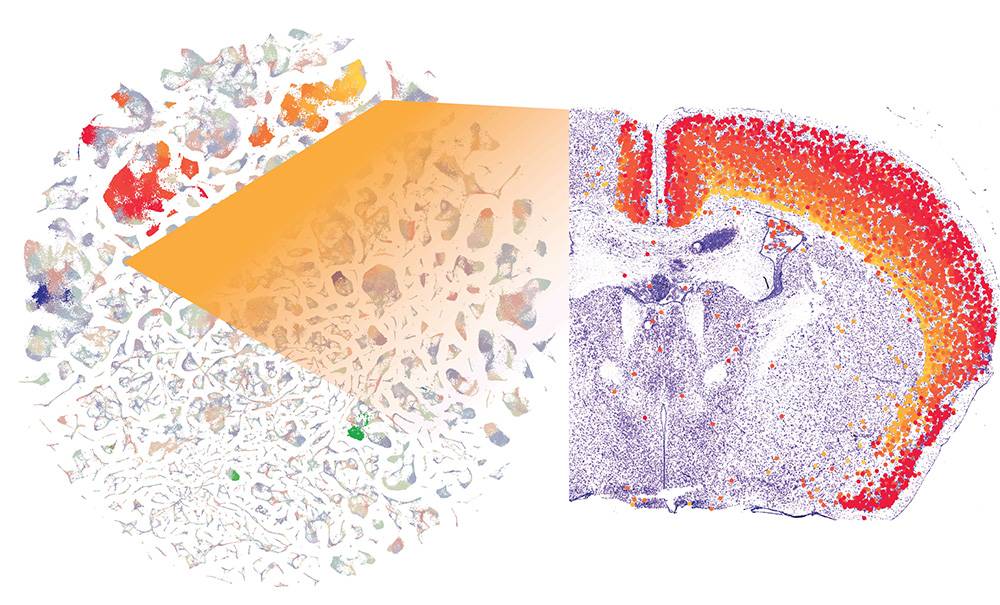
Example of mouse brain cell types and their location. / Chen and Macosko Laboratories
In another article, Joseph Ecker from the Salk Institute for Biological Studies, Bing Ren from the University of California at San Diego and other authors compare this Gene regulation in a brain region, primary motor cortexfrom humans, macaques, marmosets and mice.
In this way, they found conserved features of genetic variants associated with multiple sclerosis, anorexia nervosa and tobacco addiction in these four mammal species. These results demonstrate the value of brain maps in identifying genetic variants that contribute to neurological diseases and traits.
“This work helps us develop a fundamental understanding of what the brain looks like at the cellular level,” says Ren. “This will enable comparisons between our baseline model and brains with neurological and psychiatric disorders. Such a study of the brain could help us discover new therapeutic approaches for these diseases.”
For his part, Ecker emphasizes the importance of knowing the brains of other mammals: “Humans have evolved over millions of years and share a large part of this evolutionary history with other animals. Data about people alone will never be enough to tell us everything we want to know about how the brain works. Fill in these gaps with other mammal species“We can continue to answer these questions and improve the machine learning models we use by providing them with more data.”
Other work identifies specific genetic characteristics of each cell that influence specific cellular functions, or examines how cell types form connections in different parts of the brain or have evolved in different species.
Cell types of the retina
For example, one of the studies focuses on the cell types associated with the retina of the eye, and the results show a common origin among vertebrates, although they vary widely between different groups. Fish need to be able to see underwater, mice and cats need good night vision, and monkeys and humans have developed very keen daytime vision to hunt and forage for food. Some animals see bright colors, others are content to see the world in black and white.
However, numerous cell types are found across a range of vertebrate species, suggesting that the gene expression programs that define these types likely originate from the common ancestor of jawed vertebrates, these authors conclude Karthik Shekhar from the University of California at Berkeley (USA). In addition, the new detailed map of cell types in the vertebrate retina could also help study human eye diseases such as glaucoma.
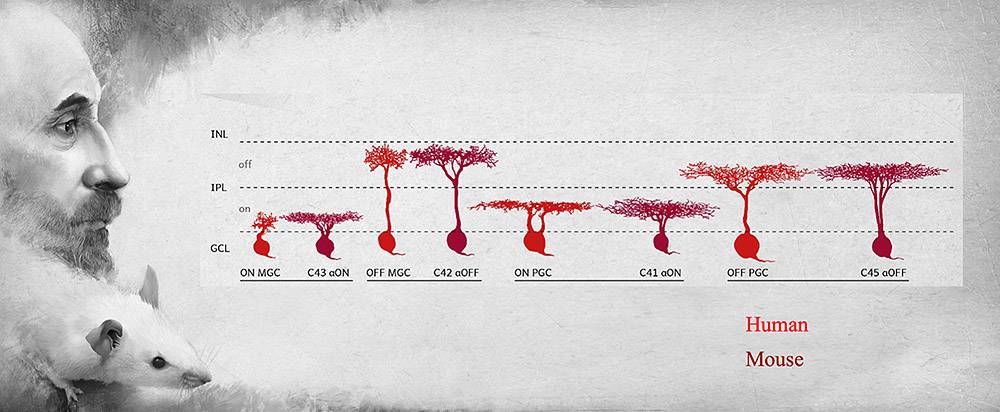
Comparison of human and mouse retinal ganglion cells. / Hugo Salais, Metazoa Studio
“Atlases of cell types are important not only for understanding the architecture of the brain at the cellular level, but also for drawing precise conclusions about brain development,” emphasizes the researcher. Maria Antonietta Tosches from Columbia University (USA) in a parallel article co-authored with Heather Lee from the University of Newcastle (Australia), which concludes: “The work presented in this issue has laid a solid foundation for many important discoveries in neurobiology and neurological diseases.”
References:
Hongkui Zeng et al. “A high-resolution transcriptomic and spatial atlas of cell types throughout the mouse brain.”
Evan Macosko et al. “The molecular cytoarchitecture of the adult mouse brain”
Xiaowei Zhuang et al. “Molecularly defined and spatially resolved cell atlas of the entire mouse brain”
Edward Callaway et al. “Brain-wide correspondence of neuronal epigenomics and long-distance projection”
Joseph Ecker et al. “Single-cell DNA methylome and 3D multi-omic atlas of adult mouse brain”
Bing Ren et al. “Single-cell analysis of chromatin accessibility in the brain of adult mice”
Bing Ren et al. “Conserved and divergent gene regulatory programs of the mammalian neocortex”
Zhigang He et al. “A transcriptomic taxonomy of mouse brain-wide spinal projecting neurons.”
Karthik Shekhar et al. “Evolution of neuronal cell classes and types in the vertebrate retina”
Nature2023