
Do you know where the main ocean currents are? The health of our planet depends on them.
Ocean currents are bodies of water that are constantly moving in the world’s oceans and have diverse and crucial functions for both the marine environment and the global climate. Archaeological evidence suggests that ancient civilizations such as the Polynesians and Australia’s Aborigines were skilled seafarers who may have used ocean currents to navigate between islands. For example, Polynesians are believed to have used currents to travel between Pacific islands long before the arrival of Europeans.
In the 15th and 16th centuries, knowledge of ocean currents became crucial to European powers such as Portugal and Spain, who were exploring maritime routes to Asia and the Americas. Christopher Columbus, for example, used his knowledge of the currents of the Atlantic to sail to the New World.
Even today, modern navigation still relies heavily on precise knowledge of ocean currents. Oceanography has developed into a science that studies, among other things, currents and their effects on navigation, climate and marine life.
But currents are important for many other reasons, including because they play a crucial role in the distribution of heat on Earth. They transport warm water from equatorial to polar regions and vice versa, which helps regulate coastal temperatures and can have profound effects on weather patterns. An example of this phenomenon is the Gulf Stream, which moderates the climate of Northern Europe.
Currents are also crucial for the distribution of nutrients and oxygen in the oceans. Upwelling is a phenomenon in which currents transport nutrients from the depths to surface waters, which is crucial for marine life. Many marine species rely on currents for their migration and life cycle. Currents can carry plankton and fish larvae to new areas, promoting dispersal and biodiversity.
Unfortunately, currents can carry pollutants and sediments and distribute them over long distances. This can have both negative effects, such as the spread of pollutants, and potentially positive effects, such as the dilution of those pollutants. Climate change brings new dangers. Rising temperatures and melting polar ice are releasing large amounts of fresh water into the oceans, which can change salinity and therefore water density. This could slow or even stop the Atlantic Meridional Overturning Circulation (AMOC), of which the Gulf Stream is an important part. A slowdown could have a significant impact on weather patterns, particularly in Europe, with extreme cold in northern Europe and much hotter in the south.
The most important currents in the world
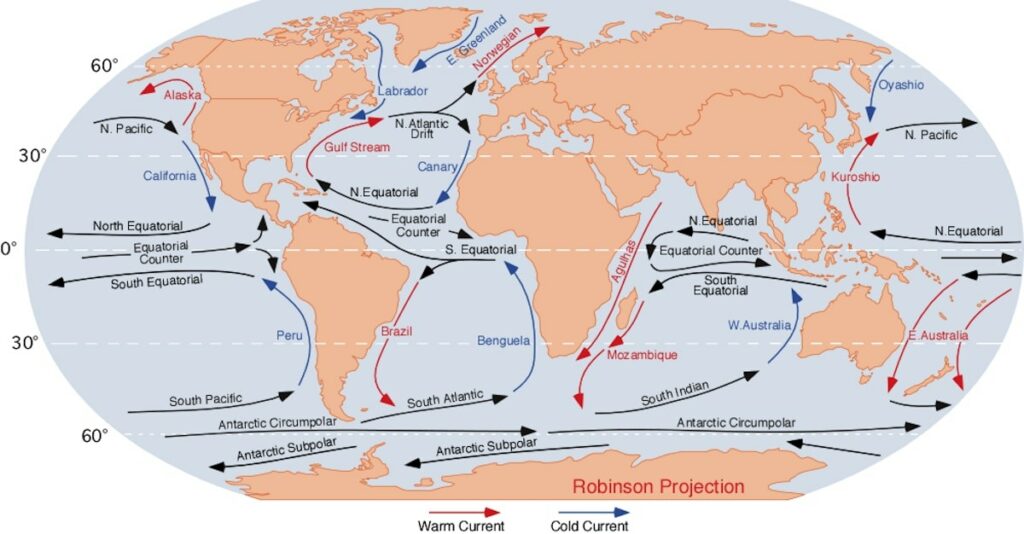
Large ocean current systems have significant impacts on global climate, biodiversity, and the circulation of nutrients and oxygen in the oceans. Here are some of the most notable current systems:
Gulf Stream
It lies in the Atlantic Ocean, from the Gulf of Mexico to the North Atlantic. This warm current system is crucial for weakening the climate in western and northern Europe. By transporting warm water from lower to higher latitudes, the Gulf Stream helps moderate temperatures in regions such as the United Kingdom and Norway.
Antarctic Circumpolar Current
It occurs around Antarctica in the Southern Ocean. It is the largest and strongest current in the world and plays a crucial role in connecting the Atlantic, Pacific and Indian Oceans. Its existence also has significant impacts on global climate and water circulation.
California Electricity
It runs through the Pacific Ocean along the west coast of North America. It is a cold current that has a significant impact on the climate of the west coast of North America. It is also crucial to marine life in the region, transporting nutrients from the deep sea to surface waters.
Kuroshio Current
In the Pacific Ocean, but now near Japan. It is a warm current that influences the region’s climate and has an important impact on marine life. Similar to the Gulf Stream, it transports warm water north and thus influences weather conditions.
Benguela Current
It is found in the Atlantic Ocean along the west coast of Africa. This cold current is rich in nutrients and contributes significantly to the biological wealth of the South Atlantic. It also influences the region’s climate, particularly in terms of precipitation and temperature.
Australian Eastern Current
It is found in the Pacific Ocean along the east coast of Australia. It has fundamental impacts on the climate and biodiversity of the east coast of Australia. It is also known for its role in the migration of various marine species.
These currents are studied for their impact on marine ecology, weather patterns and global ocean circulation. Advances in physical oceanography in recent years, such as autonomous robots, have taught us much more about these planetary regulation systems.
Quo Science Trips section sponsored by Hyundai
Photo: NASA Goddard Space Flight Center