
MIT engineers are developing a supercapacitor that stores energy from old materials like cement, soot and water, which could enable low-cost and scalable energy storage
Two of mankind’s most ubiquitous historical materials, cement and soot (which resembles very fine charcoal), could provide the basis for a novel, low-cost energy storage system, according to a new study. The technology could facilitate the use of renewable energy sources such as solar, wind and tidal power by allowing power grids to remain stable despite fluctuations in the supply of renewable energy.
The researchers found that the two materials can be combined with water to create a supercapacitor, an alternative to batteries that could store electrical energy. For example, the MIT researchers who developed the system say their supercapacitor could be embedded in the concrete foundation of a house, where it would store an entire day’s energy without incurring little (or no) expense for the foundation and the structural strength would be required. The researchers also envision a concrete roadway on which electric cars driving on it can be charged without contact.
This simple but innovative technology is described in a forthcoming article in the journal PNAS in a paper by MIT professors Franz-Josef Ulm, Admir Masic and Yang-Shao Horn and four others from MIT and the Wyss Institute.
In principle, capacitors are very simple devices consisting of two electrically conductive plates immersed in an electrolyte and separated by a membrane. When a voltage is applied across the capacitor, the positively charged ions in the electrolyte accumulate on the negatively charged plate while the positively charged plate accumulates negatively charged ions. Because the membrane between the plates prevents charged ions from migrating through them, this charge separation creates an electric field between the plates and the capacitor charges. The two plates can hold this pair of charges for a long time and release them very quickly when needed. Supercapacitors are simply capacitors that can store exceptionally large charges.
How to make a compact capacitor
The amount of energy a capacitor can store depends on the total surface area of its conductive plates. The key to the new supercapacitors developed by this team lies in a method to create a cement-based material with an extremely high internal surface area thanks to a dense, interconnected network of conductive material within its volume.
The researchers achieved this by adding carbon black, which has high conductivity, to a concrete mixture together with powdered cement and water and allowing it to harden. By reacting with the cement, the water naturally forms a complex network of openings within the structure, and carbon migrates into these spaces, forming wire-like structures within the hardened cement.
These structures have a fractal structure, with larger branches giving rise to smaller branches, and from these smaller branches to sprout, and so on, until finally there is an extremely large area within the confines of a relatively small volume. The material is then immersed in a standard electrolyte material such as potassium chloride, a type of salt that provides the charged particles that collect in the carbon structures. The researchers found that two electrodes of this material, separated by a fine gap or insulating layer, form a very powerful supercapacitor.
The two plates of the capacitor work like the two poles of a rechargeable battery of the same voltage: when connected to a power source, such as a battery, energy is stored in the plates, when connected to a load, electrical current flows again to provide power.
“The material is fascinating,” says Masic, “because we have the most commonly used material in the world by man, cement, combined with carbon black, a well-known historical material: the Dead Sea Scrolls were written with it.” materials that are at least two millennia old that, in a certain combination, result in a conductive nanocomposite, and that’s where it gets really interesting.”
Today’s batteries are too expensive and rely heavily on materials such as lithium, which supplies are limited.
As the mix hardens and hardens, he says, “water is systematically consumed by hydration reactions of the cement, and this hydration mainly affects the carbon nanoparticles because they are hydrophobic (water-repellent).”
As the mixture develops, “the soot self-assembles into a connected thread,” he says. The process is easily reproducible anywhere in the world using cheap and easily found materials. And the amount of carbon needed to achieve a percolated carbon network is very small — just 3 percent by volume of the mix — says Masic.
Supercapacitors made from this material have great potential to contribute to the global energy transition, says Ulm. The main sources of zero-emission energy, wind, solar and tidal, produce their energy at different times that often do not coincide with peak electricity consumption. It is therefore important to find ways to store this energy. “Today’s batteries are too expensive and rely heavily on materials such as lithium, which have limited supplies, requiring cheaper alternatives. “Our technology is extremely promising here, because cement is everywhere,” says Ulm.
The team calculated that a nanocarbon-doped concrete block 45 cubic meters (or yards) in size — equivalent to a cube about 3.5 meters in diameter — would have enough capacity to store about 10 kilowatt-hours of energy, equivalent to the average daily power consumption of one house is taken into account. Because concrete retains its strength, a house with concrete foundations could one day store the energy generated by solar panels or windmills and use it when needed. Also, supercapacitors can be charged and discharged much faster than batteries.
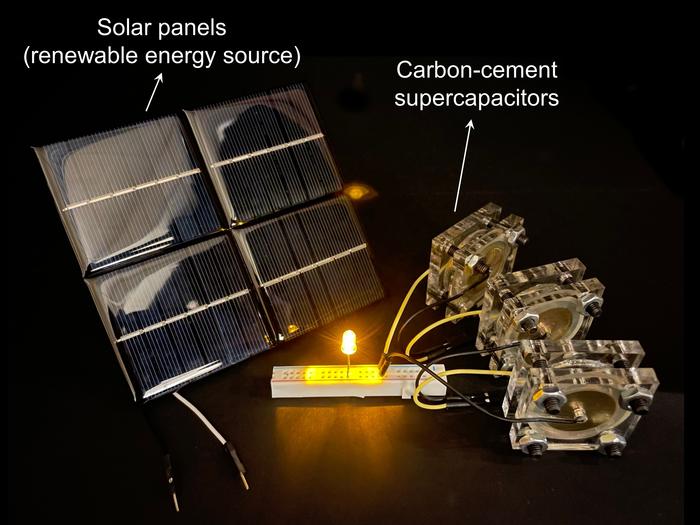
After a series of tests to determine the most effective ratios of cement, soot and water, the team demonstrated the process by making tiny supercapacitors, about the size of some button cells, 1 centimeter in diameter and 1 millimeter thick, each charging at 1 volt , comparable to a 1-volt battery. They then connected three of these together to demonstrate their ability to light up a 3-volt light-emitting diode (LED). Once the principle is demonstrated, they plan to build a number of larger versions, starting with ones the size of a 12-volt car battery, up to a 45-cubic-meter version, to demonstrate their ability to store energy for a home.
They found that there is a balance between the material’s storage capacity and its structural strength. The addition of more carbon black allows the resulting supercapacitor to store more energy, but the concrete is slightly weaker, which could be useful for applications where the concrete does not play a structural role or where the full potential of concrete resistance is not required. For applications such as foundations or structural elements at the foot of a wind turbine, the “sweet spot” is around 10% carbon black in the mix.
The same type of concrete mix can be used as a heating system simply by applying electricity
Another potential application of carbon cement supercapacitors is in the construction of concrete roads, which can store and transmit energy generated by solar panels placed along the road to electric vehicles driving along the road. It uses the same technology that wirelessly charges phones. German and Dutch companies are already developing a similar car charging system, but with standard batteries.
According to the researchers, the first uses of this technology could be in isolated, off-grid houses, buildings or emergency shelters, which could be powered by solar panels connected to cement supercapacitors.
Ulm claims that the system is highly scalable because the energy storage capacity is a direct function of the volume of the electrodes. “You can go from millimeter-thick electrodes to meter-thick electrodes, scaling the energy storage capacity from turning on an LED for a few seconds to powering an entire house,” he explains.
Depending on the properties desired for a particular application, the system could be tuned by modifying the blend. A highway to charge vehicles would require very high charging and discharging speeds, while powering a home “gives you all day to charge” so slower charging material could be used, says Ulm.
“It’s a multifunctional material,” he adds. In addition to its ability to store energy in the form of supercapacitors, the same type of concrete mix can also be used as a heating system simply by applying electricity to carbon-loaded concrete.
Ulm sees it as “a new way of looking at the future of concrete as part of the energy transition.”
REFERENCE
Carbon cement supercapacitors as a scalable mass storage solution