
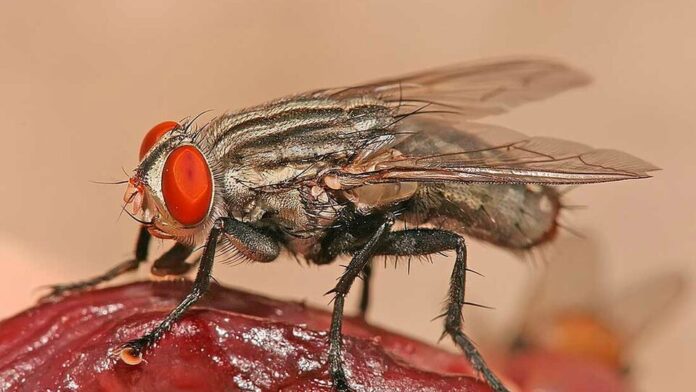
Flies are often annoying: they fly over food, rest on bodies and buzz. However, they constitute a key element when it comes to unraveling the mysteries that involve a crime, because they are the first insects to arrive and colonize a decaying body. This does not just apply to humans, but covers all types of vertebrates such as reptiles, birds, fish, amphibians and mammals. Studying the fauna that arrives at corpses allows us to obtain information about how and when that living being died, and forensic entomology takes care of that.
The Scientific News Agency of the National University of Quilmes visited the Laboratory of Applied and Forensic Entomology at this university to discuss the work they do. “We investigate which species of flies colonize decomposing bodies because they allow us to find out the approximate date that the organism died,” told the Agency Mónica Chirino, director of the Laboratory and professor at UNQ.
When a corpse is exposed to the action of insects, they begin to colonize it: flies lay eggs, which later turn into larvae and feed on the body. Later, other types of fauna arrive, such as beetles and flies of different species.
Chirino explains that “studying flies allows us to travel through time,” and gives an example: “If we find a body, which is unusual, it will have certain characteristics. It can be recent or from long ago, naked or clothed, stabbed or buried. What we have to find out is how long that body has been there. Thus, as flies are the first to detect it and to deposit their eggs which will later become larvae, we must identify the species in question and compare it with the data we have in the laboratory.”
Depending on where and what time of year the vertebrate dies, the types of flies that lay eggs first will vary. Thus, for example, in the urban area of the south zone of Buenos Aires, the most abundant flies are called “Lucilia sericata” (metallic green fly) and “Lucilia cuprina” (bronze-colored fly) and, to a lesser extent, “Lucilia ocricornis”.
In this context, the CONICET researcher also continues the example. “There are flies that are rural and others that are urban. Then, if the body appears in the countryside, but it has city fly eggs, it means it has been moved and that is not where the death occurred; similarly, if it has eggs or larvae from warm weather and it is currently cold, it means that it died earlier.”
Do they survive in water?
At the Laboratory of Applied and Forensic Entomology, Lucila Salanitro, a graduate in Biotechnology at UNQ and doctoral candidate at CONICET, investigates the development of larvae of the fly Lucilia sericata in the context of submersion. Interviewed by this outlet, the researcher reports: “We found that the eggs of this fly (which remain in the air) survive in water for up to six hours and their development to become larvae is not affected.”
“It’s a partial submersion, that is, once inside the water and once outside. It is as if a body had been thrown into the river and the tide had washed it back out. What these results allow is to consider the possibilities. For example, if the eggs didn’t survive, it’s because the body was submerged for more than six hours, or if the eggs of this species of fly that is not aquatic are present, it is because the body died on land and then went into the water,” details Salanitro.
To arrive at this result, the researcher placed mother fly eggs on pieces of meat, submerging them at different depths (25 cm, 15 cm and 5 cm) and at different time intervals. She then removed them and allowed the vital development of the larvae to continue at room temperature.
Fungi also help
If the investigation carried out by Salanitro begins at the moment of death of the body, that of Anabella Massaccesi takes place at the opposite stage, when several years have passed since death. She is doing her graduate work in Biotechnology in this lab and characterizes different fungi that appear in bone remains after a long time buried. For that, she works on the exhumations that are carried out in the Cemetery of Ezpeleta.
“The idea is to be able to determine how long the person has been buried. We’re talking years, so sometimes there’s skeletal remains, like a jawbone, and sometimes there’s nothing left.,” explains Massaccesi to the Agency. She continues: “From time to time, the cemetery transfers the remains of graves to a mass grave. Then, with the necessary permissions, I take the bones, I scrape them with sterile cotton swabs and take these samples to the lab.”
Through different materials, the thesis student evaluates the development of each fungus and characterizes it. “The problem is that the vast majority of fungi are not known. Forensic mycology is not developed all over the world, and in Argentina there are only three people specialized in it. So my job is to characterize the fungi and compare them. I work with fungi from bone remains that are more than forty years, twelve years, and three months old to find out if they change or if they are the same.”
From micro to macro, forensic entomology works with tiny elements that are of vital importance in the extensive joint work of detectives, police and judges.