
Faced with an attack, many living beings have developed defense devices throughout their evolution; however, what other species do is simply use parts of their bodies – which evolved for different reasons – to repel predators.
A new study, published in the journal Current Biology, shows that male worker wasps of the species Anterhynchium gibbifrons use their genitalia to sting predatory tree frogs to avoid being swallowed.
Misaki Tsujii, co-author of the study from the University of Kobe (Japan), came to this conclusion after a fluke. The scientist was studying these wasps when she received a sting. A fact that would not be relevant, were it not for the fact that the protagonist of the attack was a man.

Male genitalia have been studied for interactions with females, but rarely for predator-prey contact.
shinji sugiura

“Male genitalia have often been studied in relation to male-female interactions, but rarely in relation to predator-prey interactions,” explains Shinji Sugiura, co-author of the article.
In this way, the study highlights the importance of male genitalia as a defense against predators and opens up a new perspective for understanding the ecological role of the penis in animals.
“Surprisingly, the male’s ‘sting’ caused a sharp pain. Based on experience and observations, I hypothesized that the male genitalia of A. gibbifrons works as a defense”, adds Sugiura.
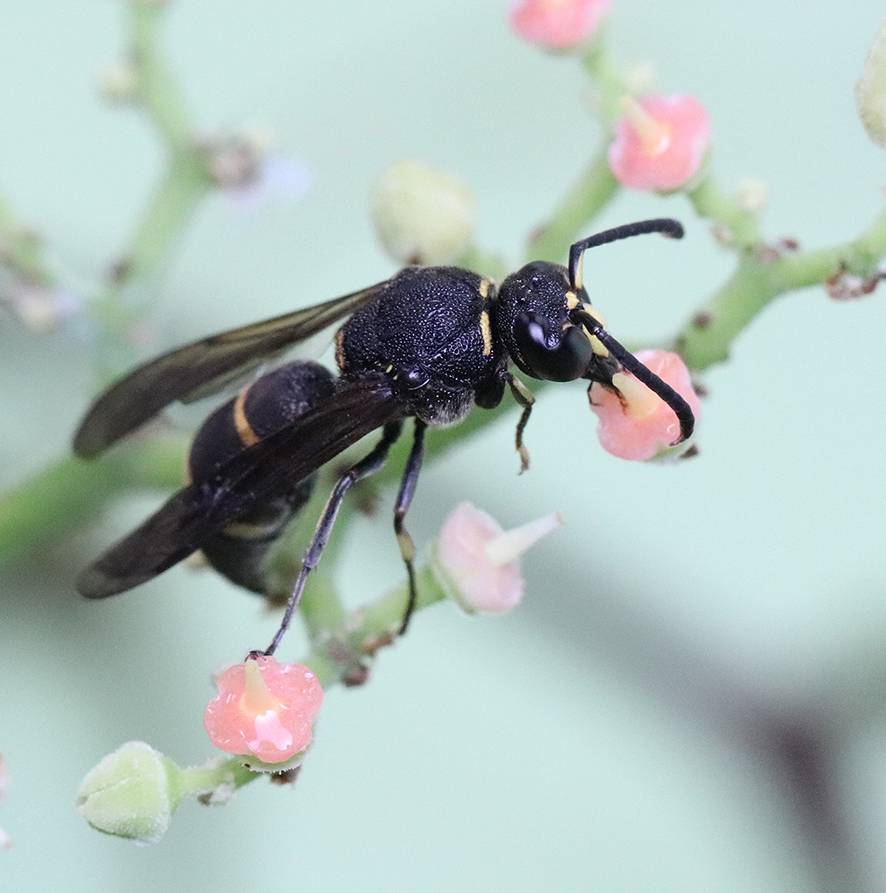
Male wasp of the species ‘Anterhynchium gibbifrons’./ Current Biology/Sugiura et al.
A male’s bite made no sense
Wasps and bees are known to use poisonous stingers to defend themselves and their colonies from attackers. For this reason, until now it was believed that males that did not have them were harmless.
Based on the observations, I hypothesized that the male genitalia of A. gibbifrons works as a defense.
shinji sugiura
To carry out experiments to test the new hypothesis, the researchers paired male wasps with a potential predator: the tree frog Dryophytes japonica. They all attacked the male wasps, but just over a third spat them out. The researchers witnessed the insects stinging the frogs with their genitals as they attacked them.
However, when they fed these amphibians wasps that no longer had genitals, they ate them directly.
As male genital spines (called ‘pseudo-stingers’) are found in other wasp families, scientists believe that the newly discovered defensive function is likely to be found in many other species.
Reference:
Sugiura et al. “Wasp male genitalia as an anti-predator defense”. current biology🇧🇷