
The Artemis I mission took off at dawn this Wednesday after months of anticipation, it is the first of the trips that will put humans on the Moon after half a century
After much difficulty in previous Artemis mission launch attempts, the imposing 98-meter-tall Space Launch System, or SLS, rocket ignited its engines and generated the equivalent of 10 million pounds of thrust to lift off the launch pad at Florida and fly in the air, crossing the night sky.
On top of the rocket was the Orion spacecraft, a teardrop-shaped capsule that detached from the rocket after reaching space. Orion was designed to carry humans, but the passenger on this test mission is a dummy called “Campos”, packed with sensors that collect vital data to help future crews live (and should survive).
The Orion rocket is expected to travel approximately 2 million kilometers, on a trajectory that will take it farther than any other spacecraft designed for human flight, according to NASA. After orbiting the Moon, Orion will make its return trip, completing its journey in about 25.5 days. The capsule is scheduled to drop into the Pacific Ocean off the coast of San Diego on Dec. 11, when rescuers will wait nearby to bring it to safety.
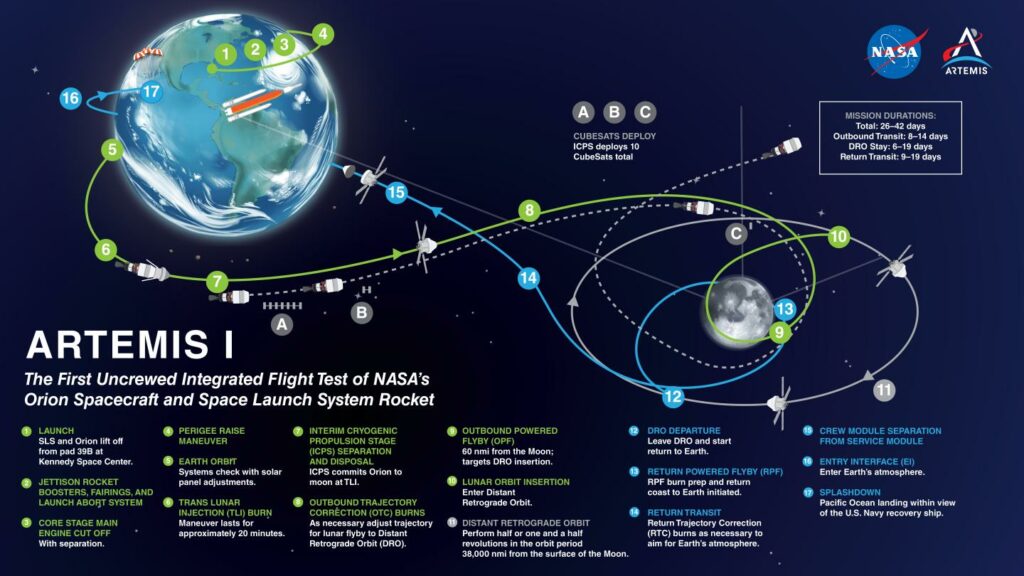
Source: NASA
Throughout the mission, NASA engineers will closely monitor the spacecraft’s performance. The team will assess whether Orion’s performance was planned and ready to support its first manned mission to lunar orbit, currently scheduled for 2024.
Artemis II will be manned, but it won’t land on the moon either.
This second mission called Artemis II will essentially repeat the path of the first mission. It will be launched into space by the same SLS rocket, but this time with a crew of four, who will fly aboard the Orion module to a distance of 7,402 km beyond the far side of the Moon, complete an orbit of the satellite and return to Earth. . The mission will last eight to 10 days and collect valuable flight test data.
From here things get more difficult and the dates more uncertain. Artemis III, due for release later this decade, is expected to put a woman and a person of color on the lunar surface for the first time.
The problems when launching Artemis I
The mission team encountered several setbacks on the way to launch on Wednesday, including technical problems with the moon rocket and two Hurricanes that passed over the launch site.
In recent months, fueling the SLS rocket with supercooled liquid hydrogen has been one of the main problems that has forced NASA to abandon previous liftoff attempts due to the risk of leaks. However, on Tuesday the tanks were filled without much problem.
To fix the leaks, NASA deployed what it calls the “red crew,” a group of people specially trained to carry out repairs while the rocket is being loaded with propellant. They tightened some nuts and bolts and managed to stop the fuel leaks. One more step towards the next manned missions to the Moon.