
Although the traffic to the beyond was a fundamental social landmark in Ancient Rome, for the common population, the meals consumed during the funeral banquets were mainly staple foods everyday. A team formed by researchers from the University of Valencia (UV), the University of Vic – Universidad Central de Catalunya (UVic-UCC) and the Institut Català d’Arqueologia Clássica (ICAC) discovered a high degree of similarity between the types of meats that were habitually consumed and those offered in funeral banquets. The study, published in the journal PLO ONEcompares biomolecular, anthropological and archaeozoological data from a necropolis of the Plaza de la Villa in Madridin Barcelona.
Contrary to what is expected of pompous Roman funeral meals, it seems that the common people did not make a great feast, and for banquets they used the same common foods as during everyday life; mainly pork and beef, followed by goat and chicken. There weren’t many exotic foods, no wild or aquatic animals. In addition, most burials did not feature food offerings, and their families did not hold any type of feast, despite these rituals being stipulated. by law.


“We were able to show that common people did not always comply with the law in relation to funeral festivities and, when they did, they spent little economic resources on banquets”, he explains. Domingo C. Salazar Garcia, lead study author and UV researcher. “Money is money, and whatever the importance of the afterlife in ancient Roman society, clearly the priority was the living people. The micro-resistance to the unreasonable rules established were already present at that time”, adds Salazar.
the beyond religion was the milestone to be reached after death, fulfilling several rituals funeral homes Part of them consisted of offerings, feasts and animal sacrifices, carried out to guarantee the protection of the deities and the memory of the deceased. However, little is known about its composition, other than what is shown in written sources. In this new study, the team investigated the funerary feasts by analyzing the isotopes of human and animal collagen and the study of skeletal remains and archaeological assemblage present in the necropolis.
Isotopic analysis of nearly 100 human and animal specimens, combined with osteological study human remains (age, sex and health status) from burials and fauna from meals and funeral offerings, revealed a differential treatment of the dead among different social classes. Furthermore, in the culture of the time, it is possible that these differences in the treatment of the deceased perpetuated social inequalities in the afterlife.
Social differences in the afterlife?
It is well known that in Ancient Rome there were different social strata and that wealth and political status were of paramount importance in the social hierarchy. In the necropolis of Villa de Madrid, the humans buried were mostly people with limited purchasing power. “We have known a lot about this since the simple burial typology, as per anthropological studywhich indicates a very low life expectancy in this population”, says Xavier Jordanaassociate professor at UVic-UCC, who analyzed human skeletal remains.
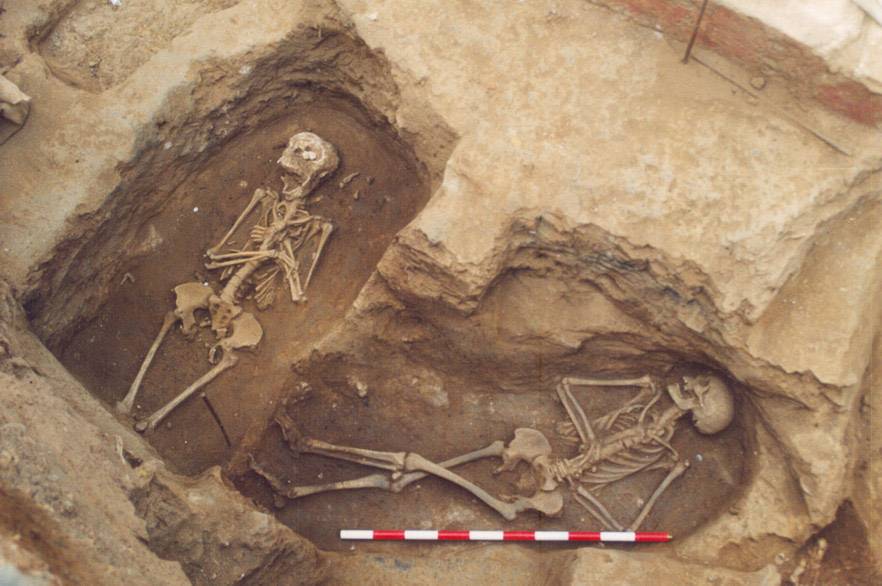
The humans buried in the necropolis of Villa de Madrid were mostly people with limited purchasing power. / University of Valencia, Catalan Institute of Classical Archaeology, University of Vic – Central University of Catalonia
The study documents a high consumption of meat by adult men during their lifetime and a greater presence of offerings at the burials of these individuals. Therefore, “these differences in ritual and diet probably show inequalities during life that could be extrapolated to the afterlife through funerary rituals. It is evident that one of the ways Roman society expressed economic and social differences was through funeral food rituals”, concludes the lead author. Lydia ColominasICAC researcher.
Reference:
Salazar-Garcia and others, “Food for the soul and food for the body. Studying dietary patterns and funeral meals in the Western Roman Empire: an anthropological and archaeozoological approach”. (2022) PLO ONE