
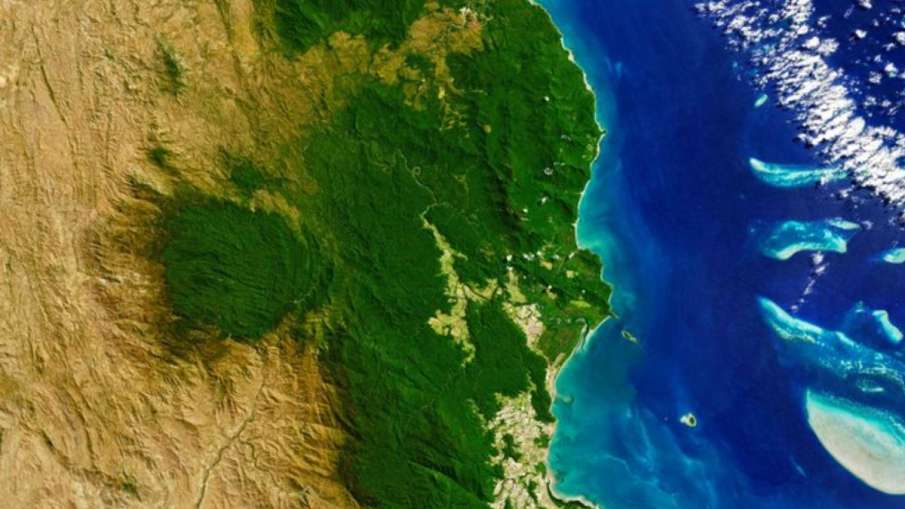
Landsat satellite 50 years
Highlights
- Earth’s life extended by Landsat satellite
- Real condition of the earth revealed by satellite
- Earth pictures captured in minutes
Landsat Satellite 50 Years Completed: American scientists launched a satellite 50 years ago that changed the way we see the world. This satellite captured pictures of the Earth’s surface within minutes. These photographs showed how forest fires burned the land, how fields destroyed forests and how humans were changing the face of the planet in many other ways. The first satellite of the Landsat series was launched on 23 July 1972. This was followed by eight other satellite launches in the series, which provided us with images of similar scenes to track changes over time, but with more powerful instruments than ever before.
Landsat 8 and Landsat 9 are currently orbiting the planet and the US National Aeronautics and Space Administration (NASA) and the US Geological Survey are planning a new Landsat mission. Images and data from these satellites are used around the world for deforestation and changing landscapes, locating urban hot spots and understanding the impact of new river dams, and many other projects. With their help, communities are often helped to deal with risks that are not known when viewed from the ground.
According to the collection ‘The Conversation’, three examples of the usefulness of Landsat are as follows-
Keep an eye on changes in Amazon
When work began on the Belo Monte Dam project in the Brazilian Amazon in 2015, indigenous tribes living near the Big Bend of the Shingu River felt a change in the river’s flow. The water they depended on for food and transportation was disappearing. 80 percent of the river water was diverted to the hydroelectric dam. The association that runs the dam argued that there was no scientific evidence that changes in water flow harmed the fish, but Pritam Das, Faisal Hussain, Horour Helgason and Shahzeb Khan of the University of Washington wrote that satellite viewing But there was clear evidence of the impact of the Belo Monte Dam project.
Satellite data from the Landsat program was used to show how the dam dramatically changed the hydrology of the river. Cities are heating up and some areas near them are warming even more. Landsat’s instruments can also measure surface temperature, helping scientists track the risk of heat exposure on city streets as global temperatures rise.
“Cities are generally hotter than surrounding rural areas, but even within cities, some residential areas are dangerously hot compared to other areas located just a few miles away,” said Daniel P. Johnson of Indiana University. become. With the help of this information, cooling centers and other programs can be started in these areas to save people from the heat.
Creation of ‘ghostly forests’
The satellite, which took pictures of the same area year after year, helped in detecting the changes taking place in the inaccessible areas. They monitor snow and ice cover and wetland forests being destroyed along the US Atlantic coast. The dead tree trunks in these areas have often turned white and are also called ‘ghost forests’ because of their eerie landscapes. Ecologist Emily Urie at the University of Waterloo in Ontario used Landsat data to observe changes in wetlands.
They zoomed in on high-resolution images available on ‘Google Earth’, which confirmed the wetland forest has been transformed into a ‘ghostly forest’ due to destruction. “These results were astonishing,” he said. We found that (in North Carolina) more than 10 percent of forested wetlands within the ‘Alligator River National Wildlife Refuge’ were lost over the past 35 years. It is a land protected by the government, in which there was no human activity that could destroy the forests. Urie says that as the planet warms and sea levels rise, more salt water reaches these humid regions, and that is why the salt content of the soils of coastal forests from Maine to Florida is increasing.
“It appears that the sea level is rising so rapidly that these forests are unable to adapt themselves to the more humid and salty conditions,” he said. Images from Landsat have yielded many more important insights, such as the impact of the war on Ukraine’s wheat crop and algae growing in Lake Okeechobee, Florida. Countless projects are using Landsat data to track global change, which could potentially help solve problems.
Latest World News