
Generally placed on roofs and distributed in solar parks, the solar panels from silicon cells are currently one of the most efficient systems for generating electricity from sunlight. But their manufacture tends to be expensive, with high energy consumption, as well as being heavy and bulky.
The possible alternatives of ultra-thin solar cells presented so far have not solved the problem either, as they contain toxic elements, such as lead or cadmium, or scarce ones, such as indium or tellurium.
In the search for new technologies to develop thin photovoltaic systems, solar cells based on bismuth silver sulfide nanocrystals (AgBiS2) came out forcefully. They are cells composed of non-toxic and abundant elements, produced at low temperatures and with low-cost processing techniques. These elements can be integrated into ultra-thin solar cells and have been shown to be very stable, thus preventing long-term degradation.
Solar cells based on silver bismuth sulfide nanocrystals (AgBiS2) are composed of non-toxic and abundant elements, are produced at low temperatures and with low-cost processing techniques.
In 2016, as part of an investigation led by Professor ICREA Gerasimos Konstantatos in Institute of Photonic Sciences (ICFO) it was possible to manufacture a 35 nm thick solar cell with an efficiency of about 6%. It was made with an absorbent semiconductor material based on AgBiS2 nanocrystals.
It was synthesized at very low temperatures (100°C, an order of magnitude lower than the temperature at which silicon cells are manufactured) and engineered at the nanoscale, using a layer-by-layer deposition process. This solution represented a ‘green’ alternative promising in relation to silicon, although it has not yet been possible to achieve a sufficiently relevant performance for its commercialization.
In recent years, many studies have looked for ways and techniques to improve the performance of these cell types and have found that the optimal thickness of these absorbent semiconductors is closely related to their absorption coefficients. The goal of all this effort is to find an ultra-thin solar cell with high absorption efficiency, quantum efficiency and maximum performance, while reducing its cost, weight and manufacturing.
A new technique for manufacturing AgBiS2-based solar cells with higher absorption coefficients compared to any other photovoltaic material used so far is presented.
However, in the process of trying to develop ultrathin solar cells, working with complex structures to capture light adds to the cost and adds complexity to the problem. Keep in mind that the thinner the structure, the more difficult it is to obtain optimal energy absorption.
To overcome this challenge, researchers Yongjie WangICFO’s Ignasi Burgues-Ceballos, together with Professor Konstantatos and scientists from University College and Imperial College London (UK) managed to make a considerable leap forward, reaching a innovative result.
In a new study published in Photonics of Naturepresent a new technique for manufacturing these AgBiS2-based solar cells with about higher absorption coefficients compared to any other photovoltaic material used so far.
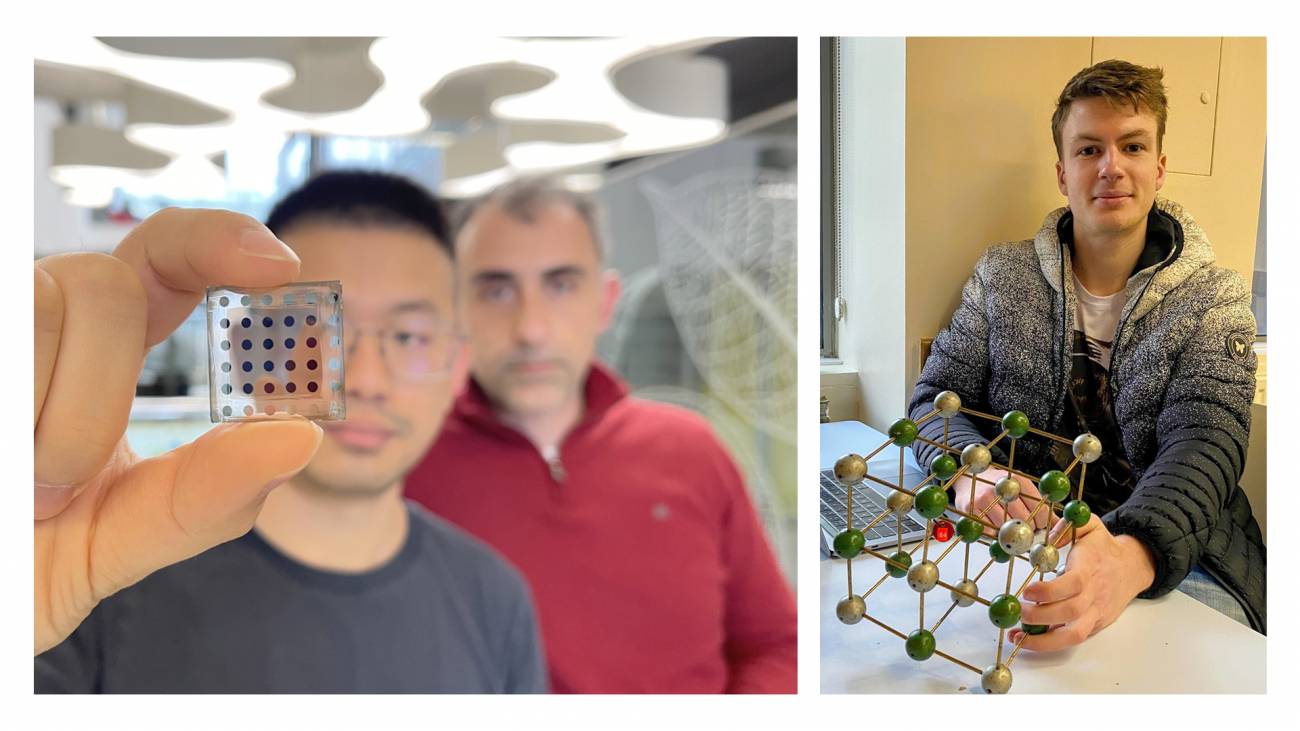
From left to right: ICFO researcher Yongjie Wang holding the device in hand with ICFO ICREA professor Gerasimos Konstantatos in the background. Right, Seán Kavanagh, a researcher at UCL & Imperial College, with an atomic model of the crystal structure of AgBiS2 rock salt. / ICFO
Cationic Disorder
In the study, the researchers deftly engineered a layer of nanocrystals inside the solar cell with a new technique, called cationic disturbance engineering. By gently firing the AgBiS2 nanocrystals, they adjusted the atomic positions of the cations within the crystal lattice. In this way, they forced the exchange of places between the cations, obtaining a homogeneous distribution of these.
Applying different firing temperatures to obtain cation distributions in the crystal lattice, the authors showed that this semiconductor material has a absorption coefficient between 5-10 times higher than any other material used today in photovoltaic technology and even in a wider spectral range from ultraviolet (400nm) to infrared (1000nm).
Through a gentle cooking process of the AgBiS2 nanocrystals, they adjusted the atomic positions of the cations within the crystal lattice, forcing them to switch places to obtain a homogeneous distribution.
To reach this result, the researchers had to design a new surface chemistry technique for the new material that would preserve the optoelectronic quality of the nanocrystals after firing. For this, the researchers used mercaptopropionic acid as a passivation binder, which helped to preserve the quality of the material during firing.
To predict and verify the hypotheses of the work, the authors performed different calculations based on the so-called functional density theory which confirmed the experimental evidence.
Sean Kavanagh, study co-author and researcher at UCL and Imperial College, explains: “The importance of atomic disorder in inorganic solar cells is currently a hot topic of discussion in the field. Our theoretical investigations into the thermodynamic and optical/electronic effects of cationic disorder on AgBiS2 revealed both the accessibility of cation redistribution and its effect on the material’s optoelectronic properties.”
“Our calculations showed that a homogeneous distribution of cations would produce optimal performance of solar cells in these disordered materials, which corroborates the experimental findings”, says the researcher.
Building an ultra-thin solar cell
With these results, the team built an ultra-thin, solution-processed solar cell and, layer by layer, deposited the AgBiS2 nanocrystals into ITO/glassone of the most widely used conductive transparent oxide substrates today.
They coated the devices with a PTAA (poly triaryl amine) solution and, by illuminating the device with artificial sunlight, recorded an efficiency of conversion of solar energy into electricity greater than 9% for a device with a total thickness of less than 100 nm, between 10 and 50 times thinner than current ultra-thin photovoltaic technologies and 1,000 times thinner than silicon photovoltaic cells.
One of the best devices made by the team was sent to Newport (USA)to an accredited photovoltaic (PV) calibration laboratory, which has certified a conversion efficiency of 8.85%, under full solar lighting.

The manufactured devices set a record among inorganic solar cells in terms of stability, form factor and performance, manufactured ‘green’ and low temperature, with solution processing methods
Gerasimos Konstantatos (ICFO)

As the first author comments, Yongjie Wang: “Although we noticed a strong darkening of our thin films after a light burn, due to increased absorption, initially it was a challenge to manufacture such thin devices.”
“After achieving full process control and cell optimization, including optimizing the electron transport layers and their holes, we finally found a highly reproducible framework for efficient solar cells with improved stability. It is really exciting to see that a 30nm device offers such a high short circuit current density of up to 27mA/cm2 and an efficiency of up to 9%,” he adds.
Finally, as emphasized Konstanates“The devices manufactured for this study set a record among inorganic solar cells in terms of stability, form factor and performance, manufactured ‘green’ and at low temperature, with solution processing methods.”
“Cationic disorder engineering in AgBiS2 nanocrystals for multi-year systems has been shown to offer an absorption coefficient superior to any other photovoltaic material used to date, which allows to achieve extremely thin and highly efficient absorbing photovoltaic devices. We will continue to advance this line of study to explore and explore its intriguing properties for photovoltaics as well as other optoelectronic devices.”
Reference:
Yongjie Wang et al. “Cationic disorder engineering produces AgBiS2 nanocrystals with improved optical absorption for efficient ultrathin solar cells”. Photonics of Nature2022
This study was made possible thanks to funding from Fundació Joan Ribas Araquistain (FJRA), as well as European competitive funds, such as the European Research Council (ERCs), among others.