
tatanka iyotake, better known as Sitting Bull, was the leader of the sioux Hunkpapa lakota. He was born in 1831 and was shot and killed by Native American police when they tried to arrest him in 1890. A few years earlier, he had led the epic battle of Little Big Horn, known as Greasy Grass, defeating General Custer.
Sitting Bull’s lock of hair was cut without permission before his burial by the surgeon at Fort Yates, who also took cloth leggings as a souvenir.
Became a symbol of struggle for Native Americans, the Sitting Bull was buried in the Fort Yates in North Dakota, the current Standing Rock Indian Reservation, but the actual whereabouts of his remains have so far been unclear.
Your bones could be at Fort Yates or at Mobridge, in South Dakota, where his relatives possibly transferred his remains in 1953. His relatives, including Ernie Lapointe, they think it could be in this second place. But to determine the official tomb and thus protect it, LaPointe had to prove with genetic tests that the Sioux chief was his family.
Thanks to the DNA analysis of the lock of hair pulled from the scalp of the legendary indigenous – cut without permission Before his burial by the Fort Yates surgeon, who also took cloth leggings as a souvenir – now a study has managed to establish Native American family ties to LaPointe. The results are published in the journal. Science Advances.
It is the first time that ancient DNA has been used to confirm a family relationship between living and historical people. In other cases, existing technology has been applied without success.
“What happens is that in the remains tested, such as the famous mummified head that could have belonged to the French King Henry IV or the presumed blood of Louis XVI, the result was negative. In other words, it is the first time that a historical work in forensic genetics is positive”, he tells SINC Carles Lalueza-Fox, a former DNA expert at the Institute of Evolutionary Biology (CSIC-UPF) and an independent scientist on this research.
For years, both the lock and the leggings were in the Smithsonian Institute where surgeon Deeble deposited them 1896. The museum returned the objects to LaPointe and his three sisters and other close relatives of the Native American leader in 2007.
The study therefore shows that LaPointe and his sisters were the legitimate recipients of the objects repatriated from the Smithsonian Institution.
The study therefore shows that LaPointe and his sisters “were the legitimate recipients of the objects repatriated from the Smithsonian Institution,” the research authors say.
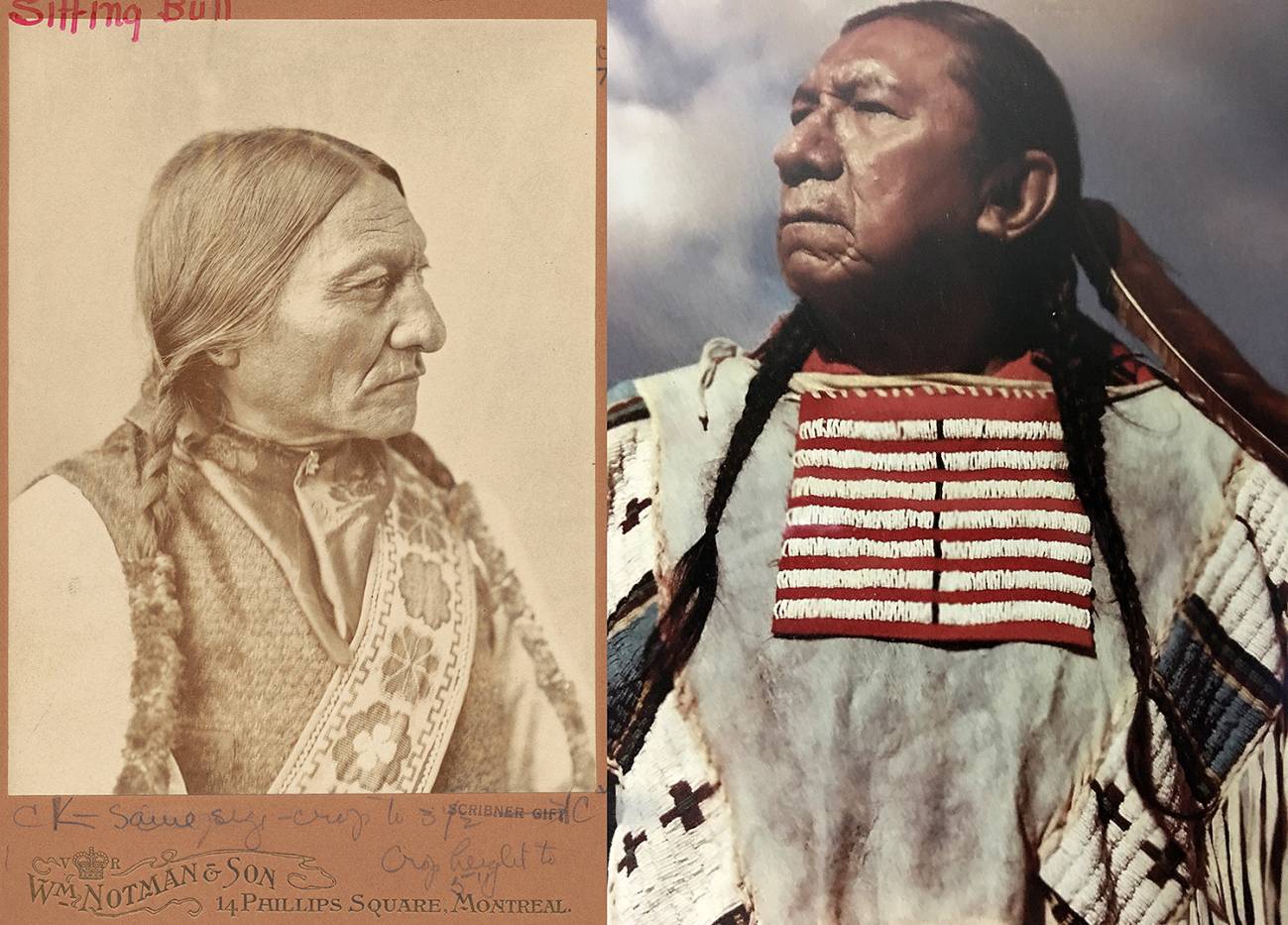
Sitting Bull, 1885, on the left and his great-grandson, LaPointe, on the right. / Smithsonian Institution / Ernie LaPointe
uniting relatives in time
Unlike other previous genetic analyses, based on uniparental markers, the confirmation of relatedness was possible thanks to a new method of family lineage analysis using ancient DNA fragments.
The technique was developed by a team of scientists led by Eske Willerslev, from the University of Cambridge (United Kingdom), and from the Center for Geogenetics at the Lundbeck Foundation (Denmark), which took 14 years to find a way to extract DNA from a piece of hair measuring about six centimeters.
Until now, the family relationship between LaPointe and Sitting Bull was based on birth and death certificates, a family tree and a review of historical records.
The method, which can be used with very limited and even deteriorated genetic data as in this case (after taking a century at room temperature in the museum), focuses on autosomal DNA – Inherited 50% from the father and mother and which allows checking genetic coincidences whether the ancestor is on the paternal or maternal side – which incorporate the genetic fragments extracted from the body sample.
By comparing it with DNA samples from Ernie LaPointe and other Lakota Sioux, the scientists were able to determine that LaPointe is the great-grandson of Sitting Bull and his closest living descendant. “Autosomal DNA is our gender-free DNA. We were able to locate sufficient amounts of this DNA in the Sitting Bull’s hair sample and compare it with the DNA sample from Ernie Lapointe and other Lakota Sioux, and we are happy that it matches,” emphasizes Willerslev, a fan of the Sioux leader.
Until this study, the family relationship between LaPointe and Toro Setado was based on birth and death certificates, a family tree and a review of historical records. This new genetic analysis provides an additional line of evidence to support your relatedness.
Now, the great-grandson, concerned about possible commercialization and care for the grave, hopes to be able to bury the bones of the Sitting Bull in their proper place. According to him, the current location in Mobridge has no significant connection to the Sioux leader or the culture he represented. But before its possible transfer, the remains from the cemetery must be analyzed in a similar way to the hair sample to ensure genetic compatibility with the Sitting Bull.

This work can be criticized from an ethical point of view for the use of alleged relics obtained illegitimately from peoples of indigenous groups, regardless of the results of the investigation.
Carles Lalueza-Fox

According to the authors, the work paves the way for similar DNA tests on kinship between many other long-deceased historical figures and their possible living descendants.
But to carry them out, it is necessary to take into account the ethical limits in the study of ancient DNA, warn some experts, such as the group that signed an article on the subject last week in Nature.
In fact, “this specific work can be criticized from an ethical point of view for the use of supposed relics obtained illegitimately from peoples of indigenous groups, regardless of the result of the investigation”, concludes Carles Lalueza-Fox to SINC.
Reference:
Ida Moltke et al. “Identifying a living great-grandson of Lakota leader Sioux Tatanka Iyotake (Sitting Bull)” Advances in Science.
Rights: Creative Commons.
.